

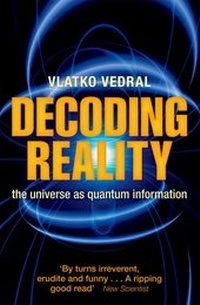
Decoding Reality
The Universe as Quantum Information
1st Edition
Published on 23. February 2012
Book
Paperback/Softback
240 pages
978-0-19-969574-4 (ISBN)
Description
For a physicist, all the world's information. The Universe and its workings are the ebb and flow of information. We are all transient patterns of information, passing on the recipe for our basic forms to future generations using a four-letter digital code called DNA.
In this engaging and mind-stretching account, Vlatko Vedral considers some of the deepest questions about the Universe and considers the implications of interpreting it in terms of information. He explains the nature of information, the idea of entropy, and the roots of this thinking in thermodynamics. He describes the bizarre effects of quantum behaviour - effects such as 'entanglement', which Einstein called 'spooky action at a distance' and explores cutting edge work on the harnessing
quantum effects in hyperfast quantum computers, and how recent evidence suggests that the weirdness of the quantum world, once thought limited to the tiniest scales, may reach into the macro world.
Vedral finishes by considering the answer to the ultimate question: where did all of the information in the Universe come from? The answers he considers are exhilarating, drawing upon the work of distinguished physicist John Wheeler. The ideas challenge our concept of the nature of particles, of time, of determinism, and of reality itself.
In this engaging and mind-stretching account, Vlatko Vedral considers some of the deepest questions about the Universe and considers the implications of interpreting it in terms of information. He explains the nature of information, the idea of entropy, and the roots of this thinking in thermodynamics. He describes the bizarre effects of quantum behaviour - effects such as 'entanglement', which Einstein called 'spooky action at a distance' and explores cutting edge work on the harnessing
quantum effects in hyperfast quantum computers, and how recent evidence suggests that the weirdness of the quantum world, once thought limited to the tiniest scales, may reach into the macro world.
Vedral finishes by considering the answer to the ultimate question: where did all of the information in the Universe come from? The answers he considers are exhilarating, drawing upon the work of distinguished physicist John Wheeler. The ideas challenge our concept of the nature of particles, of time, of determinism, and of reality itself.
Reviews / Votes
Review from previous edition By turns irreverent, erudite and funny, 'Decoding Reality' is - by the standard of books that require their readers to know what a logarithm is - a ripping good read...Not since David Deutsch's magestierial 'The Fabric of Reality' has a physicist given us such a wide-ranging and intriguing picture of how quantum mechanics constructs the world. * Seth Lloyd, New Scientist * Well written and engaging, the book provides a constant flow of new ideas. * Science * The author evinces great enthusiasm and curiosity throughout. * Steven Poole, The Guardian * By turns irreverent, erudite and funny, 'Decoding Reality' is...a ripping good read. * Seth Lloyd, New Scientist * A wide-ranging and intriguing picture of how quantum mechanics constructs the world. * Seth Lloyd, New Scientist * Excellent, thought-provoking book. * BBC Focus Magazine, Marcus Chown * An engaging, non-technical exploration of what the new theory of quantum information and computation tells us about life, the universe, and everything. * David Deutsch, author of The Fabric of Reality * Let Vedral guide you skilfully through the wonderland of modern physics - where nothing is as it seems. This is the finest treatment I have read of the weird interplay of quantum reality, information and probability. * Paul Davies, author of The Eerie Silence and The Goldilocks Enigma *More details
Language
English
Place of publication
Oxford
United Kingdom
Target group
This book will attract readers of popular science and will be of interest to students of physics, maths, and computing.
Dimensions
Height: 197 mm
Width: 129 mm
Thickness: 15 mm
Weight
182 gr
ISBN-13
978-0-19-969574-4 (9780199695744)
Copyright in bibliographic data and cover images is held by Nielsen Book Services Limited or by the publishers or by their respective licensors: all rights reserved.
Schweitzer Classification
Other editions
New editions
Book
02/2018
Oxford University Press
€16.00
Shipment within 15-20 days
Additional editions
Book
02/2018
Oxford University Press
€16.00
Shipment within 15-20 days
Book
02/2010
Oxford University Press
€21.03
Article exhausted; check for reprint
Person
Vlatko Vedral studied undergraduate theoretical physics at Imperial College London, where he also received a PhD for his work on 'Quantum Information Theory of Entanglement'. Since June 2009, Vedral has moved to Oxford as Professor of Quantum Information Science. Throughout his career he has held a number of visiting professorships at different international institutions. He has published more than 130 research papers and has written two textbooks. He has written for
popular science journals and major daily newspapers, as well as doing extensive radio programmes and television interviews.
popular science journals and major daily newspapers, as well as doing extensive radio programmes and television interviews.
Content
PROLOGUE; PART I; PART II; PART III