

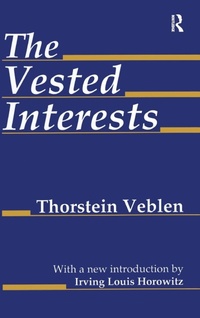
The Vested Interests
1st Edition
Published on 26. February 2018
Book
Hardback
146 pages
978-1-138-53936-5 (ISBN)
Description
Veblen's classic position on social status is intertwined with his interest in economic class and the political prospects of that class. The Vested Interests is squarely in that tradition. It aims to show how and why a discrepancy has arisen between the accepted principles of law and custom that underlie the business enterprise and the efficient management of industry. He also speculates on the civil and political difficulties inspired by this discrepancy between business civilization, and the social order.
Many of the essays in this collection originally appeared in Dial from October 1918 to January 1919. The Vested Interests includes: "The Instability of Knowledge and Belief," "The Stability of Law and Custom," "The State of the Industrial Arts," "Free Income," "The Vested Interests," "The Divine Rights of Nations," "Live and Let Live," and "The Vested Interests and the Common Man."
In his new introduction, Irving Louis Horowitz discusses Veblen as an economist turned sociologist. He explores the dichotomies in Veblen's approach, describing it as radical in input and conservative in outcome. Veblen was analytical in design, but ideological in rhetoric. He was materialist in his economic analysis, but idealistic in his emphasis on law and custom as regulatory mechanisms of the management of society. Horowitz also describes the difficulties Veblen experienced in placing his steadfastly nineteenth century ideals in the context of 1920s America. This is the final volume in Transaction's series of the essential works of Thorstein Veblen. It will be of central interest to sociologists as well as economists, particularly those interested in the history of ideas.
Many of the essays in this collection originally appeared in Dial from October 1918 to January 1919. The Vested Interests includes: "The Instability of Knowledge and Belief," "The Stability of Law and Custom," "The State of the Industrial Arts," "Free Income," "The Vested Interests," "The Divine Rights of Nations," "Live and Let Live," and "The Vested Interests and the Common Man."
In his new introduction, Irving Louis Horowitz discusses Veblen as an economist turned sociologist. He explores the dichotomies in Veblen's approach, describing it as radical in input and conservative in outcome. Veblen was analytical in design, but ideological in rhetoric. He was materialist in his economic analysis, but idealistic in his emphasis on law and custom as regulatory mechanisms of the management of society. Horowitz also describes the difficulties Veblen experienced in placing his steadfastly nineteenth century ideals in the context of 1920s America. This is the final volume in Transaction's series of the essential works of Thorstein Veblen. It will be of central interest to sociologists as well as economists, particularly those interested in the history of ideas.
More details
Language
English
Place of publication
London
United Kingdom
Publishing group
Taylor & Francis Ltd
Target group
Professional and scholarly
Dimensions
Height: 235 mm
Width: 157 mm
Thickness: 13 mm
Weight
375 gr
ISBN-13
978-1-138-53936-5 (9781138539365)
Copyright in bibliographic data and cover images is held by Nielsen Book Services Limited or by the publishers or by their respective licensors: all rights reserved.
Schweitzer Classification
Other editions
Additional editions
Thorstein Veblen
The Vested Interests
E-Book
04/2018
1st Edition
Routledge
€64.49
Available for download
Thorstein Veblen
The Vested Interests
E-Book
04/2018
1st Edition
Routledge
€64.49
Available for download
Thorstein Veblen
The Vested Interests
Book
09/2001
1st Edition
Transaction Publishers
€70.50
Shipment within 10-20 days
Person
Thorstein Veblen
Content
1: The Instability of Knowledge and Belief; 2: The Stability of Law and Custom; 3: The State of the Industrial Arts; 4: Free Income; 5: The Vested Interests; 6: The Divine Right of Nations; 7: Live and Let Live; 8: The Vested Interests and the Common Man