

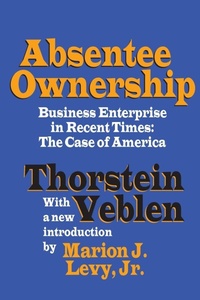
Absentee Ownership
Business Enterprise in Recent Times - The Case of America
1st Edition
Published on 30. November 1996
Book
Paperback/Softback
470 pages
978-1-56000-922-1 (ISBN)
Description
Absentee Ownership is an inquiry into the economic situation as it has taken shape in the twentieth century, particularly as exemplified in the case of America. According to Thorstein Veblen, absentee ownership is the main and immediate controlling interest in the life of civilized men. It is the paramount issue between the civilized nations, and guides the conduct of their affairs at home and abroad. World War I, says Veblen, arose out of a conflict of absentee interests and the peace was negotiated with a view to stabilize them. Part I of the book is occupied with a summary description of that range of economic circumstances and that sequence of economic growth and change that led up through the nineteenth century and have come to a head in the twentieth century. Part II is an objective, theoretical analysis of those economic circumstances described in the first part of the book. Marion Levy writes in his introduction about the phrase "absentee ownership" and how it has a definite connotation, representing a dark figure in the economic system, a frustration of desired levels of self-sufficiency. In the early days, the giants of business enterprise had faces--Rockefeller, Vanderbilt, Ford, Edison--but they all turned into faceless bureaucracies, says Levy. The giants may not have been nice, but they had faces and human traits. Absentee ownership wiped that out for the common man. Veblen's book continues to be of vital importance to the studies of economics, political theory, and sociology.
More details
Language
English
Place of publication
New York
United States
Publishing group
Taylor & Francis Inc
Target group
College/higher education
Professional and scholarly
Dimensions
Height: 229 mm
Width: 152 mm
Thickness: 25 mm
Weight
675 gr
ISBN-13
978-1-56000-922-1 (9781560009221)
Copyright in bibliographic data and cover images is held by Nielsen Book Services Limited or by the publishers or by their respective licensors: all rights reserved.
Schweitzer Classification
Other editions
Additional editions
Book
10/2017
1st Edition
Routledge
€208.00
Shipment within 10-20 days
E-Book
07/2017
Routledge
€66.99
Available for download
E-Book
07/2017
Routledge
€67.49
Available for download
Person
Thorstein Bunde Veblen (July 30, 1857 - August 3, 1929) was an influential American economist and sociologist, renowned for his critical analysis of capitalism and his contributions to institutional economics. Veblen's most famous work, The Theory of the Leisure Class (1899), introduced the concepts of "conspicuous consumption" and "conspicuous leisure," which critique the extravagant display of wealth and status by the upper class. His work examined how the wealthy class's consumption patterns are driven by the desire to show social superiority rather than for practical use, and he argued that this behavior leads to societal inefficiency and waste. Veblen's theories also laid the groundwork for the institutional economics perspective, emphasizing the role of institutions, such as laws, customs, and social structures, in shaping economic behavior. He distinguished between "institutions" and "technology," a framework known as the Veblenian dichotomy, which remains influential in contemporary economic thought. Veblen's critiques of capitalism, alongside his focus on the broader societal context in which economic activities occur, have made him a significant figure in the field of economics and sociology.
Content
INTRODUCTION TO THE TRANSACTION EDITION, PREFACE, PART I, PART II