

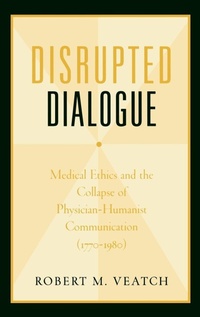
Disrupted Dialogue
Medical Ethics and the Collapse of Physician/Humanist Communication, 1770-1980
Published on 28. October 2004
Book
Hardback
344 pages
978-0-19-516976-8 (ISBN)
Description
Medical ethics changed dramatically in the past 30 years because physicians and humanists actively engaged each other in discussions that sometimes led to confrontation and controversy, but usually have improved the quality of medical decision-making. Before then medical ethics had been isolated for almost two centuries from the larger philosophical, social, and religious controversies of the time. There was, however, an earlier period where leaders in medicine and in the humanities worked closely together and both fields were richer for it.
This volume begins with the 18th century Scottish Enlightenment when professors of medicine such as John Gregory, Edward Percival, and the American, Benjamin Rush, were close friends of philosophers like David Hume, Adam Smith, and Thomas Reid. They continually exchanged views on matters of ethics with each other in print, at meetings of elite intellectual groups, and at the dinner table. Then something happened, physicians and humanists quit talking with each other. In searching for the causes of the collapse, this book identifies shifts in the social class of physicians, developments in medical science, and changes in the patterns of medical education. Only in the past three decades has the dialogue resumed as physicians turned to humanists for help just when humanists wanted their work to be relevant to real-life social problems. Again, the book asks why, finding answers in the shift from acute to chronic disease as the dominant pattern of illness, the social rights revolution of the 1960's, and the increasing dissonance between physician ethics and ethics outside medicine. The book tells the critical story of how the breakdown in communication between physicians and humanists occurred and how it was repaired when new developments in medicine together with a social revolution forced the leaders of these two fields to resume their dialogue.
This volume begins with the 18th century Scottish Enlightenment when professors of medicine such as John Gregory, Edward Percival, and the American, Benjamin Rush, were close friends of philosophers like David Hume, Adam Smith, and Thomas Reid. They continually exchanged views on matters of ethics with each other in print, at meetings of elite intellectual groups, and at the dinner table. Then something happened, physicians and humanists quit talking with each other. In searching for the causes of the collapse, this book identifies shifts in the social class of physicians, developments in medical science, and changes in the patterns of medical education. Only in the past three decades has the dialogue resumed as physicians turned to humanists for help just when humanists wanted their work to be relevant to real-life social problems. Again, the book asks why, finding answers in the shift from acute to chronic disease as the dominant pattern of illness, the social rights revolution of the 1960's, and the increasing dissonance between physician ethics and ethics outside medicine. The book tells the critical story of how the breakdown in communication between physicians and humanists occurred and how it was repaired when new developments in medicine together with a social revolution forced the leaders of these two fields to resume their dialogue.
Reviews / Votes
"Disrupted Dialogue offers an intriguing new perspective on isolation and innovation in the history of Anglo-Americal medical ethics. It also presents a wealth of valuable new biographical and bibliographic information on the major and minor figures that shaped this history. It deserves a careful reading by anyone seriously interested in the history of modern medical ethics."--Bulletin of the History of Medicine"The book presents a wealth of valuable new biographical and bibliographical information on the figures that shaped this history. It deserves a careful reading by anyone seriously interested in the interaction between moral philosophy, moral theology and medicine." --Journal of Religion
More details
Language
English
Place of publication
New York
United States
Target group
Professional and scholarly
Dimensions
Height: 240 mm
Width: 161 mm
Thickness: 23 mm
Weight
675 gr
ISBN-13
978-0-19-516976-8 (9780195169768)
Copyright in bibliographic data and cover images is held by Nielsen Book Services Limited or by the publishers or by their respective licensors: all rights reserved.
Schweitzer Classification
Other editions
Additional editions
Robert M. Veatch
Disrupted Dialogue
Medical Ethics and the Collapse of Physician-Humanist Communication (1770-1980)
E-Book
09/2004
OUP eBook
€24.99
Available for download
Person
Robert M. Veatch, Professor of Medical Ethics, Kennedy Institute of Ethics, Georgetown University, USA
Content
PART 1: SCOTLAND ; 1. Medical ethics in the Scottish enlightenment ; 2. The beginnings of medicine as an isolated science ; PART 2: ENGLAND ; 3. Eighteenth-century England's integration of medicine and the humanities ; 4. Isolation of the English physician ; PART 3: THE UNITED STATES, CANADA AND NEW ZEALAND ; 5. Physician-humanist interaction in the eighteenth century in the United States ; 6. The scientizing of medicine in the United States ; 7. Some physicians who almost confront the humanities ; 8. Diverging traditions: professional and religious medical ethics of the nineteenth century ; 9. Medical ethics in New Zealand and Nova Scotia: test cases ; PART 4: THE RECONVERGENCE OF PHYSICIANS AND HUMANISTS ; 10. The end of the isolation: hints of reconvergence ; 11. The new enlightenment: the 1970s ; Afterword: the 1980s and beyond