

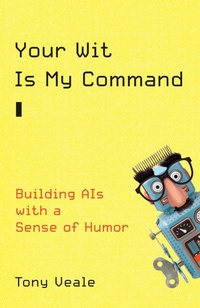
Your Wit Is My Command
Building AIs with a Sense of Humor
Published on 7. September 2021
Book
Hardback
240 pages
978-0-262-04599-5 (ISBN)
Description
An accessible, entertaining look into how we can use artificial intelligence to make smart machines funny—for fans of computers and comedy alike.
Most robots and smart devices are not known for their joke-telling abilities. And yet, as computer scientist Tony Veale explains in Your Wit Is My Command, machines are not inherently unfunny; they are just programmed that way. By examining the mechanisms of humor and jokes—how jokes actually works—Veale shows that computers can be built with a sense of humor, capable not only of producing a joke but also of appreciating one. Along the way, he explores the humor-generating capacities of fictional robots ranging from B-9 in Lost in Space to TARS in Interstellar, maps out possible scenarios for developing witty robots, and investigates such aspects of humor as puns, sarcasm, and offensiveness.
In order for robots to be funny, Veale explains, we need to analyze humor computationally. Using artificial intelligence (AI), Veale shows that joke generation is a knowledge-based process—a sense of humor is blend of wit and wisdom. He notes that existing technologies can detect sarcasm in conversation, and explains how some jokes can be pre-scripted while others are generated algorithmically—all while making the technical aspects of AI accessible for the general reader. Of course, there's no single algorithm or technology that we can plug in to make our virtual assistants or GPS voice navigation funny, but Veale provides a computational roadmap for how we might get there.
Most robots and smart devices are not known for their joke-telling abilities. And yet, as computer scientist Tony Veale explains in Your Wit Is My Command, machines are not inherently unfunny; they are just programmed that way. By examining the mechanisms of humor and jokes—how jokes actually works—Veale shows that computers can be built with a sense of humor, capable not only of producing a joke but also of appreciating one. Along the way, he explores the humor-generating capacities of fictional robots ranging from B-9 in Lost in Space to TARS in Interstellar, maps out possible scenarios for developing witty robots, and investigates such aspects of humor as puns, sarcasm, and offensiveness.
In order for robots to be funny, Veale explains, we need to analyze humor computationally. Using artificial intelligence (AI), Veale shows that joke generation is a knowledge-based process—a sense of humor is blend of wit and wisdom. He notes that existing technologies can detect sarcasm in conversation, and explains how some jokes can be pre-scripted while others are generated algorithmically—all while making the technical aspects of AI accessible for the general reader. Of course, there's no single algorithm or technology that we can plug in to make our virtual assistants or GPS voice navigation funny, but Veale provides a computational roadmap for how we might get there.
More details
Language
English
Place of publication
Cambridge (Massachusetts)
United States
Publishing group
MIT Press Ltd
Product notice
sewn/stitched
Cloth over boards
Illustrations
23
Dimensions
Height: 232 mm
Width: 158 mm
Thickness: 30 mm
Weight
584 gr
ISBN-13
978-0-262-04599-5 (9780262045995)
Copyright in bibliographic data and cover images is held by Nielsen Book Services Limited or by the publishers or by their respective licensors: all rights reserved.
Schweitzer Classification
Other editions
Additional editions
E-Book
09/2021
MIT Press
€28.99
Available for download
Person
Tony Veale
Content
Foreword
Preface
1 Does Not Compute: Why Our Machines Need a Sense of Humor
2 It's a Joke, Jim, But Not as we Know It: A Tour of Scholarly Perspectives and Theories of Humor
3 Tweet my Shorts: Twitterbots Can Turn Our Theories into Simple Practice
4 Double Trouble: Humorous Storytelling and Embodied AI
5 Practical Magic: Systematic Approaches to Joke Creation
6 Danger, Danger: Incongruity and the Time Course of Jokes
7 Wit Happens: Computational Models of Punning and Wordplay
8 Physics Envy: Quantitative Approaches to Humor Analysis
9 Taking Exception: Computational Treatments of Sarcasm and Irony
10 At Wit's End: Lessons for the Future
Notes
Bibliography
Index
Preface
1 Does Not Compute: Why Our Machines Need a Sense of Humor
2 It's a Joke, Jim, But Not as we Know It: A Tour of Scholarly Perspectives and Theories of Humor
3 Tweet my Shorts: Twitterbots Can Turn Our Theories into Simple Practice
4 Double Trouble: Humorous Storytelling and Embodied AI
5 Practical Magic: Systematic Approaches to Joke Creation
6 Danger, Danger: Incongruity and the Time Course of Jokes
7 Wit Happens: Computational Models of Punning and Wordplay
8 Physics Envy: Quantitative Approaches to Humor Analysis
9 Taking Exception: Computational Treatments of Sarcasm and Irony
10 At Wit's End: Lessons for the Future
Notes
Bibliography
Index