

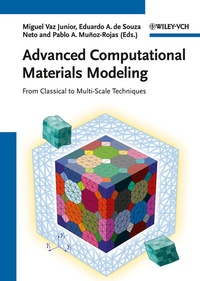
Advanced Computational Materials Modeling
From Classical to Multi-Scale Techniques
1st Edition
Published on 27. October 2010
Book
Hardback
XVIII, 432 pages
978-3-527-32479-8 (ISBN)
Description
With its discussion of strategies for modeling complex materials using new numerical techniques, mainly those based on the finite element method, this monograph covers a range of topics including computational plasticity, multi-scale formulations, optimization and parameter identification, damage mechanics and nonlinear finite elements.
Reviews / Votes
"This comprehensive resource offers one-stop shopping for all you need to know to get productive with .NET 4". (TMCnet.com , 19 January 2011)More details
Edition
1. ergänzte Auflage
Language
English
Place of publication
Berlin
Germany
Target group
Professional and scholarly
Illustrations
238
206 s/w Abbildungen, 2 farbige Abbildungen, 30 s/w Tabellen
Dimensions
Height: 24 cm
Width: 17 cm
Thickness: 2.8 cm
Weight
1130 gr
ISBN-13
978-3-527-32479-8 (9783527324798)
Schweitzer Classification
Other editions
Additional editions
Miguel Vaz Junior | Eduardo A. de Souza Neto | Pablo A. Munoz-Rojas
Advanced Computational Materials Modeling
From Classical to Multi-Scale Techniques
E-Book
09/2011
1st Edition
Wiley-VCH
€162.99
Available for download
Miguel Vaz Junior | Eduardo A. de Souza Neto | Pablo A. Munoz-Rojas
Advanced Computational Materials Modeling
From Classical to Multi-Scale Techniques
E-Book
07/2011
1st Edition
Wiley-VCH
€162.99
Available for download
Persons
Miguel Vaz Jr. heads the research group "Development and Application of Numerical Methods to Continuum Mechanics" at the State University of Santa Catarina, Brazil. He received his Ph.D. in Civil Engineering in 1998 from the Swansea University, UK. He has worked in multi-physics and coupled problems, especially computational plasticity, thermo-mechanical coupling and polymer melt flow.
Eduardo A. de Souza Neto is a Reader at the School of Engineering, Swansea University, UK. He received his Ph.D. in 1994 from Swansea University for his work in computational plasticity. He has dedicated his research activities to the development of constitutive models and numerical algorithms aimed at large strain inelasticity. He authored key papers on finite element technology, finite strain plasticity and damage mechanics and has been more recently publishing articles on multi-scale methods in non-linear solid mechanics. He is also the author of a textbook on computational methods for plasticity.
Pablo Andrés Muñoz-Rojas leads the "Computational Mechanics Laboratory" at the State University of Santa Catarina, Brazil. He obtained his Ph.D. degree at the Federal University of Rio Grande do Sul, Brazil, with research on the application of optimization techniques to metal forming problems. He has focused his work on numerical techniques for sensitivity analysis, parameter identification of elastic-plastic properties and viscoelasticity.
Eduardo A. de Souza Neto is a Reader at the School of Engineering, Swansea University, UK. He received his Ph.D. in 1994 from Swansea University for his work in computational plasticity. He has dedicated his research activities to the development of constitutive models and numerical algorithms aimed at large strain inelasticity. He authored key papers on finite element technology, finite strain plasticity and damage mechanics and has been more recently publishing articles on multi-scale methods in non-linear solid mechanics. He is also the author of a textbook on computational methods for plasticity.
Pablo Andrés Muñoz-Rojas leads the "Computational Mechanics Laboratory" at the State University of Santa Catarina, Brazil. He obtained his Ph.D. degree at the Federal University of Rio Grande do Sul, Brazil, with research on the application of optimization techniques to metal forming problems. He has focused his work on numerical techniques for sensitivity analysis, parameter identification of elastic-plastic properties and viscoelasticity.
Content
Introduction
Cellular materials
Damage: Lamaitre model
Damage: GTN model
Multi-scale: concrete
Multi-scale
Multi-scale: finite plasticity
Functionally graded materials
Metal powder
Multi-scale: texture evolution
Multi-scale: masonry
Cellular materials
Damage: Lamaitre model
Damage: GTN model
Multi-scale: concrete
Multi-scale
Multi-scale: finite plasticity
Functionally graded materials
Metal powder
Multi-scale: texture evolution
Multi-scale: masonry