

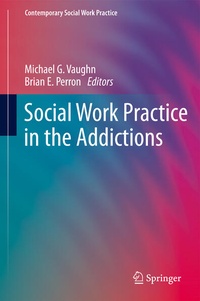
Social Work Practice in the Addictions
Published on 18. October 2013
Book
Paperback/Softback
XII, 270 pages
978-1-4614-9385-3 (ISBN)
Description
Social workers represent the largest body of addiction and mental health service providers, and there is a consistent need for up-to-date information. Social Work Practice in the Addictions is a comprehensive evidence-based volume. Contributing authors of this volume have been carefully selected to ensure representation of the leading social work addiction researchers. Additionally, researchers from other allied fields, including psychiatry, psychology, and public health, will also be involved to ensure a strong interdisciplinary perspective. Unlike other texts on addiction, this book incorporates ideas of social justice, practice with diverse communities, and ethics to represent the entire knowledge base of social work.
More details
Series
Edition
2013 ed.
Language
English
Place of publication
New York
United States
Target group
Professional and scholarly
Professional/practitioner
Illustrations
13 s/w Abbildungen
XII, 270 p. 13 illus.
Dimensions
Height: 235 mm
Width: 155 mm
Thickness: 16 mm
Weight
435 gr
ISBN-13
978-1-4614-9385-3 (9781461493853)
DOI
10.1007/978-1-4614-5357-4
Schweitzer Classification
Other editions
Additional editions
Michael G. Vaughn | Brian E. Perron
Social Work Practice in the Addictions
E-Book
12/2012
1st Edition
Springer
€181.89
Available for download
Michael G. Vaughn | Brian E. Perron
Social Work Practice in the Addictions
Book
12/2012
Springer
€192.59
Shipment within 15-20 days
Content
Historical and Contemporary Perspectives.- Epidemiology. Etiology.- Assessment Strategies.- The Language of Diagnosis.- Motivational Interventions.- Recovery, AA/NA, and 12-step facilitation.- Cognitive Behavioral Therapy.- A Framework for Integrating Culture, Diversity, and Social Justice in Addictions.- Empirical Status of Culturally Competent Practices.- Adolescents.- Women and Families.- Older Adults.- Alcohol Policy.- Drug Control Policies: Problems and Prospects.- Conclusions and Future Directions.