

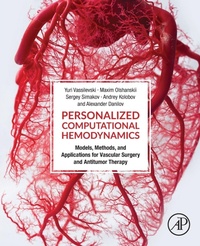
Personalized Computational Hemodynamics
Models, Methods, and Applications for Vascular Surgery and Antitumor Therapy
Published on 16. April 2020
Book
Paperback/Softback
280 pages
978-0-12-815653-7 (ISBN)
Description
Personalized Computational Hemodynamics: Models, Methods, and Applications for Vascular Surgery and Antitumor Therapy offers practices and advances surrounding the multiscale modeling of hemodynamics and their personalization with conventional clinical data. Focusing on three physiological disciplines, readers will learn how to derive a suitable mathematical model and personalize its parameters to account for pathologies and diseases. Written by leading experts, this book mirrors the top trends in mathematical modeling with clinical applications. In addition, the book features the major results of the "Research group in simulation of blood flow and vascular pathologies" at the Institute of Numerical Mathematics of the Russian Academy of Sciences.
Two important features distinguish this book from other monographs on numerical methods for biomedical applications. First, the variety of medical disciplines targeted by the mathematical modeling and computer simulations, including cardiology, vascular neurology and oncology. Second, for all mathematical models, the authors consider extensions and parameter tuning that account for vascular pathologies.
Two important features distinguish this book from other monographs on numerical methods for biomedical applications. First, the variety of medical disciplines targeted by the mathematical modeling and computer simulations, including cardiology, vascular neurology and oncology. Second, for all mathematical models, the authors consider extensions and parameter tuning that account for vascular pathologies.
More details
Language
English
Place of publication
San Diego
United States
Publishing group
Elsevier Science Publishing Co Inc
Target group
Professional and scholarly
Graduate students and researchers focusing on mathematical modeling in biomedicine, computational biology
Product notice
Paperback (trade)
Dimensions
Height: 235 mm
Width: 191 mm
Thickness: 15 mm
Weight
491 gr
ISBN-13
978-0-12-815653-7 (9780128156537)
Copyright in bibliographic data and cover images is held by Nielsen Book Services Limited or by the publishers or by their respective licensors: all rights reserved.
Schweitzer Classification
Other editions
Additional editions
Yuri Vassilevski | Maxim Olshanskii | Sergey Simakov
Personalized Computational Hemodynamics
Models, Methods, and Applications for Vascular Surgery and Antitumor Therapy
E-Book
04/2020
Academic Press
€131.00
Available for download
Persons
Professor, corresponding member of Russian Academy of Sciences Yuri Vassilevski is the deputy director of Marchuk Institute of Numerical Mathematics, Russian Academy of Sciences, the head of Laboratory of mathematical modelling in medicine of Sechenov University, the head of the department of computational technologies and modelling in geophysics and biomathematics at Moscow Institute of Physics and Technology and the head of the department of mathematics, mechanics and mathematical modelling at Sechenov University. He received his PhD Degree from Institute of Numerical Mathematics, Russian Academy of Science (1993) and second doctorate (Habilitation) in Mathematics at the same institute (2006). His research interests are in adaptive meshing, numerical analysis, mathematical modelling and scientific computing with applications in geophysics and biomedical engineering. From 2013 he serves as the Managing Editor of the Russian Journal of Numerical Analysis and Mathematical Modelling. Maxim Olshanskii is currently professor of Mathematics at the University of Houston. He also holds adjunct professorships at Department of Mathematics and Computer Science at Emory University. He was previously professor at the Department of Mathematics and Mechanics at Moscow State University. He received his PhD degree from Moscow State University (1997) and second doctorate (Habilitation) in Mathematics from the Institute of Numerical Mathematics, Russian Academy of Sciences (2006). His research interests are in numerical analysis and scientific computing, with applications to fluid problems, interface and free boundary problems, geometric PDEs, and cardiovascular models. He is a recipient of research awards by multiple agencies in USA, Russia and Germany as well as the Prize of the European Academy for Russian young scientists (2001). From 2014 he serves as the Managing Editor of the Journal of Numerical Mathematics. Sergey Simakov is the deputy chair of the department of computational physics, at Moscow Institute of Physics and Technology, associated professor of the department of computational physics at Moscow Institute of Physics and Technology, senior researcher of Laboratory of human physiology of Moscow Institute of Physics and Technology, senior researcher of Laboratory of mathematical modelling in medicine of Sechenov University and associated professor of the department of mathematics, mechanics and mathematical modelling at Sechenov University.
He received his PhD degree from Moscow Institute of Physics and Technology (2006) in Mathematics.
His research interests are in numerical methods, wave processes in a network, biological flows including cardiovascular and respiratory systems, biomedical engineering. PhD Andrey Kolobov is the scientific secretary of Lebedev Physical Institute of the Russian Academy of Sciences, senior scientist in Laboratory of Nonlinear Dynamics and Theoretical Biophysics
He received his PhD Degree from Lomonosov Moscow State University in 2004.
His research interests are mathematical modeling in oncology with account of tumor associated angiogenesis, nonlinear dynamics of complex systems, study of combustion processes such as flame ignition and deflagration.
Andrey Kolobov works closely with Marchuk Institute of Numerical Mathematics of the Russian Academy of Sciences and Peoples' Friendship University of Russia. Alexander Danilov is the senior researcher at Marchuk Institute of Numerical Mathematics, Russian Academy of Sciences, Laboratory of mathematical modelling in medicine of Sechenov University, and Laboratory of human physiology at Moscow Institute of Physics and Technology. He received his PhD Degree from Institute of Numerical Mathematics, Russian Academy of Sciences in 2010. He is a laureate of Russian academy of sciences medal with prizes for young scientists of Russian academy of sciences, other agencies and organizations of Russia for best work in 2011. His research interests are in mesh generation, image segmentation, mathematical modelling and scientific computing in biomedical engineering.
He received his PhD degree from Moscow Institute of Physics and Technology (2006) in Mathematics.
His research interests are in numerical methods, wave processes in a network, biological flows including cardiovascular and respiratory systems, biomedical engineering. PhD Andrey Kolobov is the scientific secretary of Lebedev Physical Institute of the Russian Academy of Sciences, senior scientist in Laboratory of Nonlinear Dynamics and Theoretical Biophysics
He received his PhD Degree from Lomonosov Moscow State University in 2004.
His research interests are mathematical modeling in oncology with account of tumor associated angiogenesis, nonlinear dynamics of complex systems, study of combustion processes such as flame ignition and deflagration.
Andrey Kolobov works closely with Marchuk Institute of Numerical Mathematics of the Russian Academy of Sciences and Peoples' Friendship University of Russia. Alexander Danilov is the senior researcher at Marchuk Institute of Numerical Mathematics, Russian Academy of Sciences, Laboratory of mathematical modelling in medicine of Sechenov University, and Laboratory of human physiology at Moscow Institute of Physics and Technology. He received his PhD Degree from Institute of Numerical Mathematics, Russian Academy of Sciences in 2010. He is a laureate of Russian academy of sciences medal with prizes for young scientists of Russian academy of sciences, other agencies and organizations of Russia for best work in 2011. His research interests are in mesh generation, image segmentation, mathematical modelling and scientific computing in biomedical engineering.
Author
Marchuk Institute of Numerical Mathematics, Russian Academy of Sciences, Moscow Institute of Technology, Sechenov University
Professor, University of Houston, Texas, USA
Moscow Institute of Physics and Technology, Sechenov University
Lebedev Physical Institute of the Russian Academy of Sciences
Marchuk Institute of Numerical Mathematics, Russian Academy of Sciences, Moscow Institute of Physics and Technology, Sechenov University
Content
1. Introduction2. Basic facts about a human cardiovascular system3. Patient-specific geometric modelling4. General equations of motion5. 3D vascular and heart hemodynamics6. 0D lumped models7. 1D vascular hemodynamics 8. Hemodynamics in capillary networks and angiogenesis9. Applications in vascular surgery10. Applications in antitumor therapy11. Summary