

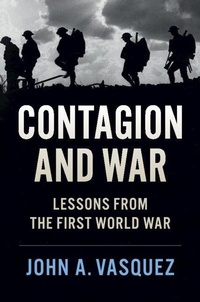
Contagion and War
Lessons from the First World War
Published on 22. November 2018
Book
Hardback
412 pages
978-1-108-41704-4 (ISBN)
Description
John A. Vasquez explains the processes that cause the spread of interstate war by looking at how contagion worked to bring countries into the First World War. Analysing all the key states that declared war, the book is comprised of three parts. Part I lays out six models of contagion: alliances, contiguity, territorial rivalry, opportunity, 'brute force' and economic dependence. Part II then analyses in detail the decision making of every state that entered the war from Austria-Hungary in 1914 to the United States and Greece in 1917. Part III has two chapters - the first considers the neutral countries, and the second concludes the book with an overarching theoretical analysis, including major lessons of the war and new hypotheses about contagion. This book will be of great interest to students and scholars of international relations, conflict studies and international history, especially those interested in the spread of conflict, or the First World War.
Reviews / Votes
'Some scholars like to look at forests from the outside-in and never get too close to the trees. Others like to plunge into the forest and tag every tree. Despite the old adage of not seeing the forest for the trees, both approaches can prove profitable. John A. Vasquez's latest book is a tree-tagging exercise that pays off in generating an inside-out look at why war participation spreads. There is still more to learn about these contagious processes but tackling first one of the toughest nuts to crack in the war inventory, World War I, should make it easier to figure out why wars spread in general. And just when you thought everything had been said about World War I that could be said, Vasquez comes up with some new twists on how things worked between 1914 and 1918.' William R. Thompson, Distinguished and Rogers Professor Emeritus, Indiana University 'Contagion and War is a nuanced and systematic exploration of the multiple causal processes through which war might spread, illustrated by a detailed examination of the First World War. Vasquez makes a significant contribution to both the theory of international conflict and to our historical understanding of one of the world's most catastrophic and consequential wars.' Jack S. Levy, Rutgers University, New Jersey 'Contagion and War adds to our knowledge of World War I and multiparty conflicts ... by recognizing that temporal sequences are involved in both the start and spread of belligerency, and teasing out and exploring the mechanisms associated with them.' Richard Ned Lebow, War in HistoryMore details
Language
English
Place of publication
Cambridge
United Kingdom
Target group
Professional and scholarly
Illustrations
Worked examples or Exercises; 15 Tables, black and white; 27 Plates, black and white
Dimensions
Height: 235 mm
Width: 157 mm
Thickness: 28 mm
Weight
770 gr
ISBN-13
978-1-108-41704-4 (9781108417044)
Copyright in bibliographic data and cover images is held by Nielsen Book Services Limited or by the publishers or by their respective licensors: all rights reserved.
Schweitzer Classification
Other editions
Additional editions
Book
11/2018
Cambridge University Press
€44.30
Shipment within 15-20 days
E-Book
11/2018
Cambridge University Press
€26.99
Available for download
E-Book
11/2018
Cambridge University Press
€32.49
Available for download
Person
John A. Vasquez is the Thomas B. Mackie Scholar in International Relations at the University of Illinois, Urbana-Champaign. He is author of eight books including, The War Puzzle (Cambridge, 1993), and The Power of Power Politics (Cambridge, 1999) and editor of ten others, including The Outbreak of the First World War, with Jack S. Levy (Cambridge, 2014). He has published over forty-five articles in major journals in political science and international relations. In 2017, he received the Lifetime Achievement Award of the Conflict Processes section of the American Political Science Association.
Content
Part I. Theoretical Expectations: 1. Contagion processes in the First World War; 2. Research design; Part II. Dyadic Case Analyses: History and Data: 3. 1914: the local war and the first wave; 4. 1915-16: the second wave; 5. 1917: the third wave; Part III. Conclusions: Lessons from the First World War: 6. The neutrals; 7. How contagion actually worked.