

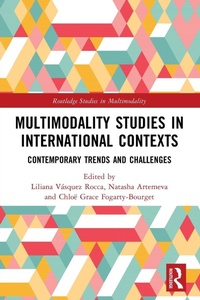
Multimodality Studies in International Contexts
Contemporary Trends and Challenges
1st Edition
Published on 5. May 2025
Book
Paperback/Softback
284 pages
978-1-032-43489-6 (ISBN)
Description
This collection responds to the need for theoretically informed and methodologically grounded empirical research on the global transformations in multimodal human communication and social practices in light of recent widespread change.
The volume highlights the need to expand on the established approaches--Social Semiotics, Multimodal Discourse Analysis, and Multimodal (Inter)action Analysis--by complementing them with other analytical frameworks to better understand the impact of unprecedented global challenges, such as Covid-19, on the way humans communicate and make use of meaning-making resources. Bringing together established and emergent scholars from a variety of geographical, cultural, and linguistic contexts, the collection presents studies from both the Global North and Global South, including South Africa, Latin America, Brazil, and the Caribbean, to showcase new perspectives in multimodality research.
This innovative book will be of interest to students and scholars in multimodality, social semiotics, and discourse analysis.
The volume highlights the need to expand on the established approaches--Social Semiotics, Multimodal Discourse Analysis, and Multimodal (Inter)action Analysis--by complementing them with other analytical frameworks to better understand the impact of unprecedented global challenges, such as Covid-19, on the way humans communicate and make use of meaning-making resources. Bringing together established and emergent scholars from a variety of geographical, cultural, and linguistic contexts, the collection presents studies from both the Global North and Global South, including South Africa, Latin America, Brazil, and the Caribbean, to showcase new perspectives in multimodality research.
This innovative book will be of interest to students and scholars in multimodality, social semiotics, and discourse analysis.
More details
Series
Language
English
Place of publication
London
United Kingdom
Publishing group
Taylor & Francis Ltd
Target group
College/higher education
Postgraduate
Illustrations
50 s/w Abbildungen, 30 s/w Photographien bzw. Rasterbilder, 20 s/w Zeichnungen, 8 s/w Tabellen
8 Tables, black and white; 20 Line drawings, black and white; 30 Halftones, black and white; 50 Illustrations, black and white
Dimensions
Height: 229 mm
Width: 152 mm
Thickness: 17 mm
Weight
460 gr
ISBN-13
978-1-032-43489-6 (9781032434896)
Copyright in bibliographic data and cover images is held by Nielsen Book Services Limited or by the publishers or by their respective licensors: all rights reserved.
Schweitzer Classification
Other editions
Additional editions
Liliana Vasquez Rocca | Natasha Artemeva | Chloe Grace Fogarty-Bourget
Multimodality Studies in International Contexts
Contemporary Trends and Challenges
E-Book
12/2023
1st Edition
Taylor & Francis
€60.49
Available for download
Liliana Vasquez Rocca | Natasha Artemeva | Chloe Grace Fogarty-Bourget
Multimodality Studies in International Contexts
Contemporary Trends and Challenges
E-Book
12/2023
1st Edition
Taylor & Francis
€60.49
Available for download
Liliana Vasquez Rocca | Natasha Artemeva | Chloe Grace Fogarty-Bourget
Multimodality Studies in International Contexts
Contemporary Trends and Challenges
Book
12/2023
1st Edition
Routledge
€206.90
Shipment within 10-20 days
Persons
Liliana Vasquez Rocca, PhD, is Assistant Professor in the Department of Humanities, Faculty of Education and Social Sciences, Universidad Andres Bello, Chile. In 2018-2022, she coordinated Red Latinoamericana de Estudios sobre Multimodalidad (REDLEM, or the Latin American Network of Studies on Multimodality). She specializes in multimodality and media discourse analysis.
Natasha Artemeva, PhD, is Professor, School of Linguistics and Language Studies, Carleton University, Canada. She specializes in Genre Studies, theories of learning, and multimodality. She co-edited Writing in Knowledge Societies (Parlor Press) and Genre Studies around the Globe (Inkshed), and co-authored Reconsidering Context in Language Assessment (Routledge).
Chloe Grace Fogarty-Bourget holds a PhD in Applied Linguistics and Discourse Studies from the School of Linguistics and Language Studies, Carleton University, Canada, where she teaches courses in Writing and Discourse Studies. She specializes in Multimodal Discourse Analysis, Writing and Genre Studies, and the scholarship of university teaching.
Natasha Artemeva, PhD, is Professor, School of Linguistics and Language Studies, Carleton University, Canada. She specializes in Genre Studies, theories of learning, and multimodality. She co-edited Writing in Knowledge Societies (Parlor Press) and Genre Studies around the Globe (Inkshed), and co-authored Reconsidering Context in Language Assessment (Routledge).
Chloe Grace Fogarty-Bourget holds a PhD in Applied Linguistics and Discourse Studies from the School of Linguistics and Language Studies, Carleton University, Canada, where she teaches courses in Writing and Discourse Studies. She specializes in Multimodal Discourse Analysis, Writing and Genre Studies, and the scholarship of university teaching.
Content
Lists of Figures
List of Contributors
List of Tables
Foreword
Teresa Oteiza
Acknowledgements
Introduction
Natasha Artemeva, Liliana Vasquez Rocca, and Chloe Grace Fogarty-Bourget
PART I
Current Trends in Multimodality Studies
Chapter 1. Theoretical and Methodological Perspectives on Multimodality in South Africa
Arlene Archer
Chapter 2. The Seeds and Growth of Multimodality in Latin America: A Historical Review
Dominique Manghi, Carolina Badillo, and Danielle Almeida
Chapter 3. Consolidation of Multimodality Studies in Latin America: A Review of Emergent Themes
Carolina Perez-Arredondo and Camila Cardenas-Neira
Chapter 4. PanMeMic. Changes in Communication and Interaction During the COVID-19 Pandemic and Beyond: Insights from a Collective, Multimodal Research Method
Ana Pedrazzini, Clarice Gualberto, Styliani Karatza, Maryam S. Ghiasian, and Elisabetta Adami
PART II
Challenges to Multimodality Research in Educational Contexts
Chapter 5. Combining Multimodal Techniques to Approach the Study of Academic Lectures: A Methodological Reflection
Edgar Bernad-Mecho
Chapter 6. A Toolkit for the Analysis of Modal Intensity: Strategies Instructors Use to Facilitate Student Engagement in Learning
Chloe Grace Fogarty-Bourget, Jesse Pirini, and Natasha Artemeva
Chapter 7. A Multimodal Analysis of an Integrating Content and Language in Higher Education (ICLHE) Lecture: Multimodal Ensembles in Action
Miguel F. Ruiz-Garrido and Inmaculada Fortanet-Gomez
Chapter 8. Textbook and Learning
German Canale
PART III
Challenges to Multimodality Studies of Social Interaction
Chapter 9. Once Upon a Time: Toy Stories, Affordances, and the Playing Activity
Danielle Almeida and Jonathan Feitosa Ferreira
Chapter 10. Chilean Movement for Non-sexist Education and Semiosis in Social Media: Students Advance, and Teachers Wake Up
Liliana Vasquez Rocca, Dominique Manghi, Felipe Pereira, Tomas Farias, and Katherine Malhue
Chapter 11. Conflict in Interaction: Diverging Topic Trajectories and Misalignment
Jarret G. Geenen and Austin Howard
Chapter 12. Peer Review and Hidden Modalities of Research Process Genres
Brad Mehlenbacher and Ashley Rose Mehlenbacher
PART IV
Conclusion
Chapter 13. Multimodal Body Work: Research in the Built Environment
Christine Raeisaenen
Index
List of Contributors
List of Tables
Foreword
Teresa Oteiza
Acknowledgements
Introduction
Natasha Artemeva, Liliana Vasquez Rocca, and Chloe Grace Fogarty-Bourget
PART I
Current Trends in Multimodality Studies
Chapter 1. Theoretical and Methodological Perspectives on Multimodality in South Africa
Arlene Archer
Chapter 2. The Seeds and Growth of Multimodality in Latin America: A Historical Review
Dominique Manghi, Carolina Badillo, and Danielle Almeida
Chapter 3. Consolidation of Multimodality Studies in Latin America: A Review of Emergent Themes
Carolina Perez-Arredondo and Camila Cardenas-Neira
Chapter 4. PanMeMic. Changes in Communication and Interaction During the COVID-19 Pandemic and Beyond: Insights from a Collective, Multimodal Research Method
Ana Pedrazzini, Clarice Gualberto, Styliani Karatza, Maryam S. Ghiasian, and Elisabetta Adami
PART II
Challenges to Multimodality Research in Educational Contexts
Chapter 5. Combining Multimodal Techniques to Approach the Study of Academic Lectures: A Methodological Reflection
Edgar Bernad-Mecho
Chapter 6. A Toolkit for the Analysis of Modal Intensity: Strategies Instructors Use to Facilitate Student Engagement in Learning
Chloe Grace Fogarty-Bourget, Jesse Pirini, and Natasha Artemeva
Chapter 7. A Multimodal Analysis of an Integrating Content and Language in Higher Education (ICLHE) Lecture: Multimodal Ensembles in Action
Miguel F. Ruiz-Garrido and Inmaculada Fortanet-Gomez
Chapter 8. Textbook and Learning
German Canale
PART III
Challenges to Multimodality Studies of Social Interaction
Chapter 9. Once Upon a Time: Toy Stories, Affordances, and the Playing Activity
Danielle Almeida and Jonathan Feitosa Ferreira
Chapter 10. Chilean Movement for Non-sexist Education and Semiosis in Social Media: Students Advance, and Teachers Wake Up
Liliana Vasquez Rocca, Dominique Manghi, Felipe Pereira, Tomas Farias, and Katherine Malhue
Chapter 11. Conflict in Interaction: Diverging Topic Trajectories and Misalignment
Jarret G. Geenen and Austin Howard
Chapter 12. Peer Review and Hidden Modalities of Research Process Genres
Brad Mehlenbacher and Ashley Rose Mehlenbacher
PART IV
Conclusion
Chapter 13. Multimodal Body Work: Research in the Built Environment
Christine Raeisaenen
Index