

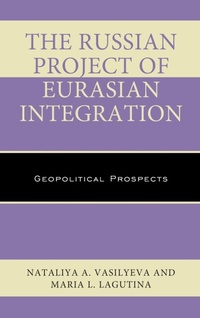
The Russian Project of Eurasian Integration
Geopolitical Prospects
Published on 14. September 2016
Book
Hardback
226 pages
978-1-4985-2564-0 (ISBN)
Description
Modern trends in geopolitics have raised serious questions about the future global and regional architecture of the world system. In the case of the Eurasian Economic Union, these questions bring up important issues for debate: What is the Eurasian Economic Union? What theoretical concepts could be applied for modern Eurasian integration? Why is the Eurasian Economic Union forming? Most importantly, what prospects does this Union have in the framework of the modern geopolitical situation?
This book explores the process of Eurasian integration in the modern global world. The creation of the Eurasian Economic Union has become a topical issue in modern Russian foreign policy. Neo-Eurasianist ideas can be viewed as a geopolitical basis and rationale for the Eurasian Economic Union that may constitute an integrational structure, consolidating the post-Soviet area and neighboring regions. This book argues that Eurasia is a region representing an organic integrity due to close mentality, common and centuries-long history, common language of international communication, a multitude of economic ties, and an identical level of technological development across all countries within the post-Soviet area. Yet, advancement of the Eurasian integration idea into practical implementation should have new objective suppositions as well. These are defined by the contemporary economic, political, and ethno-cultural processes in the post-Soviet space.
This book explores the process of Eurasian integration in the modern global world. The creation of the Eurasian Economic Union has become a topical issue in modern Russian foreign policy. Neo-Eurasianist ideas can be viewed as a geopolitical basis and rationale for the Eurasian Economic Union that may constitute an integrational structure, consolidating the post-Soviet area and neighboring regions. This book argues that Eurasia is a region representing an organic integrity due to close mentality, common and centuries-long history, common language of international communication, a multitude of economic ties, and an identical level of technological development across all countries within the post-Soviet area. Yet, advancement of the Eurasian integration idea into practical implementation should have new objective suppositions as well. These are defined by the contemporary economic, political, and ethno-cultural processes in the post-Soviet space.
Reviews / Votes
This is one of the most valuable books recently published on a subject which is presently regularly treated in media.... The Russian Project of Eurasian Integration: Geopolitical Prospects is necessary reading when a resurging Russia is challenging the West with two other World Island empires. It should be obligatory reading in the West and this book on the Russian Eurasian integration project belongs in libraries world wide. * Center for Research on Geopolitics * A needed Russian perspective on geopolitics in Eurasia that stresses the world's regionalization and polycentrism. -- Andrei Tsygankov, San Francisco State University Comprehensive in scope, this book will be an indispensable read for anyone interested in the subject of Eurasian regional integration. Especially useful is the positioning of the Eurasian Economic Union project within the framework of transcontinental and global trade architecture. -- Mikhail A. Molchanov, St. Thomas UniversityMore details
Series
Language
English
Place of publication
United States
Publishing group
Bloomsbury Publishing Plc
Target group
Professional and scholarly
Product notice
sewn/stitched
Cloth over boards
With dust jacket
Dimensions
Height: 235 mm
Width: 157 mm
Thickness: 18 mm
Weight
524 gr
ISBN-13
978-1-4985-2564-0 (9781498525640)
Copyright in bibliographic data and cover images is held by Nielsen Book Services Limited or by the publishers or by their respective licensors: all rights reserved.
Schweitzer Classification
Other editions
Additional editions
Nataliya A. Vasilyeva | Maria L. Lagutina
The Russian Project of Eurasian Integration
Geopolitical Prospects
E-Book
09/2016
1st Edition
Lexington Books
€42.49
Available for download
Persons
Nataliya A. Vasilyeva is professor of world politics at St. Petersburg State University.
Maria L. Lagutina is associate professor of world politics at St. Petersburg State University.
Maria L. Lagutina is associate professor of world politics at St. Petersburg State University.
Content
Chapter 1. New approaches to analysis of the "Post-Soviet area" phenomenon
Chapter 2. Integration and disintegration as major trends in the Post-Soviet area
Chapter 3. The main integration models within the Post-Soviet area
Chapter 4. The notion "Eurasia": the problem of identification of the region
Chapter 5. The Eurasian idea in contemporary interpretation
Chapter 6. Contemporary Eurasian integration in experts' estimates
Chapter 7. The Foundation of the Present Eurasian Integration in International Law
Chapter 8. The main interests and expectations of the member-states of Eurasian Economic Union
Chapter 9. Russian Geopolitical Interests in the Eurasian Economic Union
Chapter 10. The strategy of Eurasian Integration: Regional and Global Dimensions
Chapter 2. Integration and disintegration as major trends in the Post-Soviet area
Chapter 3. The main integration models within the Post-Soviet area
Chapter 4. The notion "Eurasia": the problem of identification of the region
Chapter 5. The Eurasian idea in contemporary interpretation
Chapter 6. Contemporary Eurasian integration in experts' estimates
Chapter 7. The Foundation of the Present Eurasian Integration in International Law
Chapter 8. The main interests and expectations of the member-states of Eurasian Economic Union
Chapter 9. Russian Geopolitical Interests in the Eurasian Economic Union
Chapter 10. The strategy of Eurasian Integration: Regional and Global Dimensions