

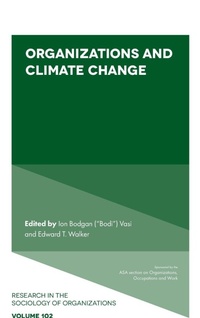
Organizations and Climate Change
Will be published approx. on 27. April 2026
Book
Hardback
392 pages
978-1-80592-556-9 (ISBN)
Description
This volume contains an Open Access chapter.
While the domains of organizational theory, grand challenges, and environmental sociology have developed via relatively distinct fields in sociology and management, they speak to a common set of social change phenomena at the intersection of the state, non-profits, and businesses. Organizations and Climate Change brings together new empirical papers that bridge these domains and sets an agenda for a more holistic theory of organizations and climate change, a theory that examines how various kinds of organizations respond to what is considered as one of the most important challenges for humanity during the 21st century.
Each of papers included in this volume focus on the way in which organizations shape or respond to the climate change challenge. Three papers examine how business organizations address the climate change problem, including corporate communication of climate change mitigation actions, corporate strategies that undermine decarbonization, and corporate marketing of low-carbon technologies. Three papers investigate how non-profit organizations form networks that shape climate change negotiations, incorporate climate change into their missions, and justify not incorporating climate change into their mission. Finally, three papers explore how universities, boundary organizations, and organizational fields engage in climate change mitigation or attempt to influence other organizations to engage in these actions. The afterword summarizes research on both enablers and blockers of climate action and identifies several promising directions for future work.
Organizations and Climate Change distils insights and highlights opportunities for future research on organizations and the climate change grand challenge.
While the domains of organizational theory, grand challenges, and environmental sociology have developed via relatively distinct fields in sociology and management, they speak to a common set of social change phenomena at the intersection of the state, non-profits, and businesses. Organizations and Climate Change brings together new empirical papers that bridge these domains and sets an agenda for a more holistic theory of organizations and climate change, a theory that examines how various kinds of organizations respond to what is considered as one of the most important challenges for humanity during the 21st century.
Each of papers included in this volume focus on the way in which organizations shape or respond to the climate change challenge. Three papers examine how business organizations address the climate change problem, including corporate communication of climate change mitigation actions, corporate strategies that undermine decarbonization, and corporate marketing of low-carbon technologies. Three papers investigate how non-profit organizations form networks that shape climate change negotiations, incorporate climate change into their missions, and justify not incorporating climate change into their mission. Finally, three papers explore how universities, boundary organizations, and organizational fields engage in climate change mitigation or attempt to influence other organizations to engage in these actions. The afterword summarizes research on both enablers and blockers of climate action and identifies several promising directions for future work.
Organizations and Climate Change distils insights and highlights opportunities for future research on organizations and the climate change grand challenge.
More details
Series
Language
English
Place of publication
Bingley
United Kingdom
Target group
Professional and scholarly
Dimensions
Height: 235 mm
Width: 157 mm
Thickness: 22 mm
Weight
616 gr
ISBN-13
978-1-80592-556-9 (9781805925569)
Copyright in bibliographic data and cover images is held by Nielsen Book Services Limited or by the publishers or by their respective licensors: all rights reserved.
Schweitzer Classification
Persons
Ion Bogdan Vasi is Associate Professor in the Department of Sociology at the University of Iowa, USA. He also holds a courtesy appointment in the Department of Management.
Edward T. Walker is Professor and Chair in the Department of Sociology at the University of California, Los Angeles, USA.
Edward T. Walker is Professor and Chair in the Department of Sociology at the University of California, Los Angeles, USA.
Content
Introduction: Connecting Climate Change to Sociological Research on Organizations; Ion Bogdan Vasi and Edward T. Walker
Section A. Climate Change and Business Organizations
Chapter 1. The Future's a Gas: How 'Corporate Realism' Undermines Decarbonization; Vanessa Bowden, Daniel Nyberg, Christopher Wright, Peter Fleming, and Csilla Demeter
Chapter 2. Mind the Gap: Supply-Side Effects on Differential Diffusion in the Household Energy Technologies Market; Fedor A. Dokshin and Mircea Gherghina
Chapter 3. 'We Are on a Journey.' Corporate Communication of Climate Change Mitigation in the United States; Ion Bogdan Vasi, Edward T. Walker, and Levi Sands
Section B. Climate Change and Civil Society Organizations
Chapter 4. Network Drivers of Organizational Diversity and Participation across 30 Years of International Climate Change Negotiations; Zack W. Almquist, Benjamin E. Bagozzi, and Daria Blinova
Chapter 5. The Climate Environment: The Landscape of US Environmental Nonprofits in the Climate Change Era; Nicholas V. DiRago, Sumin Lee, and Pamela Paxton
Chapter 6. "It's Not Really Part of Our Mission": Organizational Inertia in Addressing Climate Change in Small Non-Profits; Lisa Y. Seiler
Section C. Climate Change and Organizational Fields, Boundary Organizations, and Knowledge Institutions
Chapter 7. Institutional Entrepreneurship in the Creation of Multistakeholder Governance Fields for Climate Change: The Case of the Corporate Climate Disclosure Field; Neil Fligstein and Janna Z. Huang
Chapter 8. Legitimacy Maintenance in Boundary Organizations: Balancing Inclusiveness and Expertise in International Climate Change Assessments; Ian Gray
Chapter 9. Organizational Resources and Civic Organizing for Climate Action in Disinvested Regions; Paul Almeida, Rasha Naseif, and Isabelle Haddad OPEN ACCESS
Afterword: The Urgency and Future of Organizational Scholarship on Climate Change; Thomas P. Lyon and Todd Schifeling
Section A. Climate Change and Business Organizations
Chapter 1. The Future's a Gas: How 'Corporate Realism' Undermines Decarbonization; Vanessa Bowden, Daniel Nyberg, Christopher Wright, Peter Fleming, and Csilla Demeter
Chapter 2. Mind the Gap: Supply-Side Effects on Differential Diffusion in the Household Energy Technologies Market; Fedor A. Dokshin and Mircea Gherghina
Chapter 3. 'We Are on a Journey.' Corporate Communication of Climate Change Mitigation in the United States; Ion Bogdan Vasi, Edward T. Walker, and Levi Sands
Section B. Climate Change and Civil Society Organizations
Chapter 4. Network Drivers of Organizational Diversity and Participation across 30 Years of International Climate Change Negotiations; Zack W. Almquist, Benjamin E. Bagozzi, and Daria Blinova
Chapter 5. The Climate Environment: The Landscape of US Environmental Nonprofits in the Climate Change Era; Nicholas V. DiRago, Sumin Lee, and Pamela Paxton
Chapter 6. "It's Not Really Part of Our Mission": Organizational Inertia in Addressing Climate Change in Small Non-Profits; Lisa Y. Seiler
Section C. Climate Change and Organizational Fields, Boundary Organizations, and Knowledge Institutions
Chapter 7. Institutional Entrepreneurship in the Creation of Multistakeholder Governance Fields for Climate Change: The Case of the Corporate Climate Disclosure Field; Neil Fligstein and Janna Z. Huang
Chapter 8. Legitimacy Maintenance in Boundary Organizations: Balancing Inclusiveness and Expertise in International Climate Change Assessments; Ian Gray
Chapter 9. Organizational Resources and Civic Organizing for Climate Action in Disinvested Regions; Paul Almeida, Rasha Naseif, and Isabelle Haddad OPEN ACCESS
Afterword: The Urgency and Future of Organizational Scholarship on Climate Change; Thomas P. Lyon and Todd Schifeling