

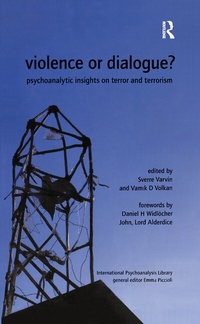
Violence or Dialogue?
Psychoanalytic Insights on Terror and Terrorism
1st Edition
Published on 31. July 2019
Book
Paperback/Softback
300 pages
978-0-367-32278-6 (ISBN)
Description
Our understanding of terrorism since the events of September 11th 2001 has usually been channelled through the two dimensional lens of religion and politics. This important new work contributes a richer understanding of terrorism by examining a third dimension of individual and group psychology and demonstrates how insights garnered from the human
More details
Series
Language
English
Place of publication
London
United Kingdom
Publishing group
Taylor & Francis Ltd
Target group
Professional and scholarly
Professional Practice & Development
Dimensions
Height: 230 mm
Width: 145 mm
Weight
385 gr
ISBN-13
978-0-367-32278-6 (9780367322786)
Copyright in bibliographic data and cover images is held by Nielsen Book Services Limited or by the publishers or by their respective licensors: all rights reserved.
Schweitzer Classification
Other editions
Additional editions
E-Book
10/2018
1st Edition
Routledge
€49.99
Available for download
E-Book
10/2018
1st Edition
Routledge
€49.99
Available for download
Sverre Varvin | Vamik D. Volkan
Violence or Dialogue?
Psychoanalytic Insights on Terror and Terrorism
Book
12/2003
IPA Publications
€185.70
Shipment within 3-4 weeks
Person
Varvin, Sverre
Content
The International Psychoanalysis Library -- Foreword -- Foreword -- Introduction -- Background: History and Concepts -- When violence masquerades as virtue: a brief history of terrorism -- Terror in everyday life: revisting Mr Kurtz -- Terrorism and victimization: individual and large-group dynamics -- Killer apes on American Airlines, or: how religion was the main hijacker on September 11 -- Globalization and identity -- Hate, humiliation, and masculinity -- What Leads to Terrorism? -- Collective phantasms, destructiveness, and terrorism -- Dehumanization: origins, manifestations, and remedies -- Reflections on the terrorist mind -- The minds and perceptions of "the others" -- Consequences of Terror -- Silence in the aftermath -- Childhood terror -- Trauma and its after-effects -- Traumatized societies -- Conclusion