

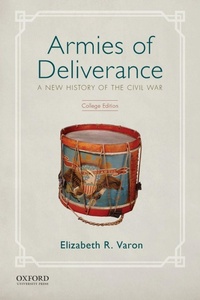
Armies of Deliverance
A New History of the Civil War
Published on 22. April 2020
Book
Paperback/Softback
560 pages
978-0-19-933539-8 (ISBN)
Description
In Armies of Deliverance, Elizabeth R. Varon argues that Northerners imagined the war as a crusade to deliver the Southern masses from slaveholder domination and to bring democracy, prosperity, and education to the region. And that Confederates, fighting to establish an independent slaveholding republic, were determined to preempt, discredit, and silence Yankee appeals to the Southern masses. Interweaving military and social history, Varon shows how the Union's politics of deliverance helped it to win the war but also ultimately sowed the seeds of postwar discord.
Reviews / Votes
Elizabeth R. Varon's highly original and sweeping new study is one of the few histories of the war that deserve to be ranked as essential reading. Varon never veers too far from her overarching theme, but she has done her readers an enormous service by resisting the temptation to use 'deliverance' as a cudgel to reframe every last aspect of the war. When she returns periodically to her main argument, she does so with admirable deftness backed by persuasive research. * The Wall Street Journal * Varon's main theme, offered in clear, straightforward prose, is that, contrary to what many have maintained, the Union tended to see the war as one of liberation * a mission of freeing a broad mass of poor deluded whites (and, for some, enslaved blacks) from the thrall of a tiny elite of oligarchical slaveholders. Varon shows that we can often learn more about what led to victory from politics than from battles.The New York Times * This is some of the finest battle writing around, and a sweeping analysis of both United States and Confederate strategy and tactics."-The Washington Post Armies of Deliverance argues that the Northern government's anti-slavery, Unionist political coalition created a message of liberation that was then taken up as its main reason for fighting the Civil War. Union armies embraced this liberation theme, claiming that a small coterie of wealthy planters deceived Southerners who did not own slaves into agreeing to secession. Summing Up: Recommended * CHOICE * This book is an enjoyable read, engaging and well researched ... This is a substantial contribution to our understanding of the motivations, strategies, tensions, controversies, and triumphs that had characterized their lives and experiences. This reviewer highly recommends this for anyone interested in the Civil War. * David Marshall, The NYMAS Review * This is not a traditional story of North versus South but rather a story of North and South versus the Confederacy. Running alongside this revisionist narrative in Armies of Deliverance is a more-or-less straightforward political and military history of the Civil War, done very well. Varon creates thrilling set pieces of all the familiar battles and controversies. * The Christian Science Monitor *More details
Edition
College Edition
Language
English
Place of publication
New York
United States
Target group
College/higher education
Dimensions
Height: 234 mm
Width: 156 mm
Thickness: 30 mm
Weight
840 gr
ISBN-13
978-0-19-933539-8 (9780199335398)
Copyright in bibliographic data and cover images is held by Nielsen Book Services Limited or by the publishers or by their respective licensors: all rights reserved.
Schweitzer Classification
Person
Elizabeth R. Varon is Langbourne M. Williams Professor of American History and a member of the Executive Council of the John L. Nau III Center for Civil War History at the University of Virginia.
Content
Maps Acknowledgments About the Author Timeline Introduction: "We Are Fighting for Them" Setting the Stage: The Secession Crisis in the North Building a Wartime Unionist Coalition The Confederate Response PART ONE: LOYALISM 1. March of Redemption: From Bull Run to Fort Donelson Green Together Advent of the "Contraband" Policy Missouri and Irregular Warfare in the Trans-Mississippi Theater Kentucky and "Armed Neutrality" in the Western Theater of War 2. Ripe for the Harvest: To Shiloh Deliverance Diplomacy Winter Doldrums Shiloh War Work Battle Hymns Compensated Emancipation 3. Sacred Soil: Virginia in the Summer of 1862 The Peninsula Campaign The Seesaw of Deliverance in the Valley Seven Days "A Conservative Course" Portents of Hard War Military Necessity and Black Labor The Second Confiscation Act Lincoln's Road to Emancipation Lincoln's August Gambit 4. The Perils of Occupation Carrot and Stick The "Woman Order" and Female Accountability Second Bull Run The War in the West "My Maryland" Antietam Combat Motivation PART TWO: EMANCIPATION 5. Countdown to Jubilee: Lincoln's Hundred Days The Righteous Decree "Liberating" Kentucky Vicksburg Is the Key Forlorn Hope at Fredericksburg Lincoln's Second Annual Message 6. The Emancipation Proclamation New Birth of Freedom Reactions to the Proclamation in the North "Contraband" Camps Confederate Reactions to the Proclamation 7. Fire in the Rear: To Chancellorsville Hell's Half Acre Return to Vicksburg Slough of Despond Chancellorsville Vallandham and Civil Liberties Union Leagues The Lieber Code and the Laws of War 8. Under a Scorching Sun: The Summer of 1863 Lee's Second Invasion Meade Takes Charge Gettysburg Begins July 2: Day Two July 3: Day Three
Vicksburg's Circle of Fire Port Hudson and Milliken's Bend Vicksburg Falls at Last
A Turning Point? The New York Draft Riot The Fighting 54th Fort Wagner PART THREE: AMNESTY 9. Rallying Point: Lincoln's Ten Percent Plan
Chickamauga and Chattanooga The Liberation of East Tennessee "Internal Reconstruction" in the Border States Military Reconstruction in the Confederate States The Gettysburg Address Lincoln's Ten Percent Plan Confederate Dissent and Southern Unionism 10. Is This Hell? Fort Pillow to Atlanta Fort Pillow Prisoners of War The Overland Campaign Atlanta Campaign, Phase One Challenges to Lincoln
The Wade-Davis Bill The Crater Siege and Stalemate 11. Campaign Season: The Election of 1864 The Fall of Atlanta The Burning
The National Union Party Confederate Reactions to the 1864 Campaign The Result Sherman's March Special Field Order No. 15 12. Malice Toward None: The Union Triumphant The Richmond-Petersburg Front The Richmond Underground Confederate Emancipation The Thirteenth Amendment Lincoln's Second Inaugural The Fall of Richmond The Surrender at Appomattox The Advent of Peace Confederate Interpretations of Lee's Surrender The Assassination The Final Surrenders Conclusion: "Deliver Us from Such a Moses": Andrew Johnson and the Legacy of the Civil War Johnson's Amnesty Plan Congressional Reconstruction and Beyond Notes Suggested Readings Table of Contents for Sources for Armies of Deliverance Glossary Index
Vicksburg's Circle of Fire Port Hudson and Milliken's Bend Vicksburg Falls at Last
A Turning Point? The New York Draft Riot The Fighting 54th Fort Wagner PART THREE: AMNESTY 9. Rallying Point: Lincoln's Ten Percent Plan
Chickamauga and Chattanooga The Liberation of East Tennessee "Internal Reconstruction" in the Border States Military Reconstruction in the Confederate States The Gettysburg Address Lincoln's Ten Percent Plan Confederate Dissent and Southern Unionism 10. Is This Hell? Fort Pillow to Atlanta Fort Pillow Prisoners of War The Overland Campaign Atlanta Campaign, Phase One Challenges to Lincoln
The Wade-Davis Bill The Crater Siege and Stalemate 11. Campaign Season: The Election of 1864 The Fall of Atlanta The Burning
The National Union Party Confederate Reactions to the 1864 Campaign The Result Sherman's March Special Field Order No. 15 12. Malice Toward None: The Union Triumphant The Richmond-Petersburg Front The Richmond Underground Confederate Emancipation The Thirteenth Amendment Lincoln's Second Inaugural The Fall of Richmond The Surrender at Appomattox The Advent of Peace Confederate Interpretations of Lee's Surrender The Assassination The Final Surrenders Conclusion: "Deliver Us from Such a Moses": Andrew Johnson and the Legacy of the Civil War Johnson's Amnesty Plan Congressional Reconstruction and Beyond Notes Suggested Readings Table of Contents for Sources for Armies of Deliverance Glossary Index