

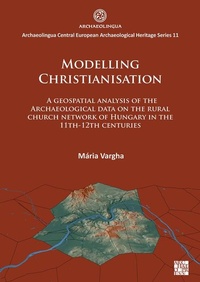
Modelling Christianisation: A Geospatial Analysis of the Archaeological Data on the Rural Church Network of Hungary in the 11th-12th Centuries
Published on 18. August 2022
Book
Paperback/Softback
160 pages
978-1-80327-279-5 (ISBN)
Description
Modelling Christianisation breaks new ground by studying the underutilised archaeological material for the Christianisation of the medieval Kingdom of Hungary. Around the first Millennium, in present-day Central Europe, the political and religious landscape changed dramatically. With the Christianisation of the pagan societies on its borders, the Ottonian/Holy Roman Empire significantly expanded according to the principles of the Imperium Christianum. This process - Christianisation - frequently tied to 'the making of Europe', has long generated broad interest in scholarship. Although recent attempts have shown archaeology's potential to shed light on the subject, interpretations of Christianisation and state formation are still primarily dominated by historical narratives.
Instead of concentrating on the upper echelons of society, the volume draws on the archaeological record relating to the Christianisation of the commoners - rural churches and field cemeteries - and more precisely (digital) archaeological archival data. This was subjected to geospatial analysis to uncover potential networks and clusters and to provide a different narrative about the course of Christianisation. Written evidence deals typically only with the topmost layer of institutions, such as the foundation of bishoprics, archbishoprics and some monasteries. Local churches, the smallest but most numerous elements of the church system, seldom appear in written sources; thus, theories about the development of the Church as an institution have often lacked direct evidence about the local church network. The approach taken here integrates this abundant data which provides information about the largest part of the population, otherwise absent in the written sources. It allows the reconstruction of a cultural landscape and lets us see the process of (institutionalised) Christianisation as a process of adaptation. Thus, it also offers a new interpretation for modelling Christianisation in newly emergent kingdoms.
Instead of concentrating on the upper echelons of society, the volume draws on the archaeological record relating to the Christianisation of the commoners - rural churches and field cemeteries - and more precisely (digital) archaeological archival data. This was subjected to geospatial analysis to uncover potential networks and clusters and to provide a different narrative about the course of Christianisation. Written evidence deals typically only with the topmost layer of institutions, such as the foundation of bishoprics, archbishoprics and some monasteries. Local churches, the smallest but most numerous elements of the church system, seldom appear in written sources; thus, theories about the development of the Church as an institution have often lacked direct evidence about the local church network. The approach taken here integrates this abundant data which provides information about the largest part of the population, otherwise absent in the written sources. It allows the reconstruction of a cultural landscape and lets us see the process of (institutionalised) Christianisation as a process of adaptation. Thus, it also offers a new interpretation for modelling Christianisation in newly emergent kingdoms.
More details
Series
Language
English
Place of publication
Oxford
United Kingdom
Publishing group
Archaeopress
Target group
Professional and scholarly
Illustrations
43 figures (colour throughout)
Dimensions
Height: 204 mm
Width: 289 mm
Thickness: 12 mm
Weight
596 gr
ISBN-13
978-1-80327-279-5 (9781803272795)
Copyright in bibliographic data and cover images is held by Nielsen Book Services Limited or by the publishers or by their respective licensors: all rights reserved.
Schweitzer Classification
Other editions
Additional editions
E-Book
08/2022
Archaeopress Archaeology
€19.49
Available for download
Content
I. INTRODUCTION ;
Problems to be Considered in the Discourse ;
Contextualisation of the Historical Events in the Christianisation of Hungary ;
Contextualisation of the Notion of Christianisation, and Issues with Baptism ;
II. RESEARCH TRENDS IN THE HISTORICAL AND ARCHAEOLOGICAL STUDIES ON THE CHRISTIANISATION OF HUNGARY ;
Archaeology in the Interpretation of the Christianisation of Medieval Hungary ;
Results and Problems in the Archaeological Research of Christianisation ;
Elements of Secular and Ecclesiastical Power - The Castle System and Church Organisation ;
III. SOURCES, METHODS AND APPROACHES ;
Spatial Approaches to Christianisation and State Formation ;
Written Evidence Connected to Christianisation ;
Types of Archaeological Data Considered and their Issues ;
IV. SPATIAL ANALYSIS OF THE ARCHAEOLOGICAL MATERIAL - MODELLING CHRISTIANISATION ;
Primary Questions and Methods ;
The Eleventh Century ;
Central Power and Christianisation in the Eleventh Century ;
Ecclesiastical Centres as Places of Central Power in the Eleventh Century ;
Rural Sites and Christianisation in the Eleventh Century ;
The Twelfth Century ;
V. HISTORICAL THEORIES AND THE ARCHAEOLOGICAL MATERIAL OF CHRISTIANISATION COMPARED TO THE DEVELOPMENT OF THE PAROCHIAL NETWORK ;
Precedents and Influences on the Ecclesiastical System ;
The Role of Royal Churches ;
VI. CONCLUSIONS ;
APPENDIX ;
Field Cemeteries (Fig. 33.) ;
Churches of the 11th Century (Fig. 34.) ;
Transitional Cemeteries of the 11th Century (Fig. 35) ;
Monasteries of the 11th Century (Fig. 36.) ;
Bishoprics of the 11th Century (Fig. 37.) ;
Castles of the 11th Century (Fig. 38.) ;
Churches of the 12th Century (Fig. 39.) ;
Transitional Cemeteries of the 12th Century (Fig. 40.) ;
Monasteries of the 12th Century457 (Fig. 41.) ;
Bishoprics in the 12th Century458 (Fig. 42.) ;
Castles in the 12th Century459 (Fig. 43.) ;
BIBLIOGRAPHY
Problems to be Considered in the Discourse ;
Contextualisation of the Historical Events in the Christianisation of Hungary ;
Contextualisation of the Notion of Christianisation, and Issues with Baptism ;
II. RESEARCH TRENDS IN THE HISTORICAL AND ARCHAEOLOGICAL STUDIES ON THE CHRISTIANISATION OF HUNGARY ;
Archaeology in the Interpretation of the Christianisation of Medieval Hungary ;
Results and Problems in the Archaeological Research of Christianisation ;
Elements of Secular and Ecclesiastical Power - The Castle System and Church Organisation ;
III. SOURCES, METHODS AND APPROACHES ;
Spatial Approaches to Christianisation and State Formation ;
Written Evidence Connected to Christianisation ;
Types of Archaeological Data Considered and their Issues ;
IV. SPATIAL ANALYSIS OF THE ARCHAEOLOGICAL MATERIAL - MODELLING CHRISTIANISATION ;
Primary Questions and Methods ;
The Eleventh Century ;
Central Power and Christianisation in the Eleventh Century ;
Ecclesiastical Centres as Places of Central Power in the Eleventh Century ;
Rural Sites and Christianisation in the Eleventh Century ;
The Twelfth Century ;
V. HISTORICAL THEORIES AND THE ARCHAEOLOGICAL MATERIAL OF CHRISTIANISATION COMPARED TO THE DEVELOPMENT OF THE PAROCHIAL NETWORK ;
Precedents and Influences on the Ecclesiastical System ;
The Role of Royal Churches ;
VI. CONCLUSIONS ;
APPENDIX ;
Field Cemeteries (Fig. 33.) ;
Churches of the 11th Century (Fig. 34.) ;
Transitional Cemeteries of the 11th Century (Fig. 35) ;
Monasteries of the 11th Century (Fig. 36.) ;
Bishoprics of the 11th Century (Fig. 37.) ;
Castles of the 11th Century (Fig. 38.) ;
Churches of the 12th Century (Fig. 39.) ;
Transitional Cemeteries of the 12th Century (Fig. 40.) ;
Monasteries of the 12th Century457 (Fig. 41.) ;
Bishoprics in the 12th Century458 (Fig. 42.) ;
Castles in the 12th Century459 (Fig. 43.) ;
BIBLIOGRAPHY