

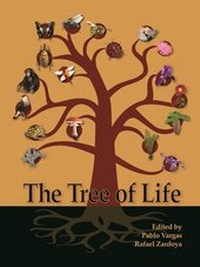
The Tree of Life
Published on 23. July 2014
Book
Hardback
740 pages
978-1-60535-229-9 (ISBN)
Description
The Tree of Life presents the ultimate phylogenetic tree; featuring 44 chapters each authored by experts in their field, it provides for the first time a comprehensive overview of evolutionary relationships for the main groups of living organism.
Reviews / Votes
I was impressed by this book when I first saw the edition in Spanish soon after publication in 2012. The English edition is not just a translation, however, but revised and extended to include the most recent results and information on some 'hyperdiverse' groups not included in the original Spanish edition. This is, as far as I am aware, the most comprehensive account of the diversity of life on Earth (viruses excluded) as we know it in a single volume. This book could almost be looked on as a 'coffee-table' work on the diversity of life, but it is actually something that should not only be a reference work on the shelves of biodiversity, conservation, and molecular scientists, molecular biologists, but a basic reference text for all students in the non-medical biological sciences. The modest price for such a substantial full-colour work should help this title get the wide circulation it merits. * David L. Hawksworth, Biodiversity and Conservation * One could scarcely wish for a more authoritative brief guide to the Earth's biota." * Kevin Padian, Reports of the National Center for Science Education * The book emphatically holds its own against the strong competition, and it thus belongs on the bookshelf of anyone who pretends to an interest in the phylogenetic view of biodiversity." * David A. Morrison, Systematic Biology * The Tree of Life is a wonderful achievement. It is authoritative, and for this we are grateful to the authors. But it is also didactic and elegantly produced, and for this we thank the editors and the publishers." * Francisco J. Ayala, University of California, Irvine * This exquisite summary of the phylogeny of major groups of life provides one of the most comprehensive and useful overviews of biodiversity available. Each chapter is written by a leading expert in the respective taxonomic group. This will be an important reference for anyone interested in life's diversity and evolutionary relationships." * David M. Hillis, University of Texas at Austin *More details
Persons
Pablo Vargas is Scientific Researcher of the Spanish National Research Council (CSIC) at the Royal Botanic Garden of Madrid, Spain. He earned his Ph.D. at the Royal Botanic Garden of Madrid and completed a four-year postdoctoral period in California (UC Berkeley), England (University of Reading) and Germany (University of Mainz). The postdoctoral period and current researcher position allowed specialization in plant phylogenetics. As a result, he has published over 100 scientific papers, including tree reconstructions of more than 20 angiosperm families in the last 15 years. In addition, four more books on public dissemination of plant sciences were also published in this period. Currently, three main projects address hypotheses on systematics of Mediterranean angiosperm families, phylogenomics of the olive tree and relatives, and ecological processes in plants and animals of the Galápagos Islands.
Rafael Zardoya is Research Professor of the Spanish National Research Council (CSIC) at the National Museum of Natural Sciences in Madrid, Spain. He earned a Ph.D. in Biochemistry and Molecular Biology from the University Complutense of Madrid and completed a post-doctoral fellowship at the State University of New York at Stony Brook (with Axel Meyer). His current research interests include: the study of higher phylogenetic relationships of several metazoan phyla, with particular emphasis on mollusks and vertebrates; the genetic basis of speciation in marine snails and their phylogeography; the molecular evolution of complete animal mitochondrial genomes and nuclear gene families; and the performance and limitations of phylogenetic methods in a genomic context.
Rafael Zardoya is Research Professor of the Spanish National Research Council (CSIC) at the National Museum of Natural Sciences in Madrid, Spain. He earned a Ph.D. in Biochemistry and Molecular Biology from the University Complutense of Madrid and completed a post-doctoral fellowship at the State University of New York at Stony Brook (with Axel Meyer). His current research interests include: the study of higher phylogenetic relationships of several metazoan phyla, with particular emphasis on mollusks and vertebrates; the genetic basis of speciation in marine snails and their phylogeography; the molecular evolution of complete animal mitochondrial genomes and nuclear gene families; and the performance and limitations of phylogenetic methods in a genomic context.
Content
Presentation.- Preface, Francisco Ayala.- Prologue, Michael J. Donoghue.- Introduction.- 1. Systematics: Charting the Tree of Life; Fredrik Ronquist.- 2. Great Domains: Archaea, Bacteria, and Eucarya; David Moreira.- 3. Archaea and Bacteria: The Prokaryotic Cell Organization; Ramón Rosselló and Josefa Antón.- 4. The Domain Eucarya: The Rise of Organisms with Nucleated Cells; Guifré Torruella, David Moreira, and Iñaki Ruiz-Trillo.- 5. The Former 'Protists': Amoebozoa, Rhizaria, Excavata, Haptophyta, Cryptophyta, Heterokonta, and Alveolata; Naiara Rodríguez-Ezpeleta, David Moreira, and Iñaki Ruiz-Trillo.- 6. Plants: Origin of Glaucophytes and Rhodophytes, before Land Plant Diversification; Adrian Reyes-Prieto.- 7. Chlorobionts: Ancestors of Land Plants; Francisco F. Pedroche.- 8. Embryophytes: Early Land Plants; Josep A. Rosselló.- 9. Tracheophytes: Land Conquest by Vascular Plants; Virginia Valcárcel and Pablo Vargas.- 10. Ferns: Vascular Plants that Reproduce by Spores; Santiago Pajarón and Emilia Pangua.- 11. Conifers: The Most Diverse Group of Seed Plants; David S. Gernandt and Alejandra Vázquez Lobo.- 12. Angiosperms: Plants with Flowers that Produce Fruits; Pablo Vargas.- 13. Monocotelydons: Great Diversity of an Ancient Angiosperm Lineage; Modesto Luceño and Santiago Martín-Bravo.- 14. Eudicotyledons: The Greatest Flower Diversity in Angiosperms; Susana Magallón and Pablo Vargas.- 15. Fungi: Hyperdiversity Closer to Animals than to Plants; Ana Crespo, Pradeep K. Divakar, and H. Thorsten Lumbsch.- 16. Metazoans: The Rise of Early Animals; Manuel Maldonado.- 17. Eumetazoans: The Rise of Tissue and Guts; André C. Morandini and Mónica Medina.- 18. Bilaterians: The Evolutionary Advantage of Being Two-sided; Marta Riutort, Jordi Paps, and Iñaki Rúiz-Trillo.- 19. Protostomes: The Greatest Animal Diversity; Gonzalo Giribet.- 20. Spiralians: Animals with Spiral Cleavage and Their Relatives; Gonzalo Giribet.- 21. Molluscs: Diversity of Shells and Soft Bodies; Cristina Grande and Rafa Zardoya.- 22. Annelids: Segmented Worms; M. Teresa Aguado, María Capa, Alejandro Oceguera-Figueroa, and Greg W. Rouse.- 23. Platyhelminthes: Are Flatworms Simple or Simplified?; Marta Riutort.- 24. Ecdysozoans: The Molting Animals; Noemí Guil and Gonzalo Giribet.- 25. Nematodes: The Ubiquitous Roundworms; Alfonso Navas.- 26. Panarthropods: Arthropods and Their Closest Relatives; Gustavo Hormiga and Jesús Ballesteros Chávez.- 27. Chelicerates: The Eight-Legged Colonization of Land; Miquel Arnedo and Carles Ribera.- 28. Mandibulates: Arthropods with Mandibles; Marcos Pérez-Losada.- 29. Hexapods: Insects and Closely Related Groups; Ignacio Ribera.- 30. Odonates: Dragonflies and Damselflies; Adolfo Cordero. 31. Orthopterans: Grasshoppers and Katydids, the First Singers on Earth; Mario García-París.- 32. Hemipterans: The Largest Hemimetabolous Insect Order; Dora Aguin Pombo and Thierry Bourgoin.- 33. Coleopterans: Beetles; Ignacio Ribera and Rolf G. Beutel.- 34. Hymenopterans: Ants, Bees, Wasps, and the Majority of Insect Parasitoids; Jose L. Nieves Aldrey and Mike Sharkey.- 35. Dipterans: Two-winged Flies; David Yeates and Dalton de Souza Amorim.- 36. Lepidopterans: Butterflies and Moths; Roger Vila.- 37. Deuterostomes: The Ancestry of Vertebrates; José Castresana.- 38. Echinoderms: Reinventing Radial Symmetry; Samuel Zamora, Patricio Domínguez and Pablo Vargas.- 39. Chordates: The Acquisition of an Axial Backbone; Stéphanie Bertrand and Héctor Escrivá.- 40. Actinopterygians: The Extraordinary Diversity of Ray-Finned Fishes; Ignacio Doadrio and Omar Domínguez-Domínguez.- 41. Sarcopterygians: The Rise of Land Vertebrates; Rafael Zardoya.- 42. Amphibians: Land Conquest by Vertebrates; Diego San Mauro.- 43. Mammals: Prolific Speciation after Dinosaurs' Demise; Pablo Vargas.- 44. Sauropsids: Reptilian Relationships, including Aves; Salvador Carranza.- 45. Aves: Birds, the Living Descendants of Flying Dinosaurs; Per G. P. Ericson.- 46. Speciation; Antonio Fontdevila.- 47. Biogeography; Isabel Sanmartín.- 48. Evolution on Islands; Pablo Vargas.- 49. Evolutionary Ecology; Patrick S. Fitze.- 50. Evolution of Behavior; Patrick S. Fitze.- 51. Phylogenies and the Evolution of Development; Ehab Abouheif.- 52. Symbiosis; Andrés Moya and Amparo Latorre.- 53. Phylogenetic Techniques and Markers; Pilar Catalán and Fernando González-Candelas.- 54. Reconstruction of Phylogenetic Trees; David Posada.- 55. Analysis of Genetic Variation and Intraspecific Phylogenies; Julio Rozas and Alejandro Sánchez-Gracia.