

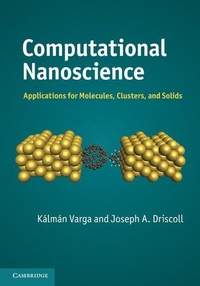
Computational Nanoscience
Applications for Molecules, Clusters, and Solids
Published on 14. April 2011
Book
Hardback
444 pages
978-1-107-00170-1 (ISBN)
Description
Computer simulation is an indispensable research tool in modeling, understanding and predicting nanoscale phenomena. However, the advanced computer codes used by researchers are too complicated for graduate students wanting to understand computer simulations of physical systems. This book gives students the tools to develop their own codes. Describing advanced algorithms, the book is ideal for students in computational physics, quantum mechanics, atomic and molecular physics, and condensed matter theory. It contains a wide variety of practical examples of varying complexity to help readers at all levels of experience. An algorithm library in Fortran 90, available online at www.cambridge.org/9781107001701, implements the advanced computational approaches described in the text to solve physical problems.
More details
Language
English
Place of publication
Cambridge
United Kingdom
Target group
Professional and scholarly
Product notice
Unsewn / adhesive bound
Paper over boards
Illustrations
33 Tables, black and white; 52 Halftones, unspecified; 123 Line drawings, unspecified
Dimensions
Height: 254 mm
Width: 182 mm
Thickness: 27 mm
Weight
1021 gr
ISBN-13
978-1-107-00170-1 (9781107001701)
Copyright in bibliographic data and cover images is held by Nielsen Book Services Limited or by the publishers or by their respective licensors: all rights reserved.
Schweitzer Classification
Other editions
Additional editions
Kalman Varga | Joseph A. Driscoll
Computational Nanoscience
Applications for Molecules, Clusters, and Solids
E-Book
05/2011
1st Edition
Cambridge University Press
€82.99
Available for download
Persons
Kalman Varga is an Assistant Professor in the Department of Physics and Astronomy, Vanderbilt University. His main research interest is computational nanoscience, focusing on developing novel computational methods for electronic structure calculations. Joseph Driscoll has a PhD in Electrical Engineering from Vanderbilt University, where his research was in the area of intelligent robotics. He has worked in industry as a software developer in the areas of Internet content delivery and bioinformatics. He was an Assistant Professor of Computer Science at Middle Tennessee State University. Dr Driscoll also has a PhD in Physics, where his interests include theoretical and computational physics of nanoscale systems. In 2011 he moved to Bradley University, where he was first an Assistant Professor of Engineering Physics, and then became an Assistant Professor of Electrical and Computer Engineering. Dr Driscoll's primary research areas are intelligent robotics, high-performance computing, and MEMS/NEMS (micro/nano electromechanical system) device simulation. He works with neural networks, genetic algorithms, computer vision, and other forms of artificial intelligence. Many types of robots are used in his experiments, including flying, walking, and wheeled robots.
Content
Preface; Part I. 1D Problems: 1. Variational solution of the Schroedinger equation; 2. Solution of bound state problems using a grid; 3. Solution of the Schroedinger equation for scattering states; 4. Periodic potentials: band structure in 1D; 5. Solution of time-dependent problems in quantum mechanics; 6. Solution of Poisson's equation; Part II. 2D and 3D Systems: 7. 3D real space approach: from quantum dots to Bose-Einstein condensates; 8. Variational calculations in 2D: quantum dots; 9. Variational calculations in 3D: atoms and molecules; 10. Monte Carlo calculations; 11. Molecular dynamics simulations; 12. Tight binding approach to electronic structure calculations; 13. Plane wave density functional calculations; 14. Density functional calculations with atomic orbitals; 15. Real-space density functional calculations; 16. Time-dependent density functional calculations; 17. Scattering and transport in nanostructures; 18. Numerical linear algebra; Appendix: code descriptions; References; Index.