

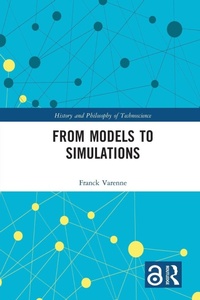
From Models to Simulations
1st Edition
Published on 30. June 2020
Book
Paperback/Softback
224 pages
978-0-367-58662-1 (ISBN)
Description
This book analyses the impact computerization has had on contemporary science and explains the origins, technical nature and epistemological consequences of the current decisive interplay between technology and science: an intertwining of formalism, computation, data acquisition, data and visualization and how these factors have led to the spread of simulation models since the 1950s.
Using historical, comparative and interpretative case studies from a range of disciplines, with a particular emphasis on the case of plant studies, the author shows how and why computers, data treatment devices and programming languages have occasioned a gradual but irresistible and massive shift from mathematical models to computer simulations.
Using historical, comparative and interpretative case studies from a range of disciplines, with a particular emphasis on the case of plant studies, the author shows how and why computers, data treatment devices and programming languages have occasioned a gradual but irresistible and massive shift from mathematical models to computer simulations.
More details
Series
Language
English
Place of publication
London
United Kingdom
Publishing group
Taylor & Francis Ltd
Target group
College/higher education
Postgraduate
Dimensions
Height: 234 mm
Width: 156 mm
Weight
440 gr
ISBN-13
978-0-367-58662-1 (9780367586621)
Copyright in bibliographic data and cover images is held by Nielsen Book Services Limited or by the publishers or by their respective licensors: all rights reserved.
Schweitzer Classification
Other editions
Additional editions
Franck Varenne
From Models to Simulations
Book
09/2018
1st Edition
Routledge
€207.60
Shipment within 10-20 days
Franck Varenne
From Models to Simulations
E-Book
09/2018
1st Edition
Routledge
€0.00
Available for download
Persons
Franck Varenne is Associate Professor of philosophy of science at the University of Rouen (Normandy - France) and associate researcher at IHPST (CNRS - Paris). His research focuses on the history and epistemology of formal models and computer simulations in contemporary science, especially in biology and geography. He has published around fifty-five articles and chapters. He has also published eight books and co-edited three collective books.
Content
Contents ; List of figures;Acknowledgments ;List of French abbreviations ; Introduction ; Chapter 1 - Geometric and botanic simulation ; 1 The probabilistic simulation of branching biological shapes: Cohen (1966) ;2 The epistemic functions of modular programming, simulation and visualization;3 The first geometric and realistic simulation of trees (Honda-Fisher, 1971-1977) ;4 The limitations of morphometry and of thermodynamics of trees ;5 The first geometric simulation of an actual tree: Terminalia ;6 A recap of geometric simulation ; Chapter 2: The logical model and algorithmic simulation of algae ; 1 A botanist won over by logical positivism: the theory of lifecycles by A. Lindenmayer (1963-1965) ;2 Unusable set of axioms and used set of axioms ;3 From logical theory to automata theory (1966-1967) ;4 The developmental model and the rules of rewriting (1968) ;5 The dispute with Brian Carey Goodwin regarding natural formalisms ;6 Recap: the computer as automata model and deductive machine; Chapter 3: The limitations of biometric models and the transition to simulation in agronomy; 1 The institutional and technical context of the IFCC (1966-1971);2 Transferring a little bit of econometrics to biometrics: a problem of optimization (1974);3 The first application of plant simulation in agronomics (1974-1975) ;4 Fragmented modelling and geometric simulation: de Reffye (1975-1981);5 Simulation, imitation and the sub-symbolic use of formalisms; Chapter 4: A random and universal architectural simulation ; 1 Making headway in botany: the notion of architectural model (1966-1978) ;2 The search for botanical realism (1978-1979) ;3 Criticisms of theoretical models ;4 Criticisms of biometric models ;5 A mixed reception (1979-1981); Chapter 5: Convergence between integrative simulation and computer graphics ; 1 The relaunch of research into architectural simulation (1985-1991) ;2 Jaeger's thesis: the prefixed model and synthesis of botanical images (1987) ;3 Blaise's thesis: the simulation of buds parallelism (1991) ;4 How can an integrative simulation be validated?; Chapter 6: Convergence between universal simulation and forestry (1990-1998) ; 1 An epistemological dispute between modellers: INRA and CIRAD ;2 Conceptual and institutional convergence: the CIRAD/INRA partner laboratory (1995);3 The empirical value of simulation ;4 Supra-simulations ; Chapter 7: The remathematization of simulations (from 1998 onwards) ; 1 The first mixed structure-function model: water efficiency (1997-1999) ;2 The parallel evolution of algorithmic simulation: 1984-1994 ;3 Simulating the individual plant in order to observe crop functioning (1997-2000) ;4 The association between AMAP and INRIA: sub-structures and factorization (1998-2006);5 Recap: pluriformalized simulation and convergence between disciplines; Chapter 8: Twenty-one functions of models and three types of simulations - Classifications and applications ; 1 General function, main functions and specific functions of models ;2 General characterization and classification of computer simulations ;3 System simulation, model simulation, system-simulation model and model-simulation model ;4 Applications to different plant models and plant simulations; Conclusion ; Glossary ;Selected Bibliography ;Index of names ;Index of subjects