

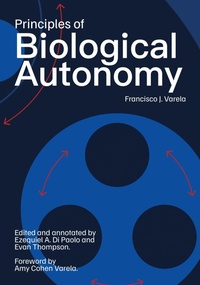
Principles of Biological Autonomy, a new annotated edition
Will be published approx. on 13. May 2025
Book
Paperback/Softback
400 pages
978-0-262-55140-3 (ISBN)
Description
A new, updated edition of the 1979 classic from one of the foremost authors in cognitive science and theoretical biology, with the original text as well as more than 200 citations to current scientific developments.
Francisco Varela’s Principles of Biological Autonomy was a groundbreaking text when it was first published in 1979, putting forth a novel theory of how living systems produce and maintain themselves. This new edition, edited and annotated by cognitive scientists Ezequiel Di Paolo and Evan Thompson—revised and complemented with introductory essays for each part of the book—contains a wealth of ideas relevant to current projects in theoretical biology, cognitive science, systems theory, philosophy of mind, and philosophy of biology. Over 220 margin annotations supplement the reading of the text, linking to subsequent research and broader contemporary debates.
This foundational book introduces the key concept of autonomy derived as an elaboration of the idea of autopoiesis (the self-production and self-distinction) of living organisms. Varela covers topics in systems theory, neuroscience, theories of perception, and immune networks and offers a participatory epistemology that goes on to be further developed in later enactive literature. These ideas are compelling not only for historical reasons but also because they still illuminate current efforts in developing the enactive approach toward wider and more challenging goals (including language, human cognition, ethics, and environmentalism).
Francisco Varela’s Principles of Biological Autonomy was a groundbreaking text when it was first published in 1979, putting forth a novel theory of how living systems produce and maintain themselves. This new edition, edited and annotated by cognitive scientists Ezequiel Di Paolo and Evan Thompson—revised and complemented with introductory essays for each part of the book—contains a wealth of ideas relevant to current projects in theoretical biology, cognitive science, systems theory, philosophy of mind, and philosophy of biology. Over 220 margin annotations supplement the reading of the text, linking to subsequent research and broader contemporary debates.
This foundational book introduces the key concept of autonomy derived as an elaboration of the idea of autopoiesis (the self-production and self-distinction) of living organisms. Varela covers topics in systems theory, neuroscience, theories of perception, and immune networks and offers a participatory epistemology that goes on to be further developed in later enactive literature. These ideas are compelling not only for historical reasons but also because they still illuminate current efforts in developing the enactive approach toward wider and more challenging goals (including language, human cognition, ethics, and environmentalism).
More details
Language
English
Place of publication
Cambridge (Massachusetts)
United States
Publishing group
MIT Press Ltd
Illustrations
12 BLACK AND WHITE ILLUS.
Dimensions
Height: 250 mm
Width: 176 mm
Thickness: 30 mm
Weight
624 gr
ISBN-13
978-0-262-55140-3 (9780262551403)
Copyright in bibliographic data and cover images is held by Nielsen Book Services Limited or by the publishers or by their respective licensors: all rights reserved.
Schweitzer Classification
Other editions
Additional editions
Francisco J. Varela | Ezequiel A. Di Paolo | Evan Thompson
Principles of Biological Autonomy, a new annotated edition
E-Book
05/2025
MIT Press
€73.49
Available for download
Persons
Francisco J. Varela; edited by Ezequiel A. Di Paolo and Evan Thompson; foreword by Amy Cohen Varela
Content
Foreword
Introduction to the New Edition. A Message from the Margins
Preface. Information and Control Revisited
Part I. Autonomy of the Living and Organizational Closure
1. Autonomy and Biological Thinking
2. Autopoiesis and the Organization of Living Systems
3. A Tessellation Example of Autopoiesis
4. Embodiments of Autopoiesis
5. The Individual in Development and Evolution
6. On the Consequences of Autopoiesis
7. The Idea of Organizational Closure
Part II. Descriptions, Distinctions, and Circularities
8. Operational Explanations and the Dispensability of Information
9. Symbolic Explanations
10. The Framework of Complementarities
11. Calculating Distinctions
12. Closure and Dynamics of Form
13. Eigenbehavior
Part III. Cognitive Processes
14. The Immune Network: Self and Nonsense in the Molecular Domain
15. The Nervous System as a Closed Network
16. Epistemology Naturalized
Appendices
Appendix A Algorithm for a Tesselation Example of Autopoiesis
Appendix B Some Remarks on Reflexive Domains and Logic
Bibliography
Introduction to the New Edition. A Message from the Margins
Preface. Information and Control Revisited
Part I. Autonomy of the Living and Organizational Closure
1. Autonomy and Biological Thinking
2. Autopoiesis and the Organization of Living Systems
3. A Tessellation Example of Autopoiesis
4. Embodiments of Autopoiesis
5. The Individual in Development and Evolution
6. On the Consequences of Autopoiesis
7. The Idea of Organizational Closure
Part II. Descriptions, Distinctions, and Circularities
8. Operational Explanations and the Dispensability of Information
9. Symbolic Explanations
10. The Framework of Complementarities
11. Calculating Distinctions
12. Closure and Dynamics of Form
13. Eigenbehavior
Part III. Cognitive Processes
14. The Immune Network: Self and Nonsense in the Molecular Domain
15. The Nervous System as a Closed Network
16. Epistemology Naturalized
Appendices
Appendix A Algorithm for a Tesselation Example of Autopoiesis
Appendix B Some Remarks on Reflexive Domains and Logic
Bibliography