

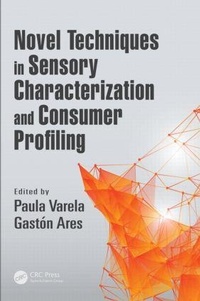
Novel Techniques in Sensory Characterization and Consumer Profiling
1st Edition
Published on 23. April 2014
Book
Hardback
416 pages
978-1-4665-6629-3 (ISBN)
Description
Sensory characterization is one of the most powerful, sophisticated, and extensively applied tools in sensory science. Descriptive analysis with trained assessors has been traditionally used for sensory characterization. Due to the cost of time and money required for its application, several novel methodologies, which do not require training, have been recently developed and are gaining popularity as quick and reliable options for gathering sensory information. These methodologies enable the study of consumers' perceptions of the sensory characteristics of products. However, information on these techniques is scattered in scientific journal articles, which hinders their application and creates a need for a book to assemble the details of the latest advances.
Novel Techniques in Sensory Characterization and Consumer Profiling provides a comprehensive overview of classical and novel methods for sensory characterization of food and nonfood products. The book presents the history behind descriptive analysis, describes the most common novel methodologies and detailed information for their implementation, and discusses examples of applications and case studies. It also includes an introduction to exploratory multivariate analysis, addressing the theory and application of some of the most useful multivariate statistical tools applied in the analysis of consumer profiling data sets.
Most of the data analysis is implemented in the statistical free software R, making the book accessible to readers unfamiliar with complex statistical software.
Chapters examine a range of techniques including the ideal profile method, just-about-right scales in consumer research, free choice profiling, flash profiling, and repertory grid methods. They cover emerging profiling methods, such as sorting, and projective mapping or Napping (R). Other techniques less frequently used for sensory profiling are also considered: the application of open-ended questions for sensory characterization, polarized sensory positioning, and the consumer-friendly check-all-that-apply questions. In addition, dynamic sensory characterization methods, useful for studying temporal aspects of in-mouth sensory perception, are described. The final chapter provides a critical comparison of the methodologies discussed, their advantages and disadvantages, and general recommendations for their application.
Novel Techniques in Sensory Characterization and Consumer Profiling provides a comprehensive overview of classical and novel methods for sensory characterization of food and nonfood products. The book presents the history behind descriptive analysis, describes the most common novel methodologies and detailed information for their implementation, and discusses examples of applications and case studies. It also includes an introduction to exploratory multivariate analysis, addressing the theory and application of some of the most useful multivariate statistical tools applied in the analysis of consumer profiling data sets.
Most of the data analysis is implemented in the statistical free software R, making the book accessible to readers unfamiliar with complex statistical software.
Chapters examine a range of techniques including the ideal profile method, just-about-right scales in consumer research, free choice profiling, flash profiling, and repertory grid methods. They cover emerging profiling methods, such as sorting, and projective mapping or Napping (R). Other techniques less frequently used for sensory profiling are also considered: the application of open-ended questions for sensory characterization, polarized sensory positioning, and the consumer-friendly check-all-that-apply questions. In addition, dynamic sensory characterization methods, useful for studying temporal aspects of in-mouth sensory perception, are described. The final chapter provides a critical comparison of the methodologies discussed, their advantages and disadvantages, and general recommendations for their application.
More details
Language
English
Place of publication
Bosa Roca
United States
Publishing group
Taylor & Francis Inc
Target group
Professional and scholarly
Professional Reference
Product notice
sewn/stitched
Cloth over boards
Illustrations
109 s/w Abbildungen, 56 s/w Tabellen
56 Tables, black and white; 109 Illustrations, black and white
Dimensions
Height: 238 mm
Width: 159 mm
Thickness: 30 mm
Weight
716 gr
ISBN-13
978-1-4665-6629-3 (9781466566293)
Copyright in bibliographic data and cover images is held by Nielsen Book Services Limited or by the publishers or by their respective licensors: all rights reserved.
Schweitzer Classification
Other editions
Additional editions
Paula Varela | Gaston Ares
Novel Techniques in Sensory Characterization and Consumer Profiling
Book
10/2016
CRC Press
€148.40
Shipment within 10-20 days
Paula Varela | Gaston Ares
Novel Techniques in Sensory Characterization and Consumer Profiling
E-Book
04/2014
CRC Press
€139.99
Available for download
Paula Varela | Gaston Ares
Novel Techniques in Sensory Characterization and Consumer Profiling
E-Book
04/2014
1st Edition
CRC Press
€139.99
Available for download
Persons
Paula Varela is a food engineer from Universidad de la Republica, Uruguay. She earned her PhD in food science and technology from Universidad Politecnica de Valencia, Spain. She has wide experience both in academic and industrial research in sensory and consumer science, having worked in collaboration with various research groups from Europe, Asia, and South America. She recently joined Nofima - The food Research Institute (Norway) as senior scientist. Dr. Varela has published more than 60 SCI papers and various book chapters, and has made several contributions to international symposiums. Dr. Varela collaborates as reviewer in various journals in this field and is a member of the editorial board of Food Research International. In recent years, her research has focused on the exploration of new methodologies to further the understanding of consumer perception, in particular sensory descriptive techniques with the use of consumers and the influence of non-sensory parameters in consumer food choice.
Gaston Ares is a food engineer. He received his PhD in chemistry, with a focus on sensory and consumer science, from Universidad de la Republica, Uruguay. He works as professor and researcher in the Food Science and Technology Department of the Chemistry Faculty at the same university. He has authored more than 80 articles in international refereed journals and numerous presentations in scientific meetings. He was awarded the 2007 Rose Marie Pangborn Sensory Science Scholarship, granted to PhD students in sensory science worldwide. In 2011, he won the Food Quality and Preference Award for a young researcher for his contributions to sensory and consumer science. He is a member of the editorial boards of both the Journal of Sensory Studies and Food Quality and Preference, as well as an associate editor of Food Research International.
Gaston Ares is a food engineer. He received his PhD in chemistry, with a focus on sensory and consumer science, from Universidad de la Republica, Uruguay. He works as professor and researcher in the Food Science and Technology Department of the Chemistry Faculty at the same university. He has authored more than 80 articles in international refereed journals and numerous presentations in scientific meetings. He was awarded the 2007 Rose Marie Pangborn Sensory Science Scholarship, granted to PhD students in sensory science worldwide. In 2011, he won the Food Quality and Preference Award for a young researcher for his contributions to sensory and consumer science. He is a member of the editorial boards of both the Journal of Sensory Studies and Food Quality and Preference, as well as an associate editor of Food Research International.
Content
Introduction. Classical Descriptive Analysis. Introduction to Multivariate Statistical Techniques for Sensory Characterization. Ideal Profiling. Use of Just-About-Right Scales in Consumer Research. Free-Choice Profile Combined with Repertory Grid Method. Flash Profile. Free Sorting Task. Projective Mapping and Napping. Polarized Sensory Positioning Methodologies. Check-All-That-Apply Questions. Open-Ended Questions. Dynamic Sensory Descriptive Methodologies: Time-Intensity and Temporal Dominance of Sensations. Comparison of Novel Methodologies for Sensory Characterization. Index.