

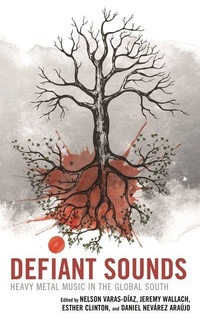
Defiant Sounds
Heavy Metal Music in the Global South
Will be published approx. on 7. January 2027
Book
Paperback/Softback
432 pages
978-1-7936-5187-7 (ISBN)
Description
This book creates necessary dialogue within the world of heavy metal by bringing together multiple regions in the Global South.
Defiant Sounds: Heavy Metal Music in the Global South brings together authors working from and/or with the Global South to reflect on the roles of metal music throughout their respective regions. The essays position metal music at the epicenter of region-specific experiences of oppression marked by colonialism, ethnic extermination, political persecution, and war. More importantly, the authors stress how metal music is used throughout the Global South to face these oppressive experiences, foster hope, and promote an agenda that seeks to build a better world.
Defiant Sounds: Heavy Metal Music in the Global South brings together authors working from and/or with the Global South to reflect on the roles of metal music throughout their respective regions. The essays position metal music at the epicenter of region-specific experiences of oppression marked by colonialism, ethnic extermination, political persecution, and war. More importantly, the authors stress how metal music is used throughout the Global South to face these oppressive experiences, foster hope, and promote an agenda that seeks to build a better world.
Reviews / Votes
Defiant Sounds: Heavy Metal Music in the Global South is an important book, both for metal scholarship (which is a large and expanding global community) and equally for understanding Latin America, Africa, the Middle East, Asia, Oceania, and Indigenous Nations in the current world. Metal was ahead of the curve in grasping the political and cultural changes in the region. The editors are esteemed scholars of metal and globalization. -- Deena Weinstein * DePaul University, USA * This is an important book. It is not just about metal music; it gives voice to those often ignored by a Western myopic parochialism. It opens a greater transformative perspective on cultures and politics receiving the attention that is much deserved from a rising Global South. Much praise is due to this collection of essays for continuing to expand decolonial dialogue in transdisciplinary research. -- Niall W.R. Scott * Reader in Philosophy and Popular Culture, UCLan * Defiant Sounds constitutes a paradigmatic shift in metal music studies and is a vital model for future studies of globalized cultures. It is a must-read for activists and students of heavy metal, and for researchers in popular culture studies, anthropology, sociology, and ethnomusicology. -- Paul Greene * Pennsylvania State University, USA *More details
Series
Language
English
Place of publication
United States
Publishing group
Bloomsbury Publishing Plc
Target group
Professional and scholarly
Product notice
Paperback (trade)
Unsewn / adhesive bound
Illustrations
21 b/w photos
Dimensions
Height: 229 mm
Width: 152 mm
Thickness: 25 mm
Weight
454 gr
ISBN-13
978-1-7936-5187-7 (9781793651877)
Copyright in bibliographic data and cover images is held by Nielsen Book Services Limited or by the publishers or by their respective licensors: all rights reserved.
Schweitzer Classification
Persons
Nelson Varas-Diaz is Professor of Social-Community Psychology at Florida International University, USA.
Jeremy Wallach is Professor of popular culture in the School of Cultural and Critical Studies at Bowling Green State University, USA.
Esther Clinton taught in the department of popular culture at Bowling Green State University for 16 years on topics ranging from traditional narrative to popular novels to advanced cultural theory. Esther's tragic, untimely death at age 50 cut short her exploration of these topics, but her many students carry on her legacy.
Daniel Nevarez Araujo is Assistant Professor in the Department of English at the University of Puerto Rico - Rio Piedras.
Jeremy Wallach is Professor of popular culture in the School of Cultural and Critical Studies at Bowling Green State University, USA.
Esther Clinton taught in the department of popular culture at Bowling Green State University for 16 years on topics ranging from traditional narrative to popular novels to advanced cultural theory. Esther's tragic, untimely death at age 50 cut short her exploration of these topics, but her many students carry on her legacy.
Daniel Nevarez Araujo is Assistant Professor in the Department of English at the University of Puerto Rico - Rio Piedras.
Content
Introduction
Section I: Conceptualizing the Distorted South
1. Metal Music in the Distorted South (Nelson Varas-Diaz, Daniel Nevarez Araujo, Jeremy Wallach, and Esther Clinton)
Section II: Hope
2. An Exegesis of Excess (Susana Gonzalez-Martinez)
3. Reclaiming Aotearoa (Didier Goossens)
4. "A Whole New Type of Isolation" (Anthony J. Thibodeau and Sage Bond)
Section III: Social Change
5. "We Play Heavy Metal Because Our Lives Are Heavy Metal" (Mark LeVine)
6. Youth Activism and Decolonial Metal (Paula Rowe)
7. Coloniality and Gender in the Argentinian Metal Scene (Manuela Belen Calvo)
Section IV: Dialogues
8. An Interview on Contar/Cantar Memorias da Resistencia (Susane Hecate (Miasthenia) and Daniel Nevarez Araujo)
9. Misusing Things in Metal Music (Manuel Gagneux (Zeal & Ardor) and Daniel Nevarez Araujo)
10. The Alternative Side of the Frame (Kobi Farhi (Orphaned Land) and Nelson Varas-Diaz)
11. A Dialogue on Metal Festivals and Social Justice (Tshomarelo "Vulture" Mosaka (Overthrust) and Edward Banchs)
Section V: Diaspora
12. The Ultra-Violence (Kevin Fellezs)
13. "Somewhere They Belong" (Azmyl Yusof and Adil Johan)
Section VI: Transgression
14. Ancient, Evil, and African (Edward Banchs)
15. The Influence of Different Satanic Panics on the Transgressive Practices of Metal Music in Egypt, Iran, and Syria (Pasqualina Eckerstro?m)
Section VII: Resistance and Community
16. Decolonizing the Mind's Eye (Nelson Varas-Diaz and Daniel Nevarez Araujo)
17. Nongkrong, Value of Community, and Everyday Resistance in the Indonesian Metal Scene (Oki Rahadianto Sutopo and Agustinus Aryo Lukisworo)
18: Satan Wasn't There (Amine Hamma and Brian Trott)
Epilogue
Index
About the Editors and Contributors
Section I: Conceptualizing the Distorted South
1. Metal Music in the Distorted South (Nelson Varas-Diaz, Daniel Nevarez Araujo, Jeremy Wallach, and Esther Clinton)
Section II: Hope
2. An Exegesis of Excess (Susana Gonzalez-Martinez)
3. Reclaiming Aotearoa (Didier Goossens)
4. "A Whole New Type of Isolation" (Anthony J. Thibodeau and Sage Bond)
Section III: Social Change
5. "We Play Heavy Metal Because Our Lives Are Heavy Metal" (Mark LeVine)
6. Youth Activism and Decolonial Metal (Paula Rowe)
7. Coloniality and Gender in the Argentinian Metal Scene (Manuela Belen Calvo)
Section IV: Dialogues
8. An Interview on Contar/Cantar Memorias da Resistencia (Susane Hecate (Miasthenia) and Daniel Nevarez Araujo)
9. Misusing Things in Metal Music (Manuel Gagneux (Zeal & Ardor) and Daniel Nevarez Araujo)
10. The Alternative Side of the Frame (Kobi Farhi (Orphaned Land) and Nelson Varas-Diaz)
11. A Dialogue on Metal Festivals and Social Justice (Tshomarelo "Vulture" Mosaka (Overthrust) and Edward Banchs)
Section V: Diaspora
12. The Ultra-Violence (Kevin Fellezs)
13. "Somewhere They Belong" (Azmyl Yusof and Adil Johan)
Section VI: Transgression
14. Ancient, Evil, and African (Edward Banchs)
15. The Influence of Different Satanic Panics on the Transgressive Practices of Metal Music in Egypt, Iran, and Syria (Pasqualina Eckerstro?m)
Section VII: Resistance and Community
16. Decolonizing the Mind's Eye (Nelson Varas-Diaz and Daniel Nevarez Araujo)
17. Nongkrong, Value of Community, and Everyday Resistance in the Indonesian Metal Scene (Oki Rahadianto Sutopo and Agustinus Aryo Lukisworo)
18: Satan Wasn't There (Amine Hamma and Brian Trott)
Epilogue
Index
About the Editors and Contributors