

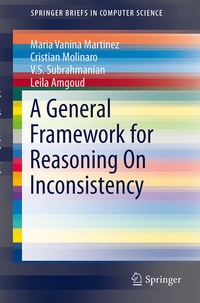
A General Framework for Reasoning On Inconsistency
1st Edition
Published on 20. March 2013
Book
Paperback/Softback
VII, 45 pages
978-1-4614-6749-6 (ISBN)
Description
This SpringerBrief proposes a general framework for reasoning about inconsistency in a wide variety of logics, including inconsistency resolution methods that have not yet been studied. The proposed framework allows users to specify preferences on how to resolve inconsistency when there are multiple ways to do so. This empowers users to resolve inconsistency in data leveraging both their detailed knowledge of the data as well as their application needs. The brief shows that the framework is well-suited to handle inconsistency in several logics, and provides algorithms to compute preferred options. Finally, the brief shows that the framework not only captures several existing works, but also supports reasoning about inconsistency in several logics for which no such methods exist today.
Reviews / Votes
From the reviews:
"The aim of this book, consisting of six chapters, is to develop a unified framework for reasoning on inconsistency which allows end-users to apply their domain knowledge and subsequently tailor it to their needs. In particular, the framework shall be applicable to any Tarskian logic the end-user employs." (Jürgen Landes, zbMATH, Vol. 1276, 2014)More details
Series
Language
English
Place of publication
New York
United States
Target group
Professional and scholarly
Research
Illustrations
VII, 45 p.
Dimensions
Height: 235 mm
Width: 155 mm
Thickness: 4 mm
Weight
102 gr
ISBN-13
978-1-4614-6749-6 (9781461467496)
DOI
10.1007/978-1-4614-6750-2
Schweitzer Classification
Other editions
Additional editions
Maria Vanina Martinez | Cristian Molinaro | V.S. Subrahmanian
A General Framework for Reasoning On Inconsistency
E-Book
03/2013
1st Edition
Springer
€42.79
Available for download
Content
Introduction and Preliminary Concepts.- A General Framework for Handling Inconsistency.- Algorithms.- Handling Inconsistency in Monotonic Logics.- Link with Existing Approaches.- Conclusions.