

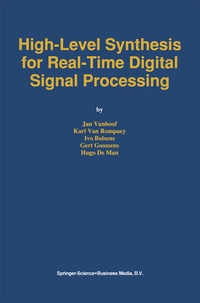
High-Level Synthesis for Real-Time Digital Signal Processing
The CATHEDRAL-II Silicon Compiler
Published on 31. January 1993
Book
Hardback
VIII, 302 pages
978-0-7923-9313-9 (ISBN)
Description
High-Level Synthesis for Real-Time Digital Signal Processing
is a comprehensive reference work for researchers and practicing ASIC design engineers. It focuses on methods for compiling complex, low to medium throughput DSP system, and on the implementation of these methods in the CATHEDRAL-II compiler.
The emergence of independent silicon foundries, the reduced price of silicon real estate and the shortened processing turn-around time bring silicon technology within reach of system houses. Even for low volumes, digital systems on application-specific integrated circuits (ASICs) are becoming an economically meaningful alternative for traditional boards with analogue and digital commodity chips.
ASICs cover the application region where inefficiencies inherent to general-purpose components cannot be tolerated. However, full-custom handcrafted ASIC design is often not affordable in this competitive market. Long design times, a high development cost for alow production volume, the lack of silicon designers and the lack of suited design facilities are inherent difficulties to manual full-custom chip design.
To overcome these drawbacks, complex systems have to be integrated in ASICs much faster and without losing too much efficiency in silicon area and operation speed compared to handcrafted chips. The gap between system design and silicon design can only be bridged by new design (CAD). The idea of a silicon compiler , translating a behavioural system specification directly into silicon, was born from the awareness that the ability to fabricate chips is indeed outrunning the ability to design them. At this moment, CAD is one order of magnitude behind schedule. Conceptual CAD is the keyword to mastering the design complexity in ASIC design and the topic of this book.
The emergence of independent silicon foundries, the reduced price of silicon real estate and the shortened processing turn-around time bring silicon technology within reach of system houses. Even for low volumes, digital systems on application-specific integrated circuits (ASICs) are becoming an economically meaningful alternative for traditional boards with analogue and digital commodity chips.
ASICs cover the application region where inefficiencies inherent to general-purpose components cannot be tolerated. However, full-custom handcrafted ASIC design is often not affordable in this competitive market. Long design times, a high development cost for alow production volume, the lack of silicon designers and the lack of suited design facilities are inherent difficulties to manual full-custom chip design.
To overcome these drawbacks, complex systems have to be integrated in ASICs much faster and without losing too much efficiency in silicon area and operation speed compared to handcrafted chips. The gap between system design and silicon design can only be bridged by new design (CAD). The idea of a silicon compiler , translating a behavioural system specification directly into silicon, was born from the awareness that the ability to fabricate chips is indeed outrunning the ability to design them. At this moment, CAD is one order of magnitude behind schedule. Conceptual CAD is the keyword to mastering the design complexity in ASIC design and the topic of this book.
More details
Series
Edition
1993 ed.
Language
English
Place of publication
New York
United States
Target group
Professional and scholarly
Research
Illustrations
VIII, 302 p.
Dimensions
Height: 241 mm
Width: 160 mm
Thickness: 22 mm
Weight
632 gr
ISBN-13
978-0-7923-9313-9 (9780792393139)
DOI
10.1007/978-1-4757-2222-2
Schweitzer Classification
Other editions
Additional editions
Jan Vanhoof | Karl Van Rompaey | Ivo Bolsens
High-Level Synthesis for Real-Time Digital Signal Processing
E-Book
12/2012
Springer
€149.79
Available for download
Jan Vanhoof | Karl Van Rompaey | Ivo Bolsens
High-Level Synthesis for Real-Time Digital Signal Processing
The CATHEDRAL-II Silicon Compiler
Book
12/2010
Springer
€160.49
Shipment within 15-20 days
Content
1 Introduction.- 1.1 History and related work.- 1.2 Design methodologies for silicon compilation.- 1.3 Design methodologies for architecture synthesis.- 1.4 The cathedral silicon compilers.- 1.5 Outline of this book.- 2 DSP architecture synthesis.- 2.1 Digital signal processing.- 2.2 DSP system specifications.- 2.3 DSP target architectures.- 2.4 Building a DSP silicon compiler.- 2.5 Summary.- 3 Implementation of data structures.- 3.1 Literature survey.- 3.2 Memory management strategy.- 3.3 Constrained storage.- 3.4 Unconstrained storage.- 3.5 Selecting resource types and instances.- 3.6 Organising indirectly-addressed memories.- 3.7 Organising directly-addressed memories.- 3.8 Physical address generation.- 3.9 Summary.- 4 Implementation of high-level operations.- 4.1 Code expansion strategy.- 4.2 Explicitising data dependencies.- 4.3 Code expansion.- 4.4 Data routing.- 4.5 Summary.- 5 Implementation of control functions.- 5.1 Literature survey.- 5.2 Control function implementation strategy.- 5.3 Selection.- 5.4 Repetition.- 5.5 Hierarchy.- 5.6 Multi-rate systems.- 5.7 Summary.- 6 Scheduling.- 6.1 Scheduling strategy.- 6.2 Scheduling algorithms.- 6.3 Graph transformations.- 6.4 The balancer.- 6.5 Estimators.- 6.6 Summary.- 7 Structure generation.- 7.1 Literature survey.- 7.2 Structure generation strategy.- 7.3 Instance assignment.- 7.4 Netlist generation.- 7.5 Execution unit parameters.- 7.6 Summary.- 8 Demonstrator designs.- 8.1 An 8-ary baseband PAM modem for ISDN.- 8.2 An 800 bit/s voice coder.- 8.3 Summary.