

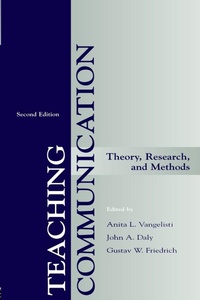
Teaching Communication
Theory, Research, and Methods
2nd Edition
Published on 1. September 1998
Book
Paperback/Softback
584 pages
978-0-8058-2836-8 (ISBN)
Description
The field of communication was founded, in part, because of a need to make people better communicators. That meant teaching them how to communicate more effectively, whether it be in public settings or in private. Most of that teaching has happened within the classroom and many professionals have spent their lives instructing others on various aspects of communication. Inside this second edition, the editors have assembled a fully comprehensive and contemporary discussion of topics and issues concerning the teaching of communication. The chapters contained herein--contributed by key voices throughout the communication discipline--address conceptual as well as practical issues related to communication instruction. The contents of this new edition reflect the dramatic changes that have occurred in communication education since the publication of the first edition in 1990.
This book focuses initially on the goals of communication education, then delves into the preparation of specific communication courses. It includes assistance for instructors in organizing instructional content and discusses the use of instructional strategies and tools, as well as offering ideas on evaluating the processes and products of instruction. The volume also covers unique teaching assignments that may be encountered, from the basic course to continuing education, and addresses 2-year college teaching, directing forensic programs, distance education, and consulting. It concludes with important professional issues faced by both new and experienced communication instructors, including ethics and political issues within classrooms and departments.
This volume is a necessity for anyone starting out a career as a communication instructor. Veteran educators--who know that learning to teach is a continual growth experience--will find useful and invaluable information within the book's pages. Whatever background and level of experience, all communication educators will find this new edition to be an essential resource for their work.
This book focuses initially on the goals of communication education, then delves into the preparation of specific communication courses. It includes assistance for instructors in organizing instructional content and discusses the use of instructional strategies and tools, as well as offering ideas on evaluating the processes and products of instruction. The volume also covers unique teaching assignments that may be encountered, from the basic course to continuing education, and addresses 2-year college teaching, directing forensic programs, distance education, and consulting. It concludes with important professional issues faced by both new and experienced communication instructors, including ethics and political issues within classrooms and departments.
This volume is a necessity for anyone starting out a career as a communication instructor. Veteran educators--who know that learning to teach is a continual growth experience--will find useful and invaluable information within the book's pages. Whatever background and level of experience, all communication educators will find this new edition to be an essential resource for their work.
Reviews / Votes
"I found this to be an interesting and informative book, one that deals knowledgeably and sensitively with a number of important issues in education from a communications standpoint....I do applaud the basic concept of the book, which is to provide a wide-ranging resource to beginning faculty members in university and college communication programmes."-Research in Drama Education
More details
Edition
2nd edition
Language
English
Place of publication
New York
United States
Publishing group
Taylor & Francis Inc
Target group
Professional and scholarly
Edition type
New edition
Product notice
Paperback (trade)
Unsewn / adhesive bound
Dimensions
Height: 229 mm
Width: 155 mm
Thickness: 36 mm
Weight
943 gr
ISBN-13
978-0-8058-2836-8 (9780805828368)
Copyright in bibliographic data and cover images is held by Nielsen Book Services Limited or by the publishers or by their respective licensors: all rights reserved.
Schweitzer Classification
Other editions
Additional editions
Anita L. Vangelisti | John A. Daly | Gustav W. Friedrich
Teaching Communication
Theory, Research, and Methods
E-Book
11/2013
2nd Edition
Routledge
€152.99
Available for download
Anita L. Vangelisti | John A. Daly | Gustav W. Friedrich
Teaching Communication
Theory, Research, and Methods
E-Book
11/2013
2nd Edition
Routledge
€152.99
Available for download
Anita L. Vangelisti | John A. Daly | Gustav W. Friedrich
Teaching Communication
Theory, Research, and Methods
Book
09/1998
2nd Edition
Routledge
€217.50
Shipment within 10-20 days
Previous edition

John A. Daly | Gustav W. Friedrich | Anita L. Vangelisti
Teaching Communication
Theory, Research, and Methods
Book
04/1990
Lawrence Erlbaum Associates Inc
€58.43
Article exhausted; check for reprint
Persons
Vangelisti, Anita L.; Daly, John A; Friedrich, Gustav W.
Content
Contents: Part I:Thinking About the Goals of Communication Education.G.W. Friedrich, D.M. Boileau, The Communication Discipline. J. Sprague, The Goals of Communication Education. A.Q. Staton, An Ecological Perspective on College/University Teaching: The Teaching/Learning Environment and Socialization. A.L. Darling, Becoming a Professional. J.M. Civikly-Powell, Creating a New Course. Part II:Preparing Specific Communication Courses.S.E. Lucas, Teaching Public Speaking. J. Nicholson, S. Duck, Teaching Interpersonal Communication. L.R. Frey, Teaching Small Group Communication. B.E. Gronbeck, Teaching Rhetorical Studies. R.P. Hart, Teaching Persuasion. L.L. Putnam, C.R. Conrad, Teaching Organizational Communication. M.L. Knapp, Teaching Nonverbal Communication. Y.Y. Kim, W.B. Gudykunst, Teaching Intercultural Communication. C.J. Stewart, Teaching Interviewing. T.A. McCain, J.W. Turner, Teaching Mass Communication and Telecommunication. R.A. Clark, Teaching Research Methods. L.B. Rosenfeld, M.S. Waltman, Teaching a Special Topics Course. Part III:Organizing the Instructional Context.K.M. Galvin, Classroom Roles of the Teacher. J. Gorham, Diversity in Classroom Dynamics. T.G. Plax, P. Kearney, Classroom Management: Contending With College Student Discipline. G.W. Friedrich, P. Cooper, The First Day. Part IV:Selecting and Evaluating Instructional Strategies and Tools.D.H. Wulff, J.D. Nyquist, Selected Tools and Methods to Engage Students in Learning. K.E. Rowan, Explanatory Skills. C.L. Book, Lecturing. P.E. Nelson, J.C. Pearson, Large "Lecture" Classes. J. Andersen, J. Nussbaum, J.A. Grant, L. Pecchioni, Interaction Skills in Instructional Settings. W.J. Seiler, B.S. Titsworth, Individualized Approaches to Instruction. S.A. Jackson, C. Madison, Instruction By Design: Technology in the Discourse of Teaching and Learning. A.L. Vangelisti, Evaluating the Process. R.B. Rubin, Evaluating the Product. Part V:Tackling Some Unique Teaching Assignments.D.M. Trank, Directing Multiple Sections of the Basic Course. T.A. Hollihan, Directing Debate and Forensics. D.R. Wolvin, A.D. Wolvin, Communication in the Two-Year College. J.A. Daly, Distance Education. V.P. Richmond, Extended Learning. J.A. Daly, Consulting. Part VI:Exploring Important Professional Issues.K.E. Andersen, Ethical Issues in Teaching. J.C. McCroskey, Fitting Into the Department and the Profession.