

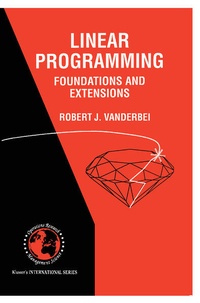
Linear Programming: Foundations and Extensions
Published on 31. December 1996
Book
Hardback
XVIII, 418 pages
978-0-7923-9804-2 (ISBN)
Description
This book focuses largely on constrained optimization. It begins with a substantial treatment of linear programming and proceeds to convex analysis, network flows, integer programming, quadratic programming, and convex optimization. Along the way, dynamic programming and the linear complementarity problem are touched on as well. This book aims to be the first introduction to the topic. Specific examples and concrete algorithms precede more abstract topics. Nevertheless, topics covered are developed in some depth, a large number of numerical examples worked out in detail, and many recent results are included, most notably interior-point methods. The exercises at the end of each chapter both illustrate the theory, and, in some cases, extend it. Optimization is not merely an intellectual exercise: its purpose is to solve practical problems on a computer. Accordingly, the book comes with software that implements the major algorithms studied. At this point, software for the following four algorithms is available: The two-phase simplex method The primal-dual simplex method The path-following interior-point method The homogeneous self-dual methods.£/LIST£.
Reviews / Votes
` Vanderbei's book is thoroughly modern. Vanderbei's book has many novel features. Some nice features. This book has style. Overall, I greatly enjoyed reviewing this book, and I highly recommend it as a textbook for an advanced undergraduate or master's level course in linear programming, particularly for courses in an engineering environment. In addition, it also is a good reference book for interior point methods as well as for implementation and computational aspects of linear programming. This is an excellent new book. 'Robert Freund, (MIT) in Optima, 56 (1997)
` In conclusion, Vanderbei's book gives an excellent introduction to linear programminbg, especially the algorithmic side of the subject. The book is highly recommended for both self study and as teaching material. '
Optima, 58 (1998)
More details
Series
Edition
1997 ed.
Language
English
Place of publication
New York
United States
Target group
Professional and scholarly
Research
Product notice
sewn/stitched
Cloth over boards
Illustrations
XVIII, 418 p.
Dimensions
Height: 241 mm
Width: 160 mm
Thickness: 29 mm
Weight
822 gr
ISBN-13
978-0-7923-9804-2 (9780792398042)
Schweitzer Classification
Other editions
New editions
Book
01/2001
2nd Edition
Kluwer Academic Publishers
€85.59
Article exhausted; check for reprint
Additional editions
Robert J. Vanderbei
Linear Programming: Foundations and Extensions
Book
03/1998
Kluwer Academic Publishers
€213.99
Shipment within 15-20 days
Person
Robert J. Vanderbei is Professor of Operations Research and Financial Engineering, and former Department Chair, OR and Financial Engineering at Princeton University. His research interests are in algorithms for nonlinear optimization and their application to problems arising in engineering and science. Application areas of interest focus mainly on inverse Fourier transform optimization problems and action minimization problems with a special interest in applying these techniques to the design of NASA's terrestrial planet finder space telescope.
Content
Preface. Part 1: Basic Theory - The Simplex Method and Duality. 1. Introduction. 2. The Simplex Method. 3. Degeneracy. 4. Efficiency of the Simplex Method. 5. Duality Theory. 6. The Simplex Method in Matrix Notation. 7. Sensitivity and Parametric Analyses. 8. Implementation Issues. 9. Problems in General Form. 10. Convex Analysis. 11. Game Theory. 12. Regression. Part 2: Network-Type Problems. 13. Network Flow Problems. 14. Applications. 15. Structural Optimization. Part 3: Interior-Point Methods. 16. The Central Path. 17. A Path-Following Method. 18. The KKT System. 19. Implementation Issues. 20. The Affine-Scaling Method. 21. The Homogeneous Self-Dual Method. Part 4: Extensions. 22. Integer Programming. 23. Quadratic Programming. 24. Convex Programming. Appendix A: Source Listings. Answers to Selected Exercises. Bibliography. Index.