

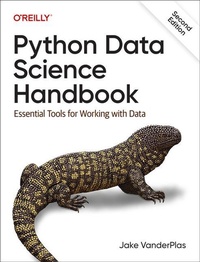
Python Data Science Handbook
Essential Tools for Working with Data
2nd Edition
Published on 31. December 2022
Book
Paperback/Softback
550 pages
978-1-0981-2122-8 (ISBN)
Description
Python is a first-class tool for many researchers, primarily because of its libraries for storing, manipulating, and gaining insight from data. Several resources exist for individual pieces of this data science stack, but only with the new edition of Python Data Science Handbook do you get them all-IPython, NumPy, pandas, Matplotlib, Scikit-Learn, and other related tools.
Working scientists and data crunchers familiar with reading and writing Python code will find the second edition of this comprehensive desk reference ideal for tackling day-to-day issues: manipulating, transforming, and cleaning data; visualizing different types of data; and using data to build statistical or machine learning models. Quite simply, this is the must-have reference for scientific computing in Python.
With this handbook, you'll learn how:
IPython and Jupyter provide computational environments for scientists using Python
NumPy includes the ndarray for efficient storage and manipulation of dense data arrays
Pandas contains the DataFrame for efficient storage and manipulation of labeled/columnar data
Matplotlib includes capabilities for a flexible range of data visualizations
Scikit-learn helps you build efficient and clean Python implementations of the most important and established machine learning algorithms
Working scientists and data crunchers familiar with reading and writing Python code will find the second edition of this comprehensive desk reference ideal for tackling day-to-day issues: manipulating, transforming, and cleaning data; visualizing different types of data; and using data to build statistical or machine learning models. Quite simply, this is the must-have reference for scientific computing in Python.
With this handbook, you'll learn how:
IPython and Jupyter provide computational environments for scientists using Python
NumPy includes the ndarray for efficient storage and manipulation of dense data arrays
Pandas contains the DataFrame for efficient storage and manipulation of labeled/columnar data
Matplotlib includes capabilities for a flexible range of data visualizations
Scikit-learn helps you build efficient and clean Python implementations of the most important and established machine learning algorithms
More details
Edition
2nd edition
Language
English
Place of publication
Sebastopol
United States
Product notice
Paperback (trade)
Unsewn / adhesive bound
Dimensions
Height: 233 mm
Width: 177 mm
Thickness: 32 mm
Weight
1030 gr
ISBN-13
978-1-0981-2122-8 (9781098121228)
Copyright in bibliographic data and cover images is held by Nielsen Book Services Limited or by the publishers or by their respective licensors: all rights reserved.
Schweitzer Classification
Other editions
Additional editions
Previous edition
Jake VanderPlas
Python Data Science Handbook
Book
12/2016
O'Reilly
€89.32
Article exhausted; check for reprint
Person
Jake VanderPlas is a software engineer at Google Research, working on tools that support data-intensive research. He maintains a technical blog, Pythonic Perambulations,
to share tutorials and opinions related to statistics, open software, and scientific computing in Python. He creates and develops Python tools for use in data-intensive science, including packages like Scikit-Learn, SciPy, AstroPy, Altair, JAX, and many others. He participates in the broader data science community, developing and presenting talks and tutorials on scientific computing topics at various conferences in the data science world.
to share tutorials and opinions related to statistics, open software, and scientific computing in Python. He creates and develops Python tools for use in data-intensive science, including packages like Scikit-Learn, SciPy, AstroPy, Altair, JAX, and many others. He participates in the broader data science community, developing and presenting talks and tutorials on scientific computing topics at various conferences in the data science world.