

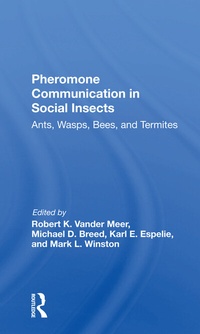
Pheromone Communication In Social Insects
Ants, Wasps, Bees, And Termites
1st Edition
Published on 4. December 2020
Book
Paperback/Softback
384 pages
978-0-367-29828-9 (ISBN)
Description
Bringing together for the first time prominent researchers in social insect pheromone communication, including nestmate recognition, this book looks at ants, wasps, bees, and termites, highlighting areas of convergence and divergence among these groups, and identifying areas that need further investigation. Presenting broad synthetic overviews as
More details
Language
English
Place of publication
London
United Kingdom
Publishing group
Taylor & Francis Ltd
Target group
College/higher education
Dimensions
Height: 237 mm
Width: 148 mm
Weight
710 gr
ISBN-13
978-0-367-29828-9 (9780367298289)
Copyright in bibliographic data and cover images is held by Nielsen Book Services Limited or by the publishers or by their respective licensors: all rights reserved.
Schweitzer Classification
Other editions
Additional editions
Robert K. Vander Meer | Michael D. Breed | Mark Winston
Pheromone Communication In Social Insects
Ants, Wasps, Bees, And Termites
E-Book
06/2019
1st Edition
CRC Press
€58.99
Available for download
Robert K. Vander Meer | Michael D. Breed | Mark Winston
Pheromone Communication In Social Insects
Ants, Wasps, Bees, And Termites
E-Book
06/2019
1st Edition
CRC Press
€58.99
Available for download
Robert K. Vander Meer | Michael D. Breed | Mark Winston
Pheromone Communication In Social Insects
Ants, Wasps, Bees, And Termites
Book
06/2019
1st Edition
CRC Press
€207.30
Shipment within 15-20 days
Persons
Robert K. Vander Meer is a research chemist with the USDA/ARS. Michael D. Breed is professor of environmental population and organismic biology at the University of Colorado at Boulder. Mark L. Winston is professor of biological sciences at Simon Fraser University. Karl E. Espelie is professor of entomology at the University of Georgia at Athens. Robert K. Vander Meer is a research chemist with the USDA/ARS. Michael D. Breed is professor of environmental population and organismic biology at the University of Colorado at Boulder. Mark L. Winston is professor of biological sciences at Simon Fraser University. Karl E. Espelie is professor of entomology at the University of Georgia at Athens. Robert K. Vander Meer is a research chemist with the USDA/ARS. Michael D. Breed is professor of environmental population and organismic biology at the University of Colorado at Boulder. Mark L. Winston is professor of biological sciences at Simon Fraser University. Karl E. Espelie is professor of entomology at the University of Georgia at Athens. Robert K. Vander Meer is a research chemist with the USDA/ARS. Michael D. Breed is professor of environmental population and organismic biology at the University of Colorado at Boulder. Mark L. Winston is professor of biological sciences at Simon Fraser University. Karl E. Espelie is professor of entomology at the University of Georgia at Athens.
Content
Foreword -- Preface -- Introduction: Sources and Secretions -- Pheromone Communication in Social Insects: Sources and Secretions -- The Cuticle and Cuticular Hydrocarbons of Insects: Structure, Function, and Biochemistry -- Nestmate Recognition in Social Insects -- Chemical Cues in Kin Recognition: Criteria for Identification, Experimental Approaches, and the Honey Bee as an Example -- Nestmate Recognition in Ants -- Nest and Nestmate Discrimination in Independent-Founding Paper Wasps -- Nestmate Recognition in Termites -- Social Insect Releaser Pheromones -- Pheromone Directed Behavior in Ants -- Releaser Pheromones in Termites -- Chemical Communication in Social Wasps -- Exocrine Glands and Their Products in Non-Apis Bees: Chemical, Functional and Evolutionary Perspectives -- Mass Action in Honey Bees: Alarm, Swarming and the Role of Releaser Pheromones -- Social Insect Primer Pheromones -- Primer Pheromones in Ants -- Primer Pheromones and Possible Soldier Caste Influence on the Evolution of Sociality in Lower Termites -- Royal Flavors: Honey Bee Queen Pheromones