

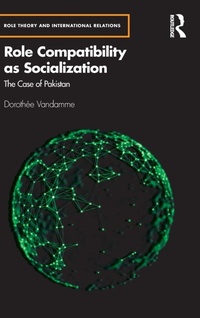
Role Compatibility as Socialization
The Case of Pakistan
1st Edition
Published on 11. March 2022
Book
Hardback
226 pages
978-1-032-15851-8 (ISBN)
Description
In Role Compatibility as Socialization, Dorothee Vandamme examines Pakistan's socialization process in terms of role compatibility in the 2008-2018 period.
Adopting an Interpretative phenomenological analysis (IPA) method of analysis, Vandamme builds on role theory to develop a theory of socialization as role compatibility to explain the dynamics of Pakistan's (dys)functioning position and its status-seeking process as a fully functioning member of the international system. Specifically, she focuses on how Pakistani civilian and military leaders define their country's positioning towards India, the United States and China. In doing so, she traces the link between domestic role contestation at the country's inception and the resulting domination of the military's conception of their country, state identity, how it projects itself externally and how it is received by others.
Departing from strictly structural or agent-oriented explanations, Vandamme expertly demonstrates Pakistan's perceived role compatibility with significant others and underlines the causality between state identity, foreign policy behavior and socialization. Role Compatibility as Socialization will be of interest to graduate students and researchers who work on and with role theory and socialization theory, and for those with a research interest on South Asia.
Adopting an Interpretative phenomenological analysis (IPA) method of analysis, Vandamme builds on role theory to develop a theory of socialization as role compatibility to explain the dynamics of Pakistan's (dys)functioning position and its status-seeking process as a fully functioning member of the international system. Specifically, she focuses on how Pakistani civilian and military leaders define their country's positioning towards India, the United States and China. In doing so, she traces the link between domestic role contestation at the country's inception and the resulting domination of the military's conception of their country, state identity, how it projects itself externally and how it is received by others.
Departing from strictly structural or agent-oriented explanations, Vandamme expertly demonstrates Pakistan's perceived role compatibility with significant others and underlines the causality between state identity, foreign policy behavior and socialization. Role Compatibility as Socialization will be of interest to graduate students and researchers who work on and with role theory and socialization theory, and for those with a research interest on South Asia.
More details
Series
Language
English
Place of publication
London
United Kingdom
Publishing group
Taylor & Francis Ltd
Target group
College/higher education
Illustrations
7 s/w Abbildungen, 7 s/w Photographien bzw. Rasterbilder, 3 s/w Tabellen
3 Tables, black and white; 7 Halftones, black and white; 7 Illustrations, black and white
Dimensions
Height: 235 mm
Width: 157 mm
Thickness: 17 mm
Weight
501 gr
ISBN-13
978-1-032-15851-8 (9781032158518)
Copyright in bibliographic data and cover images is held by Nielsen Book Services Limited or by the publishers or by their respective licensors: all rights reserved.
Schweitzer Classification
Other editions
Additional editions
Book
09/2023
1st Edition
Routledge
€65.30
Shipment within 10-20 days
E-Book
03/2022
1st Edition
Routledge
€59.49
Available for download
E-Book
03/2022
1st Edition
Routledge
€59.49
Available for download
Person
Dorothee Vandamme is a lecturer at the University of Mons and a visiting lecturer at the Universite catholigue de Louvain. She is a researcher at the ISPOLE institute and a research fellow at the European Foundation for South Asian Studies. Her main research interests are political sociology and social processes in interstate relations, the political and security environment in Pakistan and Afghanistan, Chinese foreign policy and contemporary international security issues.
Content
1. Introduction: The social world of Pakistan 2. State socialization as role compatibility 3. Acquiring statehood and building social identity 4. Setting the stage: Pakistan and its significant others' NRCs 5. Dealing with the other: The construction of India-Pakistan oppositional identities 6. Client or independent? Understanding the difficulty of the US-Pakistan relations in light of the patron-client framework 7. China as alternative dominant socializer 8. Conclusion