

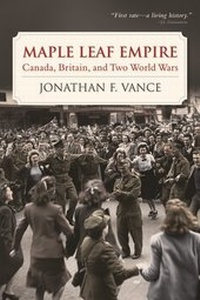
Maple Leaf Empire
Canada, Britain, and Two World Wars
Published on 19. January 2012
Book
Hardback
272 pages
978-0-19-544809-2 (ISBN)
Description
The ineffable character of "Britishness" has been used, often enigmatically, to describe Canada's distinct cultural flavour within North America. This mysterious quality, writes award-winning writer Jonathan Vance, goes back to the early days of Canadian history, and consists of far more than the sum of early migration patterns. It emerges from a long-standing respect for British liberal ideals and an identification with the British empire. Canada's own unique brand of Britishness evolved over a history of shared military endeavor, as Canadians fought alongside others to defend the ideals that the British Empire was deemed to represent.
To understand Canada's history of Britishness, Vance looks into the military past of both countries. The fabric of Canadian life in the eighteenth and nineteenth centuries owes a great deal to the presence of British military. And this, observes Vance, is a two-way relationship: he reminds us that during the two World Wars, close to a million Canadians travelled to the United Kingdom. In this form of reverse colonialism, Canadians established modest outposts in Britain, and parts of the country were Canadianized.
This new, outside-the-box narrative is Jonathan Vance at his best. Beautifully written, based on original research in the true sense of the word, and illustrated with previously unseen materials, this book reveals a side of Canada often forgotten by historians.
To understand Canada's history of Britishness, Vance looks into the military past of both countries. The fabric of Canadian life in the eighteenth and nineteenth centuries owes a great deal to the presence of British military. And this, observes Vance, is a two-way relationship: he reminds us that during the two World Wars, close to a million Canadians travelled to the United Kingdom. In this form of reverse colonialism, Canadians established modest outposts in Britain, and parts of the country were Canadianized.
This new, outside-the-box narrative is Jonathan Vance at his best. Beautifully written, based on original research in the true sense of the word, and illustrated with previously unseen materials, this book reveals a side of Canada often forgotten by historians.
Reviews / Votes
"Vance mines newspaper stories, letters, and official reports from both world wars to trace the development of Canadian experiences in wartime Britain. . . . The book is a fascinating portrait of soldiers who, at the same time as they were fighting a war, discovered both the land of their ancestors and the definition of themselves as Canadians."--Quill & Quire
"Compelling."
--Maclean's
"Maple Leaf Empire is very readable...this book will touch your heart."
--Globe and Mail
"Those wishing to deepen their understanding of [Canadian] heritage, Vance's account is a good place to start."
--Winnipeg Free Press
"A masterpiece...Maple Leaf Empire is exceedingly well written...this book is very strong."
--Literary Review of Canada
"This study of the imperial experience that is imbedded in the Canadian character is social history at its best."
--OHS Bulletin (newsletter of the Ontario Historical Society)
More details
Language
English
Place of publication
Toronto
Canada
Product notice
Unsewn / adhesive bound
Paper over boards
With dust jacket
Illustrations
46 black and white illustrations, 22 colour illustrations
Dimensions
Height: 231 mm
Width: 150 mm
Thickness: 23 mm
Weight
522 gr
ISBN-13
978-0-19-544809-2 (9780195448092)
Copyright in bibliographic data and cover images is held by Nielsen Book Services Limited or by the publishers or by their respective licensors: all rights reserved.
Schweitzer Classification
Person
Jonathan Vance is a specialist in Canadian military and cultural history, war and society in the twentieth century, and social memory. From 2000 to 2010 he held the Canada Research Chair in Conflict and Culture, and was elected a fellow of the Royal Society of Canada in 2008. His book Death So Noble won the 1998 Sir John A. Macdonald Prize, the 1998 C.P. Stacey Award, and the 1998 Dafoe Book Prize. In 2010, A History of Canadian Culture won the Lela Common Award from the Canadian Authors Association.
Content
LIST OF ILLUSTRATIONS; ACKNOWLEDGEMENTS; INTRODUCTION; EPILOGUE; NOTES; FURTHER READING; CREDITS; INDEX