

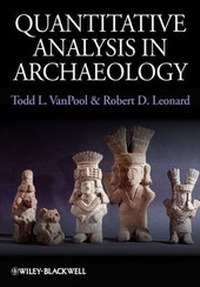
Quantitative Analysis in Archaeology
Published on 26. November 2010
Book
Paperback/Softback
376 pages
978-1-4051-8950-7 (ISBN)
Description
Quantitative Analysis in Archaeology introduces the application of quantitative methods in archaeology. It outlines conceptual and statistical principles, illustrates their application, and provides problem sets for practice.
* Discusses both methodological frameworks and quantitative methods of archaeological analysis
* Presents statistical material in a clear and straightforward manner ideal for students and professionals in the field
* Includes illustrative problem sets and practice exercises in each chapter that reinforce practical application of quantitative analysis
More details
Edition
1. Auflage
Language
English
Place of publication
Hoboken
United Kingdom
Publishing group
John Wiley and Sons Ltd
Target group
College/higher education
Professional and scholarly
Product notice
Paperback (trade)
sewn/stitched
Dimensions
Height: 246 mm
Width: 169 mm
Thickness: 25 mm
Weight
651 gr
ISBN-13
978-1-4051-8950-7 (9781405189507)
Schweitzer Classification
Other editions
Additional editions
Todd L. VanPool | Robert D. Leonard
Quantitative Analysis in Archaeology
E-Book
01/2011
Wiley-Blackwell
€41.99
Available for download

Todd L. VanPool | Robert D. Leonard
Quantitative Analysis in Archaeology
Book
11/2010
Wiley
€98.59
Article exhausted; check different version
Todd L. VanPool | Robert D. Leonard
Quantitative Analysis in Archaeology
E-Book
10/2010
Wiley-Blackwell
€41.99
Available for download
Persons
Todd L. VanPool is Assistant Professor at the Department of Anthropology, University of Missouri, Columbia. He is the co-author with Christine S. VanPool of Signs of the Casas Grandes Shamans (2007), Religion in the Prehispanic Southwest (2006) and Essential Tensions in Archaeological Method and Theory (2003).
Robert D. Leonard is retired from the Department of Anthropology, University of New Mexico, Albuquerque, where he taught for 17 years. He is currently the co-owner and a project director of Human Inquiry, a consulting firm that uses an interdisciplinary anthropological approach to help improve building designs.
Content
List of Tables.
List of Figures.
List of Equations.
Acknowledgments.
1. Quantifying Archaeology.
2. Data.
3. Characterizing Data Visually.
4.Characterizing Data Numerically: Descriptive Statistics.
5. An Introduction to Probability.
6. Putting Statistics to Work: The Normal Distribution.
7. Hypothesis Testing I: An Introduction.
8. Hypothesis Testing II: Confidence Limits, the t-Distribution, and One-Tailed Tests.
9. Hypothesis Testing III: Power.
10. Analysis of Variance and the F-Distribution.
11. Linear Regression and Multivariate Analysis.
12. Correlation.
13. Analysis of Frequencies.
14. An Abbreviated Introduction to Nonparametric and Multivariate Analysis.
15. Factor Analysis and Principal Component Analysis.
16. Sampling, Research Designs, and the Archaeological Record.
Some Concluding Thoughts.
References.
Appendix A. Areas under a Standardized Normal Distribution.
Appendix B. Critical Values for the Student's t-Distribution.
Appendix C. Critical Values for the F-Distribution.
Appendix D. Critical Values for the Chi-Square Distribution.
Appendix E. Critical Values for the Wilcoxon Two-Sample U-Test.