

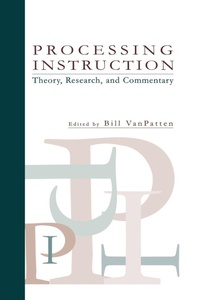
Processing Instruction
Theory, Research, and Commentary
1st Edition
Published on 7. May 2015
Book
Paperback/Softback
360 pages
978-1-138-86840-3 (ISBN)
Description
This new book, Processing Instruction: Theory, Research, and Commentary, edited by Bill VanPatten--a pioneer in processing instruction (PI)--is a refreshing presentation of 10 related and not widely available articles that illustrate the role of processing instruction in second language acquisition. The articles provide both historical and current context, as well as describe the influence of the input processing model on PI.
The contents include empirical papers presenting new data that demonstrate both the theoretical and pedagogical threads of research. Aside from simply establishing where PI stands in the field of instructed SLA, the book addresses issues, such as processing instruction versus other types of instruction; the impact of processing instruction on various linguistic structures; the role of explicit information in instructional intervention; and the long-term effects of processing instruction. Each section of the book is highlighted by commentaries from noted researchers in instructed SLA. An attempt was made to include voices that offer critical perspectives on various issues of PI research. The book achieves an unusually balanced approach to a subject that has stirred debate in the field.
Processing Instruction: Theory, Research, and Commentary will serve as an important source of information regarding research methodology and replication in second language acquisition. It will also be useful in graduate courses where students need exposure to research design and is especially useful for illustrating the usefulness of replication in SLA research.
The contents include empirical papers presenting new data that demonstrate both the theoretical and pedagogical threads of research. Aside from simply establishing where PI stands in the field of instructed SLA, the book addresses issues, such as processing instruction versus other types of instruction; the impact of processing instruction on various linguistic structures; the role of explicit information in instructional intervention; and the long-term effects of processing instruction. Each section of the book is highlighted by commentaries from noted researchers in instructed SLA. An attempt was made to include voices that offer critical perspectives on various issues of PI research. The book achieves an unusually balanced approach to a subject that has stirred debate in the field.
Processing Instruction: Theory, Research, and Commentary will serve as an important source of information regarding research methodology and replication in second language acquisition. It will also be useful in graduate courses where students need exposure to research design and is especially useful for illustrating the usefulness of replication in SLA research.
Reviews / Votes
"...this book is an excellent choice for teacher-researchers who are interested in exploring how and why the quality of the one instructional element they have lost control over - input - may facilitate acquisition when it is structured to address identifiable learner difficulties. For those who are familiar with the PI pedagogical and research literature, this is an essential work for providing a current and engaging discussion of relevant issues in processing theory and predagogical practice."-Language Teaching Research
"...recommend this volume to all SLA researchers and practitioners who are looking for the next big theoretical undertaking that also has insights for the classroom."
-TESL-EJ
"The edited volume here represents an important milestone in this program of work and will be a useful resource for SLA scholars interested in the problems of relating form and meaning to language. The volume succeeds admirably in doing all this and thereby provides the reader with a full balanced over view of the field. The book is informative, interesting, and thought-provoking....a well-rounded account of where PI research is today and provides some thoughtful observations on its accomplishments, limits, and future directions."
-Studies in Second Language Acquisition
More details
Series
Language
English
Place of publication
London
United Kingdom
Publishing group
Taylor & Francis Ltd
Target group
Professional and scholarly
Dimensions
Height: 229 mm
Width: 152 mm
Thickness: 19 mm
Weight
519 gr
ISBN-13
978-1-138-86840-3 (9781138868403)
Copyright in bibliographic data and cover images is held by Nielsen Book Services Limited or by the publishers or by their respective licensors: all rights reserved.
Schweitzer Classification
Other editions
Additional editions
E-Book
05/2004
Routledge
€76.49
Available for download
E-Book
05/2004
1st Edition
Routledge
€76.49
Available for download
E-Book
05/2004
1st Edition
Routledge
€118.59
Available for download
Book
09/2003
Routledge
€232.50
Shipment within 10-20 days
Person
Content
Contents: Part I: Foundations.B. VanPatten, Input Processing in SLA. W. Wong, The Nature of Processing Instruction. P. Lightbown, Commentary: What to Teach? How to Teach? M. Harrington, Commentary: Input Processing as a Theory of Processing Input. Part II: Processing Instruction Versus Other Types of Instruction.B. VanPatten, W. Wong, Processing Instruction and the French Causative: Another Replication. A.C. Cheng, Processing Instruction and Spanish Ser and Estar: Forms With Semantic-Aspectual Values. A.P. Farley, The Relative Effects of Processing Instruction and Meaning-Based Output Instruction. J. Collentine, Commentary: Where PI Research Has Been and Where It Should Be Going. Part III: The Roles of Structured Input and Explicit Information.W. Wong, Processing Instruction in French: The Roles of Explicit Information and Structured Input. A. Benati, The Effects of Structured Input Activities and Explicit Information on the Acquisition of the Italian Future Tense. A.P. Farley, Processing Instruction and the Spanish Subjunctive: Is Explicit Information Needed? C. Sanz, Computer Delivered Implicit Versus Explicit Feedback in Processing Instruction. C.J. Doughty, Commentary: When PI Is Focus on Form It Is Very, Very Good, but When It Is Focus on Forms... Part IV: Long-Term Effects of PI.B. VanPatten, C. Fernandez, The Long-Term Effects of Processing Instruction. Part V: Final Commentaries.S. Carroll, Some Comments on Input Processing and Processing Instruction. J.F. Lee, On the Generalizability, Limits, and Potential Future Directions of Processing Instruction Research. B. VanPatten, Several Reflections on Why There Is Good Reason to Continue Researching the Effects of Processing Instruction.