

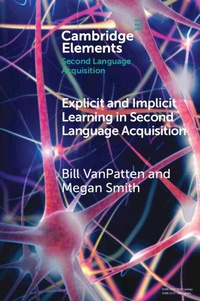
Explicit and Implicit Learning in Second Language Acquisition
Published on 23. June 2022
Book
Paperback/Softback
58 pages
978-1-009-04432-5 (ISBN)
Description
This Element explores the roles of explicit and implicit learning in second language acquisition. The authors lay out some key issues that they take to underlie the debate on the extent to which second language acquisition involves explicit learning, implicit learning, or both. They also discuss what they take to be an oversight in the field: namely, the lack of clear definitions of key constructs. Taking a generative perspective on the nature of language, while addressing alternative approaches at key points, they refocus the discussion of explicit and implicit learning by first asking what must be learned (i.e., what is this mental representation we call "language" that all functioning humans possess?) The discussion and research reviewed leads to the conclusion that second language acquisition is largely if not exclusively implicit in nature and that explicit learning plays a secondary role in how learners grapple with meaning.
More details
Series
Language
English
Place of publication
Cambridge
United Kingdom
Product notice
Paperback (trade)
Illustrations
Worked examples or Exercises
Dimensions
Height: 229 mm
Width: 152 mm
Thickness: 4 mm
Weight
100 gr
ISBN-13
978-1-009-04432-5 (9781009044325)
Copyright in bibliographic data and cover images is held by Nielsen Book Services Limited or by the publishers or by their respective licensors: all rights reserved.
Schweitzer Classification
Other editions
Additional editions
E-Book
06/2022
Cambridge University Press
€15.49
Available for download
Bill VanPatten | Megan Smith
Explicit and Implicit Learning in Second Language Acquisition
E-Book
06/2022
Cambridge University Press
€15.49
Available for download
Persons
Content
1. Introduction; 2. First, Some Definitions; 3. So, Where Does This Leave Us With the Explicit/Implicit Debate?; 4. Can Explicitly Learned Knowledge Become Implicit Representation?; 5. But Wait...; 6. Concluding Remarks.