

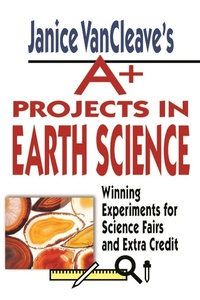
Janice VanCleave's A+ Projects in Earth Science
Winning Experiments for Science Fairs and Extra Credit
1st Edition
Published on 5. January 1999
Book
Paperback/Softback
240 pages
978-0-471-17770-8 (ISBN)
Description
Janice VanCleave's A+ Projects in Earth Science The newest volume in the bestselling A+ Science Projects series! Are you having a hard time coming up with a good idea for the science fair? Do you want to earn extra credit in your science class? Or do you just want to know more about how the world around you works? Janice VanCleave's A+ Projects in Earth Science can help you--and the best part is, it won't involve any complicated or expensive equipment. This step-by-step project book explores 30 different topics and offers dozens of experiment ideas. The book also includes lots of charts, diagrams, and illustrations. Here are just a few of the topics you'll be investigating: * Rocks and minerals * Meteorology * Oceanography * Plate tectonics * Air fronts * The greenhouse effect You'll be amazed how easy it is to turn your own ideas into winning science fair projects! Also available: Janice VanCleave's A+ Projects in Biology Janice VanCleave's A+ Projects in Chemistry
More details
Series
Language
English
Place of publication
New York
United States
Target group
College/higher education
US School Grade: From Seventh Grade to Twelfth Grade, Interest Age: From 12 to 17 years
Product notice
Paperback (trade)
Unsewn / adhesive bound
Dimensions
Height: 229 mm
Width: 152 mm
Thickness: 13 mm
Weight
357 gr
ISBN-13
978-0-471-17770-8 (9780471177708)
Copyright in bibliographic data and cover images is held by Nielsen Book Services Limited or by the publishers or by their respective licensors: all rights reserved.
Schweitzer Classification
Other editions
Additional editions
Janice VanCleave
Janice VanCleave's A+ Projects in Earth Science
Winning Experiments for Science Fairs and Extra Credit
Book
12/1998
Wiley
€23.46
Article exhausted; check different version
Person
JANICE VANCLEAVE was an award-winning science teacher before deciding to devote her time to writing and giving science workshops. She is the author of more than 40 children's science books, with sales totaling more than one million copies.
Content
MAPPING THE EARTH.
Maps and Globes: Terrestrial Guides.
Topography: Highs and Lows of the Earth's Surface.
THE EARTH AND SPACE.
Rotation: The Spinning of the Earth on Its Axis.
Heliocentric: The Earth's Solar System.
Night Light: The Structure and Movement of the Earth's Moon.
Mobile Stars: The Apparent Movement of Stars.
Time: Day Lengths and Time Zones.
Early Methods: Ancient Techniques of Determining the Earth's Sizeand Shape.
PHYSICAL COMPOSITION OF THE EARTH.
Elements: The Earth's Building Blocks.
The Earth's Layers: Chemical and Physical Properties of theEarth.
THE EARTH'S LITHOSPHERE.
Minerals: Distinguishing Physical Characteristics ofMinerals.
Crystals: Distinguishing Physical Characteristics ofCrystals.
The Rock Cycle: Processes That Change One Rock Type intoAnother.
Erosion: The Breakdown and Movement of Crustal Material.
Rock Sandwiches: Layering of Regolith Particles.
Soil Texture: Effects of Regolith Size.
Crustal Bending: Deformation of the Earth's Crust.
Faulting: The Earth's Crustal Breaking Point.
Plate Tectonics: Floating Crustal Sections.
THE EARTH'S HYDROSPHERE.
Soundings: Mapping a Profile of the Ocean Floor.
Water Waves: Surface Disturbances Due to Energy Transfer.
Percolating Water: The Movement of Water Beneath the Earth'sSurface.
The Hydrologic Cycle: The Movement of Water from Place toPlace.
THE EARTH'S ATMOSPHERE.
Atmospheric Energy: Unequal Heating by the Earth's Surface.
The Greenhouse Effect: Heat Transfer in the Atmosphere.
Convection: Air in Motion.
Fronts: Moving Air Masses.
Barometric Changes: The Cause and Measurement of AirPressure.
Hygrometers: Ways to Measure the Atmosphere's Water Content.
Precipitation: Phases of Atmospheric Water.
Appendices.
Glossary.
Index.
Maps and Globes: Terrestrial Guides.
Topography: Highs and Lows of the Earth's Surface.
THE EARTH AND SPACE.
Rotation: The Spinning of the Earth on Its Axis.
Heliocentric: The Earth's Solar System.
Night Light: The Structure and Movement of the Earth's Moon.
Mobile Stars: The Apparent Movement of Stars.
Time: Day Lengths and Time Zones.
Early Methods: Ancient Techniques of Determining the Earth's Sizeand Shape.
PHYSICAL COMPOSITION OF THE EARTH.
Elements: The Earth's Building Blocks.
The Earth's Layers: Chemical and Physical Properties of theEarth.
THE EARTH'S LITHOSPHERE.
Minerals: Distinguishing Physical Characteristics ofMinerals.
Crystals: Distinguishing Physical Characteristics ofCrystals.
The Rock Cycle: Processes That Change One Rock Type intoAnother.
Erosion: The Breakdown and Movement of Crustal Material.
Rock Sandwiches: Layering of Regolith Particles.
Soil Texture: Effects of Regolith Size.
Crustal Bending: Deformation of the Earth's Crust.
Faulting: The Earth's Crustal Breaking Point.
Plate Tectonics: Floating Crustal Sections.
THE EARTH'S HYDROSPHERE.
Soundings: Mapping a Profile of the Ocean Floor.
Water Waves: Surface Disturbances Due to Energy Transfer.
Percolating Water: The Movement of Water Beneath the Earth'sSurface.
The Hydrologic Cycle: The Movement of Water from Place toPlace.
THE EARTH'S ATMOSPHERE.
Atmospheric Energy: Unequal Heating by the Earth's Surface.
The Greenhouse Effect: Heat Transfer in the Atmosphere.
Convection: Air in Motion.
Fronts: Moving Air Masses.
Barometric Changes: The Cause and Measurement of AirPressure.
Hygrometers: Ways to Measure the Atmosphere's Water Content.
Precipitation: Phases of Atmospheric Water.
Appendices.
Glossary.
Index.