

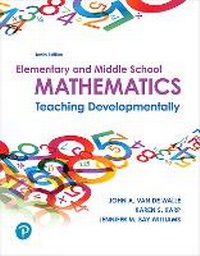
MyLab Education with Pearson eText Access Code for Elementary and Middle School Mathematics
Teaching Developmentally
10th Edition
Published on 1. January 2018
Book
Mixed media product
978-0-13-480206-0 (ISBN)
Description
ALERT: Before you purchase, check with your instructor or review your course syllabus to ensure that you select the correct ISBN. Several versions of Pearson's MyLab & Mastering products exist for each title, including customized versions for individual schools, and registrations are not transferable. In addition, you may need a CourseID, provided by your instructor, to register for and use Pearson's MyLab & Mastering products.
NOTE: Make sure to use the dashes shown on the Access Card Code when entering the code.
Student can use the URL and phone number below to help answer their questions:
https://support.pearson.com/getsupport/s/
800-677-6337
Packages
Access codes for Pearson's MyLab & Mastering products may not be included when purchasing or renting from companies other than Pearson; check with the seller before completing your purchase.
Used or rental books
If you rent or purchase a used book with an access code, the access code may have been redeemed previously and you may have to purchase a new access code.
Access codes
Access codes that are purchased from sellers other than Pearson carry a higher risk of being either the wrong ISBN or a previously redeemed code. Check with the seller prior to purchase.
0134802063 / 9780134802060 MyLab Education with Pearson eText -- Access Card -- for Elementary and Middle School Mathematics: Teaching Developmentally, 10/e
Package consists of:
0134276698 / 9780134276694 MyLab Education with Pearson eText -- Access Card - Generic, 1/e
0134802918 / 9780134802916 MyLab Education with Pearson eText -- Instant Access -- for Elementary and Middle School Mathematics: Teaching Developmentally, 10/e
NOTE: Make sure to use the dashes shown on the Access Card Code when entering the code.
Student can use the URL and phone number below to help answer their questions:
https://support.pearson.com/getsupport/s/
800-677-6337
Packages
Access codes for Pearson's MyLab & Mastering products may not be included when purchasing or renting from companies other than Pearson; check with the seller before completing your purchase.
Used or rental books
If you rent or purchase a used book with an access code, the access code may have been redeemed previously and you may have to purchase a new access code.
Access codes
Access codes that are purchased from sellers other than Pearson carry a higher risk of being either the wrong ISBN or a previously redeemed code. Check with the seller prior to purchase.
0134802063 / 9780134802060 MyLab Education with Pearson eText -- Access Card -- for Elementary and Middle School Mathematics: Teaching Developmentally, 10/e
Package consists of:
0134276698 / 9780134276694 MyLab Education with Pearson eText -- Access Card - Generic, 1/e
0134802918 / 9780134802916 MyLab Education with Pearson eText -- Instant Access -- for Elementary and Middle School Mathematics: Teaching Developmentally, 10/e
More details
Edition
10th edition
Language
English
Place of publication
United States
Publishing group
Pearson Education (US)
Target group
College/higher education
Dimensions
Height: 226 mm
Width: 150 mm
Thickness: 2 mm
Weight
14 gr
ISBN-13
978-0-13-480206-0 (9780134802060)
Copyright in bibliographic data and cover images is held by Nielsen Book Services Limited or by the publishers or by their respective licensors: all rights reserved.
Schweitzer Classification
Persons
About our authors Dr. John A. Van de Walle (1943-2006) was a professor emeritus at Virginia Commonwealth University. He was a leader in mathematics education who regularly gave professional development workshops for K-8 teachers in the United States and Canada focused on mathematics instruction that engaged students in mathematical reasoning and problem solving. He visited and taught in many classrooms and worked with teachers to implement student-centered mathematics lessons. He co-authored the Scott Foresman-Addison Wesley Mathematics K-6 series and contributed to the original Pearson School mathematics program, enVisionMATH. Additionally, John was very active in the National Council of Teachers of Mathematics (NCTM), writing book chapters and journal articles, serving on the board of directors, chairing the educational materials committee, and speaking at national and regional meetings.
Dr. Karen S. Karp is a professor at Johns Hopkins University (Maryland). Previously, she was a professor of mathematics education at the University of Louisville for more than 20 years. Prior to entering the field of teacher education, she was an elementary school teacher in New York. She is the coauthor of Strengths-Based Teaching and Learning in Mathematics: 5 Teaching Turnarounds for grades K-6, the three-book series The Math Pact: Achieving Instructional Cohesion within and Across Grades, and the What Works Clearinghouse Practice Guide on Assisting Students Struggling with Mathematics: Intervention in the Elementary Grades. She is a former member of the board of directors for the National Council of Teachers of Mathematics (NCTM) and a former president of the Association of Mathematics Teacher Educators. In 2020, she received the NCTM Lifetime Achievement Award and in 2021 became a member of the United States National Committee on Mathematics Instruction. She continues to work in classrooms to support teachers in ways to instruct students with special needs in math.
Dr. Jennifer Bay-Williams is a professor at the University of Louisville. She is a leader in mathematics education, continually working to support mathematics instruction. Beyond her work on this book and the related Teaching Student Centered Mathematics book series, Jennifer has most recently authored a book series called Figuring out Fluency in Mathematics K-12 and Math Fact Fluency: 60+ Games and Assessment Tools to Help Learning and Retention. For teacher leaders, she has authored Everything You Need for Mathematics Coaching. In the area of financial literacy, she authored a three-book series titled On the Money. Over the years, Jennifer has taught elementary, middle, and high school in the U.S. and in Peru. She continues to work with teachers around the world and in her local school districts to support their work. Jennifer has been actively involved in NCTM, NCSM, AMTE, and TODOS: Mathematics for All. Currently she is serving as an associate editor for Mathematics Teacher: Learning and Teaching in preK-12.
Dr. Karen S. Karp is a professor at Johns Hopkins University (Maryland). Previously, she was a professor of mathematics education at the University of Louisville for more than 20 years. Prior to entering the field of teacher education, she was an elementary school teacher in New York. She is the coauthor of Strengths-Based Teaching and Learning in Mathematics: 5 Teaching Turnarounds for grades K-6, the three-book series The Math Pact: Achieving Instructional Cohesion within and Across Grades, and the What Works Clearinghouse Practice Guide on Assisting Students Struggling with Mathematics: Intervention in the Elementary Grades. She is a former member of the board of directors for the National Council of Teachers of Mathematics (NCTM) and a former president of the Association of Mathematics Teacher Educators. In 2020, she received the NCTM Lifetime Achievement Award and in 2021 became a member of the United States National Committee on Mathematics Instruction. She continues to work in classrooms to support teachers in ways to instruct students with special needs in math.
Dr. Jennifer Bay-Williams is a professor at the University of Louisville. She is a leader in mathematics education, continually working to support mathematics instruction. Beyond her work on this book and the related Teaching Student Centered Mathematics book series, Jennifer has most recently authored a book series called Figuring out Fluency in Mathematics K-12 and Math Fact Fluency: 60+ Games and Assessment Tools to Help Learning and Retention. For teacher leaders, she has authored Everything You Need for Mathematics Coaching. In the area of financial literacy, she authored a three-book series titled On the Money. Over the years, Jennifer has taught elementary, middle, and high school in the U.S. and in Peru. She continues to work with teachers around the world and in her local school districts to support their work. Jennifer has been actively involved in NCTM, NCSM, AMTE, and TODOS: Mathematics for All. Currently she is serving as an associate editor for Mathematics Teacher: Learning and Teaching in preK-12.
Content
SECTION I: Teaching Mathematics: Foundations and Perspectives
Teaching Mathematics in the 21st Century
Exploring What It Means to Know and Do Mathematics
Teaching through Problem Solving
Planning in the Problem-Based Classroom
Creating Assessments for Learning
Teaching Mathematics Equitably to All Students
SECTION II: Development of Mathematical Concepts and Procedures
Developing Early Number Concepts and Number Sense
Developing Meanings for the Operations
Developing Basic Fact Fluency
Developing Whole-Number Place-Value Concepts
Developing Strategies for Addition and Subtraction Computation
Developing Strategies for Multiplication and Division Computation
Algebraic Thinking, Equations, and Functions
Developing Fraction Concepts
Developing Fraction Operations
Developing Decimal and Percent Concepts and Decimal Computation
Ratios, Proportions, and Proportional Reasoning
Developing Measurement Concepts
Geometric Thinking and Geometric Concepts
Developing Concepts of Data Analysis
Exploring Concepts of Probability
Developing Concepts of Exponents, Integers, and Real Numbers
APPENDICES
Standards for Mathematical Practice
NCTM Mathematics Teaching Practices: from Principles to Actions
Guide to Blackline Masters
Activities at a Glance
Teaching Mathematics in the 21st Century
Exploring What It Means to Know and Do Mathematics
Teaching through Problem Solving
Planning in the Problem-Based Classroom
Creating Assessments for Learning
Teaching Mathematics Equitably to All Students
SECTION II: Development of Mathematical Concepts and Procedures
Developing Early Number Concepts and Number Sense
Developing Meanings for the Operations
Developing Basic Fact Fluency
Developing Whole-Number Place-Value Concepts
Developing Strategies for Addition and Subtraction Computation
Developing Strategies for Multiplication and Division Computation
Algebraic Thinking, Equations, and Functions
Developing Fraction Concepts
Developing Fraction Operations
Developing Decimal and Percent Concepts and Decimal Computation
Ratios, Proportions, and Proportional Reasoning
Developing Measurement Concepts
Geometric Thinking and Geometric Concepts
Developing Concepts of Data Analysis
Exploring Concepts of Probability
Developing Concepts of Exponents, Integers, and Real Numbers
APPENDICES
Standards for Mathematical Practice
NCTM Mathematics Teaching Practices: from Principles to Actions
Guide to Blackline Masters
Activities at a Glance