

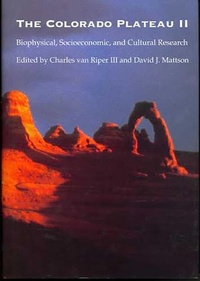
The Colorado Plateau II
Biophysical, Socioeconomic, and Cultural Research
Will be published approx. on 30. October 2005
Book
Hardback
448 pages
978-0-8165-2526-3 (ISBN)
Description
The publication of "bid1540.htm" The Colorado Plateau: Cultural, Biological, and Physical Research in 2004 marked a timely summation of current research in the Four Corners states. This new volume, derived from the seventh Biennial Conference on the Colorado Plateau in 2003, complements the previous book by focusing on the integration of science into resource management issues. The 32 chapters range in content from measuring human impacts on cultural resources, through grazing and the wildland-urban interface issues, to parameters of climate change on the Plateau. The book also introduces economic perspectives by considering shifting patterns and regional disparities in the Colorado Plateau economy. A series of chapters on mountain lions explores the human-wildland interface. These chapters deal with the entire spectrum of challenges associated with managing this large mammal species in Arizona and on the Colorado Plateau, conveying a wealth of timely information of interest to wildlife managers and enthusiasts.
Another provocative set of chapters on biophysical resources explores the management of forest restoration, from the micro scale all the way up to large-scale GIS analyses of ponderosa pine ecosystems on the Colorado Plateau. Given recent concerns for forest health in the wake of fires, severe drought, and bark-beetle infestation, these chapters will prove enlightening for forest service, park service, and land management professionals at both the federal and state level, as well as general readers interested in how forest management practices will ultimately affect their recreation activities. With broad coverage that touches on topics as diverse as movement patterns of rattlesnakes, calculating watersheds, and rescuing looted rockshelters, this volume stands as a compendium of cutting-edge research on the Colorado Plateau that offers a wealth of insights for many scholars.
Another provocative set of chapters on biophysical resources explores the management of forest restoration, from the micro scale all the way up to large-scale GIS analyses of ponderosa pine ecosystems on the Colorado Plateau. Given recent concerns for forest health in the wake of fires, severe drought, and bark-beetle infestation, these chapters will prove enlightening for forest service, park service, and land management professionals at both the federal and state level, as well as general readers interested in how forest management practices will ultimately affect their recreation activities. With broad coverage that touches on topics as diverse as movement patterns of rattlesnakes, calculating watersheds, and rescuing looted rockshelters, this volume stands as a compendium of cutting-edge research on the Colorado Plateau that offers a wealth of insights for many scholars.
More details
Language
English
Place of publication
Tucson
United States
Target group
College/higher education
Product notice
sewn/stitched
Cloth over boards
With dust jacket
Illustrations
illustrations
Dimensions
Height: 290 mm
Width: 174 mm
Thickness: 35 mm
Weight
1021 gr
ISBN-13
978-0-8165-2526-3 (9780816525263)
Copyright in bibliographic data and cover images is held by Nielsen Book Services Limited or by the publishers or by their respective licensors: all rights reserved.
Schweitzer Classification