

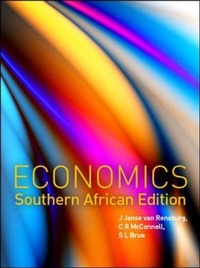
Economics
South African Edition
Published on 1. June 2011
Book
Paperback/Softback
676 pages
978-0-07-712457-1 (ISBN)
Description
Economics by van Rensburg, McConnell and Brue is an adaptation of the USA's market leading text, designed specifically for Southern African students. Taking the core principles of Economics, the author weaves regionally specific content and examples throughout to help bring relevance and application to the main theories. Combining Southern African content with a straightforward and accessible writing style, this book promises to help promote understanding of economics for all students.
More details
Edition
South African ed
Language
English
Place of publication
London
United States
Publishing group
McGraw-Hill Education - Europe
Target group
College/higher education
Dimensions
Height: 263 mm
Width: 197 mm
Thickness: 25 mm
Weight
1 gr
ISBN-13
978-0-07-712457-1 (9780077124571)
Copyright in bibliographic data and cover images is held by Nielsen Book Services Limited or by the publishers or by their respective licensors: all rights reserved.
Schweitzer Classification
Persons
Mr Jan Janse van Rensburg is a lecturer at the University of Pretoria. He is head of Undergraduate Economics courses at the university and has many years of experience teaching Principles of Economics.
Campbell R. McConnell earned his Ph.D. from the University of Iowa after receiving degrees from Cornell College and the University of Illinois. He taught at the University of Nebraska-Lincoln from 1953 until his retirement in 1990. He is also coauthor of Contemporary Labor Economics, Seventh edition, and Essentials of Economics, First edition (both The McGraw-Hill Companies), and has edited readers for the principles and labor economics courses. He is a recipient of both the University of Nebraska Distinguished Teaching Award and the James A. Lake Academic Freedom Award, and is past-president of the Midwest Economics Association. Professor McConnell was awarded an honorary Doctor of Laws degree from Cornell College in 1973 and received its Distinguished Achievement Award in 1994.
Stanley L. Brue did his undergraduate work at Augustana College (South Dakota) and received its Distinguished Achievement Award in 1991. He received his Ph.D. from the University of NebraskaLincoln. He is a professor at Pacific Lutheran University, where he has been honored as a recipient of the Burlington Northern Faculty Achievement Award. Professor Brue has also received the national Leavey Award for excellence in economic education. He has served as national president and chair of the Board of Trustees of Omicron Delta Epsilon International Economics Honorary. He is coauthor of Economic Scenes, Fifth edition (Prentice-Hall), Contemporary Labor Economics, Seventh edition, Essentials of Economics, First edition (both The McGraw-Hill Companies), and The Evolution of Economic Thought, Seventh edition (South-Western).
Campbell R. McConnell earned his Ph.D. from the University of Iowa after receiving degrees from Cornell College and the University of Illinois. He taught at the University of Nebraska-Lincoln from 1953 until his retirement in 1990. He is also coauthor of Contemporary Labor Economics, Seventh edition, and Essentials of Economics, First edition (both The McGraw-Hill Companies), and has edited readers for the principles and labor economics courses. He is a recipient of both the University of Nebraska Distinguished Teaching Award and the James A. Lake Academic Freedom Award, and is past-president of the Midwest Economics Association. Professor McConnell was awarded an honorary Doctor of Laws degree from Cornell College in 1973 and received its Distinguished Achievement Award in 1994.
Stanley L. Brue did his undergraduate work at Augustana College (South Dakota) and received its Distinguished Achievement Award in 1991. He received his Ph.D. from the University of NebraskaLincoln. He is a professor at Pacific Lutheran University, where he has been honored as a recipient of the Burlington Northern Faculty Achievement Award. Professor Brue has also received the national Leavey Award for excellence in economic education. He has served as national president and chair of the Board of Trustees of Omicron Delta Epsilon International Economics Honorary. He is coauthor of Economic Scenes, Fifth edition (Prentice-Hall), Contemporary Labor Economics, Seventh edition, Essentials of Economics, First edition (both The McGraw-Hill Companies), and The Evolution of Economic Thought, Seventh edition (South-Western).
Content
Part 1: Introduction to Economics and the Economy1: Limits, Alternatives and Choices
2: The Market System and the Circular Flow
Part 2: Micro-economics
3: Demand, Supply and Market Equilibrium
4: Extensions of Demand and Supply Analysis
5: Consumer Behaviour and Utility Maximization
6: The Costs of Production
7: Pure Competition and the Pure Monopoly
8: Monopolistic Competition and Oligopoly
Part 3: Labour and Money
9: Labour Market Institutions and Issues: Unionism, Discrimination, Immigration
10: Wage Determination
11: Income Inequality and Poverty
12: Money Banking, Interest Rates and Monetary Policy
13: Money Creation
Part 4: Macroeconomic Measurement and Basic Concepts
14: South Africa in Brief: Private and Public Sectors
15: Measuring Domestic Output and National Income
16: Basic Macroeconomic Relationships
17: The Aggregate Expenditure Model
18: Aggregate Demand and Aggregate Supply
19: Introduction to Economic Growth, Unemployment and Inflation
Part 5: Microeconomics of Government
20: Government and Market Failure
21: Fiscal Policy, Deficits and Debt
22: Public Choice Theory and the Economics of Taxation
23: Disputes over Macro Theory and Policy
Part 6: International Economics
24: International Trade
25: Exchange Rates, The Balance of Payments and Trade Deficits
26: South Africa in the Global Economy
27: The Economics of Developing Countries
2: The Market System and the Circular Flow
Part 2: Micro-economics
3: Demand, Supply and Market Equilibrium
4: Extensions of Demand and Supply Analysis
5: Consumer Behaviour and Utility Maximization
6: The Costs of Production
7: Pure Competition and the Pure Monopoly
8: Monopolistic Competition and Oligopoly
Part 3: Labour and Money
9: Labour Market Institutions and Issues: Unionism, Discrimination, Immigration
10: Wage Determination
11: Income Inequality and Poverty
12: Money Banking, Interest Rates and Monetary Policy
13: Money Creation
Part 4: Macroeconomic Measurement and Basic Concepts
14: South Africa in Brief: Private and Public Sectors
15: Measuring Domestic Output and National Income
16: Basic Macroeconomic Relationships
17: The Aggregate Expenditure Model
18: Aggregate Demand and Aggregate Supply
19: Introduction to Economic Growth, Unemployment and Inflation
Part 5: Microeconomics of Government
20: Government and Market Failure
21: Fiscal Policy, Deficits and Debt
22: Public Choice Theory and the Economics of Taxation
23: Disputes over Macro Theory and Policy
Part 6: International Economics
24: International Trade
25: Exchange Rates, The Balance of Payments and Trade Deficits
26: South Africa in the Global Economy
27: The Economics of Developing Countries