

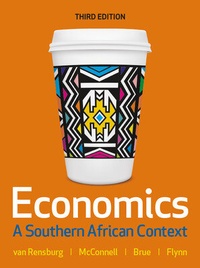
Economics: A Southern African Context, 3e
3rd Edition
Published on 27. April 2021
Book
Paperback/Softback
978-1-5268-4869-7 (ISBN)
Unfortunately, price unknown
No shipping information available
Description
Economics studies how people, businesses and governments use resources. What shapes our decisions? How do we allocate goods and services? What does a rational choice look like? In this third edition of Economics: A Southern African Context, the authors expertly guide us through the key principles of economics, providing a solid foundation in the subject. The text combines relevant Southern African examples with a clear and accessible narrative. By encouraging critical engagement with economic theories, it provides a basis for examining today's economic, social, and political issues.
Key Features:
A new structure to refocus the book and align with teaching
Additional online chapters, including the Economics of Pandemics, available in Connect®
Fully updated pedagogy, including Interactive Graphs, Last Word, and Quick Quiz boxes
Discussions on new developments in economics, such as the consequences of COVID-19 and the impact of BRICS membership on trade in South Africa
Revised end-of-chapter content to test comprehension, including Review Questions, Discussion Questions and Problems, available in Connect®
Economics: A Southern African Context is available with McGraw Hill's Connect®, the online learning platform which features resources to help faculty and institutions improve student outcomes and course delivery efficiency.
Jan J. Janse van Rensburg is a lecturer at the University of Pretoria. His main area of interest is in teaching and course development with a focus on Principles of Economics. He also specializes in Health Economics, concentrating on the economic effects and costs of substance abuse.
Campbell R. McConnell was a professor at the University of Nebraska-Lincoln, where he taught from 1953 until his retirement in 1990.
Stanley L. Brue is a professor at Pacific Lutheran University, where he has been honoured as a recipient of the Burlington Northern Faculty Achievement Award.
Sean M. Flynn is an associate professor of economics at Scripps College in Claremont, California.
Key Features:
A new structure to refocus the book and align with teaching
Additional online chapters, including the Economics of Pandemics, available in Connect®
Fully updated pedagogy, including Interactive Graphs, Last Word, and Quick Quiz boxes
Discussions on new developments in economics, such as the consequences of COVID-19 and the impact of BRICS membership on trade in South Africa
Revised end-of-chapter content to test comprehension, including Review Questions, Discussion Questions and Problems, available in Connect®
Economics: A Southern African Context is available with McGraw Hill's Connect®, the online learning platform which features resources to help faculty and institutions improve student outcomes and course delivery efficiency.
Jan J. Janse van Rensburg is a lecturer at the University of Pretoria. His main area of interest is in teaching and course development with a focus on Principles of Economics. He also specializes in Health Economics, concentrating on the economic effects and costs of substance abuse.
Campbell R. McConnell was a professor at the University of Nebraska-Lincoln, where he taught from 1953 until his retirement in 1990.
Stanley L. Brue is a professor at Pacific Lutheran University, where he has been honoured as a recipient of the Burlington Northern Faculty Achievement Award.
Sean M. Flynn is an associate professor of economics at Scripps College in Claremont, California.
More details
Persons
Author
Mr Jan Janse van Rensburg is a lecturer at the University of Pretoria. He is head of Undergraduate Economics courses at the university and has many years of experience teaching Principles of Economics.
Cambell R. McConnell earned his Ph.D. at the University of Iowa after receiving degrees from Cornell College and the University of Illinois. He taught at the University of Nebraska-Lincoln from 1953 until his retirement in 1990. He was also coauthor of Contemporary Labor Economics and Essentials of Economics. He was a recipient of both the University of Nebraska Distinguished Teaching Award and the James A. Lake Academic Freedom Award and served as president of the Midwest Economics Association. Professor McConnell was awarded an honorary Doctor of Laws degree from Cornell College in 1973 and received its Distinguished Achievement Award in 1994. He was also a jazz expert and aficionado until his passing in 2019.
Stanley L. Brue did his undergraduate work at Augustana College (South Dakota) and received its Distinguished Achievement Award in 1991. He received his Ph.D. from the University of Nebraska-Lincoln. He is retired from a long career at Pacific Lutheran University, where he was honored as a recipient of the Burlington Northern Faculty Achievement Award. Professor Brue has also received the national Leavey Award for excellence in economics education. He has served as national president and chair of the Board of Trustees of Omicron Delta Epsilon International Economics Honorary. He is coauthor of Economic Scenes, fifth edition (Prentice-Hall); Contemporary Labor Economics, twelfth edition; Essentials of Economics, fourth edition and The Evolution of Economic Thought, eighth edition (Cengage Learning). For relaxation, he enjoys international travel, attending sporting events, and going on fishing trips.
Sean M. Flynn did his undergraduate work at the University of Southern California before completing his Ph.D. at U.C. Berkeley, where he served as the Head Graduate Student Instructor for the Department of Economics after receiving the Outstanding Graduate Student Instructor Award. He teaches at Scripps College (of the Claremont Colleges) and is the author of Economics for Dummies, third edition (Wiley); Essentials of Economics, fourth edition; and The Cure That Works: How to Have the World's Best Healthcare-at a Quarter of the Price (Regnery). His research interests include behavioral finance, behavioral economics, and health care economics. An accomplished martial artist, Sean has coached five of his students to national championships and is the author of Understanding Shodokan Aikido. Other hobbies include running, traveling, and cooking.
Content
Part 1 Introduction to Economics and the Economy
1 Limits, Alternatives and Choices
2 The Market System and the Circular Flow
Part 2 Microeconomics
3 Demand, Supply and Market Equilibrium
4 Elasticity - an Application of Demand and Supply
5 Consumer Behaviour and Utility Maximization
6 The Costs of Production
7 Market Structures
Part 3 Labour, Money and Income Inequality
8 Wage Determination
9 Labour Market Institutions and Issues: Unionism, Discrimination, Immigration
10 Money, Banking, Interest Rates and Monetary Policy
11 Money Creation
12 Income Inequality and Poverty
Part 4 Macroeconomic Measurement and Basic Concepts
13 South Africa in Brief: Private and Public Sectors
14 Measuring Domestic Output and National Income
Page vii
15 Basic Macroeconomic Relationships
16 The Aggregate Expenditure Model
17 Aggregate Demand and Aggregate Supply
18 Introduction to Economic Growth, Unemployment and Inflation
Part 5 Microeconomics of Government
19 Government and Market Failure
20 Fiscal Policy, Deficits and Debt
21 Public Choice Theory and the Economics of Taxation
22 Disputes over Macro Theory and Policy
Part 6 International Economics
23 International Trade
24 Exchange Rates, the Balance of Payments and Trade Deficits
25 South Africa in the Global Economy
26 The Economics of Developing Countries
Glossary
Answers to Quick Quizzes
Index
1 Limits, Alternatives and Choices
2 The Market System and the Circular Flow
Part 2 Microeconomics
3 Demand, Supply and Market Equilibrium
4 Elasticity - an Application of Demand and Supply
5 Consumer Behaviour and Utility Maximization
6 The Costs of Production
7 Market Structures
Part 3 Labour, Money and Income Inequality
8 Wage Determination
9 Labour Market Institutions and Issues: Unionism, Discrimination, Immigration
10 Money, Banking, Interest Rates and Monetary Policy
11 Money Creation
12 Income Inequality and Poverty
Part 4 Macroeconomic Measurement and Basic Concepts
13 South Africa in Brief: Private and Public Sectors
14 Measuring Domestic Output and National Income
Page vii
15 Basic Macroeconomic Relationships
16 The Aggregate Expenditure Model
17 Aggregate Demand and Aggregate Supply
18 Introduction to Economic Growth, Unemployment and Inflation
Part 5 Microeconomics of Government
19 Government and Market Failure
20 Fiscal Policy, Deficits and Debt
21 Public Choice Theory and the Economics of Taxation
22 Disputes over Macro Theory and Policy
Part 6 International Economics
23 International Trade
24 Exchange Rates, the Balance of Payments and Trade Deficits
25 South Africa in the Global Economy
26 The Economics of Developing Countries
Glossary
Answers to Quick Quizzes
Index