

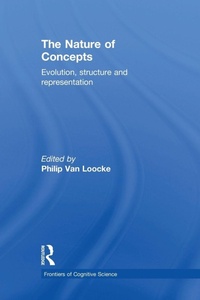
The Nature of Concepts
Evolution, Structure and Representation
1st Edition
Published on 2. December 2014
Book
Paperback/Softback
266 pages
978-1-138-88436-6 (ISBN)
Description
The Nature of Concepts examines a central issue for all the main disciplines in cognitive science: how the human mind creates and passes on to other human minds a concept. An excellent cross-disciplinary collection with contributors including Steven Pinker, Andy Clarke and Henry Plotkin.
More details
Series
Language
English
Place of publication
London
United Kingdom
Publishing group
Taylor & Francis Ltd
Target group
College/higher education
Professional and scholarly
Dimensions
Height: 234 mm
Width: 156 mm
Thickness: 15 mm
Weight
418 gr
ISBN-13
978-1-138-88436-6 (9781138884366)
Copyright in bibliographic data and cover images is held by Nielsen Book Services Limited or by the publishers or by their respective licensors: all rights reserved.
Schweitzer Classification
Other editions
Additional editions
E-Book
10/2012
1st Edition
Routledge
€64.49
Available for download
E-Book
10/2012
1st Edition
Routledge
€64.49
Available for download
Book
12/1998
Routledge
€231.90
Shipment within 15-20 days
Person
Philip Van Loocke is a Senior Research Associate of the Fund for Scientific Research (Flanders/Belgium) and Visiting Professor in Epistemology at the University of Ghent, Belgium.
Content
Introduction: the structure and representation of concepts 1 The nature of human concepts: evidence from an unusual source 2The modularity of language: some empirical considerations 3 The perspective of situated and self-organizing cognition in cognitive psychology 4 Complex systems methods in cognitive systems and there presentation of environmental information 5 Some psychological mechanisms of culture 6 Neural expectations: a possible evolutionary path from manual skills to language 7 Is "mind" a scientific kind? 8 Evolution and self-evidence 9 The development of scientific concepts and their embodiment in the representational activities of cognitive systems: neural representation spaces, theory spaces, and paradigmatic shifts 10 The concept of disease: structure and change