

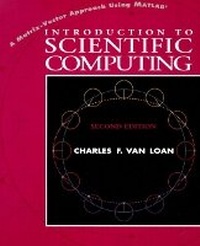
Introduction to Scientific Computing
A Matrix-Vector Approach Using MATLAB
2nd Edition
Published on 18. August 1999
Book
Paperback/Softback
367 pages
978-0-13-949157-3 (ISBN)
Description
For one-semester courses in Numerical Methods in computer science and engineering programs, and Numerical Analysis courses in mathematics programs.
Unique in content and approach, this text covers all the topics that are usually covered in an introduction to scientific computing-but folds in graphics and matrix-vector manipulation in a way that gets students to appreciate the connection between continuous mathematics and computing.Matlab 5 is used throughout to encourage experimentation, and each chapter focuses on a different important theorem-allowing students to appreciate the rigorous side of scientific computing. In addition to standard topical coverage, each chapter includes 1) a sketch of a "hard" problem that involves ill-conditioning, high dimension, etc.; 2) at least one theorem with both a rigorous proof and a "proof by MATLAB" experiment to bolster intuition; 3) at least one recursive algorithm; and 4) at least one connection to a real-world application. The text is brief and clear enough for introductory numerical analysis students to "get their feet wet," yet comprehensive enough in its treatment of problems and applications for higher-level students to develop a deeper grasp of numerical tools.
Unique in content and approach, this text covers all the topics that are usually covered in an introduction to scientific computing-but folds in graphics and matrix-vector manipulation in a way that gets students to appreciate the connection between continuous mathematics and computing.Matlab 5 is used throughout to encourage experimentation, and each chapter focuses on a different important theorem-allowing students to appreciate the rigorous side of scientific computing. In addition to standard topical coverage, each chapter includes 1) a sketch of a "hard" problem that involves ill-conditioning, high dimension, etc.; 2) at least one theorem with both a rigorous proof and a "proof by MATLAB" experiment to bolster intuition; 3) at least one recursive algorithm; and 4) at least one connection to a real-world application. The text is brief and clear enough for introductory numerical analysis students to "get their feet wet," yet comprehensive enough in its treatment of problems and applications for higher-level students to develop a deeper grasp of numerical tools.
More details
Edition
2nd edition
Language
English
Place of publication
United States
Publishing group
Pearson Education (US)
Target group
Professional and scholarly
Dimensions
Height: 192 mm
Width: 233 mm
Thickness: 18 mm
Weight
606 gr
ISBN-13
978-0-13-949157-3 (9780139491573)
Copyright in bibliographic data and cover images is held by Nielsen Book Services Limited or by the publishers or by their respective licensors: all rights reserved.
Schweitzer Classification
Other editions
New editions

Charles F. Van Loan
Introduction to Scientific Computing
Book
3rd Edition
Pearson
€54.52
The article will not be published
Previous edition
Book
09/1996
Pearson
€47.03
Article exhausted; check for reprint
Content
1. Power Tools of the Trade.
2. Polynomial Interpolation.
3. Piecewise Polynomial Interpolation.
4. Numerical Integration.
5. Matrix Computations.
6. Linear Systems.
7. The QR and Cholesky Factorizations.
8. Nonlinear Equations and Optimization.
9. The Initial Value Problem.
Bibliography.
Index.
2. Polynomial Interpolation.
3. Piecewise Polynomial Interpolation.
4. Numerical Integration.
5. Matrix Computations.
6. Linear Systems.
7. The QR and Cholesky Factorizations.
8. Nonlinear Equations and Optimization.
9. The Initial Value Problem.
Bibliography.
Index.