

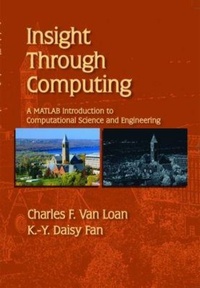
Insight Through Computing
A MATLAB Introduction to Computational Science and Engineering
Published on 30. December 2010
Book
Paperback/Softback
452 pages
978-0-89871-691-7 (ISBN)
Description
This introduction to computer-based problem-solving using the MATLAB (R) environment is highly recommended for students wishing to learn the concepts and develop the programming skills that are fundamental to computational science and engineering (CSE). Through a "teaching by examples" approach, the authors pose strategically chosen problems to help first-time programmers learn these necessary concepts and skills.
Each section formulates a problem and then introduces those new MATLAB (R) language features that are necessary to solve it. This approach puts problem-solving and algorithmic thinking first and syntactical details second. Each solution is followed by a "talking point" that concerns some related, larger issue associated with CSE. Collectively, the worked examples, talking points, and 300+ homework problems build intuition for the process of discretization and an appreciation for dimension, inexactitude, visualization, randomness, and complexity. This sets the stage for further coursework in CSE areas.
The interplay between programming and mathematics throughout the text reinforces the student's ability to reason numerically and geometrically.
Each section formulates a problem and then introduces those new MATLAB (R) language features that are necessary to solve it. This approach puts problem-solving and algorithmic thinking first and syntactical details second. Each solution is followed by a "talking point" that concerns some related, larger issue associated with CSE. Collectively, the worked examples, talking points, and 300+ homework problems build intuition for the process of discretization and an appreciation for dimension, inexactitude, visualization, randomness, and complexity. This sets the stage for further coursework in CSE areas.
The interplay between programming and mathematics throughout the text reinforces the student's ability to reason numerically and geometrically.
More details
Language
English
Place of publication
New York
United States
Target group
Professional and scholarly
Product notice
Paperback (trade)
Dimensions
Height: 260 mm
Width: 179 mm
Thickness: 24 mm
Weight
753 gr
ISBN-13
978-0-89871-691-7 (9780898716917)
Copyright in bibliographic data and cover images is held by Nielsen Book Services Limited or by the publishers or by their respective licensors: all rights reserved.
Schweitzer Classification
Persons
Charles F. Van Loan has been at Cornell University since 1975, where he is a Professor of Computer Science and the Joseph C. Ford Professor of Engineering. He is a SIAM Fellow and the author of Matrix Computations (with G. H. Golub; Johns Hopkins, 1996), Introduction to Scientific Computing: A Matrix-Vector Approach Using MATLAB (Prentice Hall, 1999), Computational Frameworks for the Fast Fourier Transform (SIAM, 1992), Handbook for Matrix Computations (with T. F. Coleman; SIAM, 1988), and Introduction to Computational Science and Mathematics (James and Bartlett, 1996). K.-Y. Daisy Fan is a Senior Lecturer in the Department of Computer Science at Cornell University. She has a Ph.D. in Civil and Environmental Engineering and for the past eight years has taught programming and scientific computing using MATLAB, Java(TM), and Lego (R) Mindstorms (R) robotics.
Content
Preface
MATLAB Glossary
Programming Topics
Software
Chapter 1: From Formula to Program
Chapter 2: Limits and Error
Chapter 3: Approximation with Fractions
Chapter 4: The Discrete versus the Continuous
Chapter 5: Abstraction
Chapter 6: Randomness
Chapter 7: The Second Dimension
Chapter 8: Reordering
Chapter 9: Search
Chapter 10: Points, Polygons, and Circles
Chapter 11: Text File Processing
Chapter 12: The Matrix: Part II
Chapter 13: Acoustic File Processing
Chapter 14: Divide and Conquer
Chapter 15: Optimization
Appendix A: Refined Graphics
Appendix B: Mathematical Facts
Appendix C: MATLAB, Java, and C
Appendix D: Exit Interview
Index
MATLAB Glossary
Programming Topics
Software
Chapter 1: From Formula to Program
Chapter 2: Limits and Error
Chapter 3: Approximation with Fractions
Chapter 4: The Discrete versus the Continuous
Chapter 5: Abstraction
Chapter 6: Randomness
Chapter 7: The Second Dimension
Chapter 8: Reordering
Chapter 9: Search
Chapter 10: Points, Polygons, and Circles
Chapter 11: Text File Processing
Chapter 12: The Matrix: Part II
Chapter 13: Acoustic File Processing
Chapter 14: Divide and Conquer
Chapter 15: Optimization
Appendix A: Refined Graphics
Appendix B: Mathematical Facts
Appendix C: MATLAB, Java, and C
Appendix D: Exit Interview
Index