

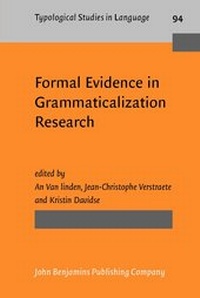
Formal Evidence in Grammaticalization Research
Published on 25. November 2010
Book
Hardback
344 pages
978-90-272-0675-6 (ISBN)
Description
This collective volume focuses on the crucial role of formal evidence in recognizing and explaining instances of grammaticalization. It addresses the hitherto neglected issue of system-internal factors steering grammaticalization and also revisits formal recognition criteria such as Lehmann and Hopper's parameters of grammaticalization. The articles investigate developments of such phenomena as modal auxiliaries, attitudinal markers, V1-conditionals, nominalizers, and pronouns, using data from a wide range of languages and (in some cases) from diachronic corpora. In the process, they explore finer mechanisms of grammaticalization such as modification of coding means, structural and semantic analogy, changes in frequency and prosody, and shifts in collocational and grammatical distribution. The volume is of particular interest to historical linguists working on grammaticalization, and general linguists working on the interface between syntax, semantics and pragmatics, as well as that between synchrony and diachrony.
More details
Series
Language
English
Place of publication
Amsterdam
Netherlands
Target group
Professional and scholarly
Illustrations
+ index
Dimensions
Height: 245 mm
Width: 164 mm
Weight
800 gr
ISBN-13
978-90-272-0675-6 (9789027206756)
Copyright in bibliographic data and cover images is held by Nielsen Book Services Limited or by the publishers or by their respective licensors: all rights reserved.
Schweitzer Classification
Other editions
Additional editions
An Van Linden | Jean-Christophe Verstraete | Kristin Davidse
Formal Evidence in Grammaticalization Research
E-Book
11/2010
1st Edition
John Benjamins Publishing Company
€123.99
Available for download
Persons
Content
1. Acknowledgements; 2. Introduction (by Davidse, Kristin); 3. On problem areas in grammaticalization: Lehmann's parameters and the issue of scope (by Fischer, Olga); 4. Grammaticalization within and outside of a domain (by Frajzyngier, Zygmunt); 5. Delexicalizing di: How a Chinese noun has evolved into an attitudinal nominalizer (by Yap, Foong Ha); 6. Should conditionals be emergent ...: Asyndetic subordination in German and English as a challenge to grammaticalization research (by Nest, Daan Van den); 7. From manner expression to attitudinal discourse marker: The case of Dutch anders (by Smessaert, Hans); 8. Grammaticalization and lexicalization effects in participial morphology: A Construction Grammar approach to language change (by Fried, Mirjam); 9. Frequency as a cause of semantic change: With focus on the second person form omae in Japanese (by Reijirou, Shibasaki); 10. The role of frequency and prosody in the grammaticalization of Korean -canh- (by Sohn, Sung-Ock S.); 11. Emergence of the indefinite article: Discourse evidence for the grammaticalization of yige in spoken Mandarin (by Liu, Mei-chun); 12. To dare to or not to: Is auxiliarization reversible? (by Schluter, Julia); 13. Author index; 14. Index of languages and language families; 15. Subject index