

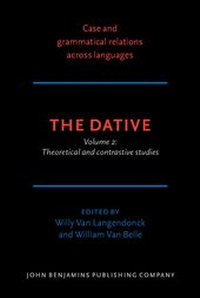
The Dative
Volume 2: Theoretical and contrastive studies
Published on 15. September 1998
Book
Hardback
296 pages
978-90-272-2813-0 (ISBN)
Description
This book is the second part of a two-volume reader on the 'Dative'. In the first part, which appeared in 1996, eleven papers were presented providing a syntactic and semantic description of the category 'Dative' in eleven languages. The aim of this second part is to discuss several aspects of the Dative in greater detail. It contains eight papers dealing with theoretical considerations on 'dativity' as well as with contrastive, typological and diachronic issues. A major concern is the relation between form (case, grammatical relation) and meaning (semantic roles or other kinds of meaning).
Most contributions in this volume represent cognitive and functional views or a critical discussion of them.
As in the first volume, the linguistic material mainly stems from Germanic and Romance languages. Contemporary English is the basis for Davidse's theoretical claims; Pasicki studies the dative in Old English. Dutch appears especially in Geeraerts' semantic analysis, but also in the papers by Draye, Lamiroy & Delbecque and Van Langendonck. Draye, Lamiroy & Delbecque and Melis also take German into consideration. Latin is dealt with by Melis and Van Langendonck. Modern Romance languages, especially French, provide further data for Melis and Lamiroy & Delbecque. Finally, Newman adduces a variety of languages for his typological analyses.
Most contributions in this volume represent cognitive and functional views or a critical discussion of them.
As in the first volume, the linguistic material mainly stems from Germanic and Romance languages. Contemporary English is the basis for Davidse's theoretical claims; Pasicki studies the dative in Old English. Dutch appears especially in Geeraerts' semantic analysis, but also in the papers by Draye, Lamiroy & Delbecque and Van Langendonck. Draye, Lamiroy & Delbecque and Melis also take German into consideration. Latin is dealt with by Melis and Van Langendonck. Modern Romance languages, especially French, provide further data for Melis and Lamiroy & Delbecque. Finally, Newman adduces a variety of languages for his typological analyses.
Reviews / Votes
[...] a stimulating piece of work since it covers the central theoretical perspectives and problems. -- Tomoko O. Hansen, Department of East European and Oriental Studies, University of Oslo, NorwayMore details
Series
Language
English
Place of publication
Amsterdam
Netherlands
Target group
College/higher education
Professional and scholarly
Dimensions
Height: 245 mm
Width: 164 mm
Weight
700 gr
ISBN-13
978-90-272-2813-0 (9789027228130)
Copyright in bibliographic data and cover images is held by Nielsen Book Services Limited or by the publishers or by their respective licensors: all rights reserved.
Schweitzer Classification
Other editions
Additional editions
E-Book
09/1998
1st Edition
John Benjamins Publishing Company
€144.99
Available for download
Persons
Content
1. List of abbreviations; 2. introduction; 3. Recipients and 'give' constructions (by Newman, John); 4. The possessive dative in romance and Germanic languages (by Lamiroy, Beatrice); 5. The case of the causee. On the competition between dative and accusative in Dutch laten and German lassen constructions (by Draye, Luk); 6. Meanings of the dative case in Old English (by Pasicki, Adam); 7. The dative as participant role versus the Indirect Object: on the need to distinguish two layers of organization (by Davidse, Kristin); 8. The semantic structure of the indirect object in Dutch (by Geeraerts, Dirk); 9. The dative in Latin and the indirect object in Dutch (by Van Langendonck, Willy); 10. From form to interpretation: building up the 'dative'-roles (by Melis, Ludo); 11. Subject index