

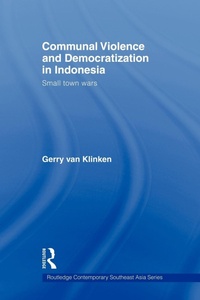
Communal Violence and Democratization in Indonesia
Small Town Wars
1st Edition
Published on 17. September 2009
Book
Paperback/Softback
204 pages
978-0-415-49397-0 (ISBN)
Description
Through close scrutiny of empirical materials and interviews, this book uniquely analyzes all the episodes of long-running, widespread communal violence that erupted during Indonesia's post-New Order transition.
Indonesia democratised after the long and authoritarian New Order regime ended in May 1998. But the transition was far less peaceful than is often thought. It claimed about 10,000 lives in communal (ethnic and religious) violence, and nearly as many as that again in separatist violence in Aceh and East Timor.
Taking a comprehensive look at the communal violence that arose after the New Order regime, this book will be of interest to students of Southeast Asian studies, social movements, political violence and ethnicity.
Indonesia democratised after the long and authoritarian New Order regime ended in May 1998. But the transition was far less peaceful than is often thought. It claimed about 10,000 lives in communal (ethnic and religious) violence, and nearly as many as that again in separatist violence in Aceh and East Timor.
Taking a comprehensive look at the communal violence that arose after the New Order regime, this book will be of interest to students of Southeast Asian studies, social movements, political violence and ethnicity.
Reviews / Votes
'...In a way few more ethnographically intensive studies can, van Klinken's volume will be exceptionally useful to students of contentious politics. In particular, the volume offers a way to bring serious discussion of Indonesia - and of a very tidy set of case studies - into classes on comparative politics, nationalism, or political violence. Moreover, the volume's conciseness and eminent readability, as well as the very fact that by not claiming to have all the answers, van Klinken invites debate and discussion, make it all the more suited for classroom use.' Meredith Weiss, Democratization'...Van Klinken's equally structuralist account looks up from the inequalities and tensions of district and region. It is an unexpectedly revelatory vantage point, and Van Klinken explores it with empirical rigor, theoretical originality, and narrative brilliance.' Bob Hefner, Journal of Asian Studies
"I found that van Klinken's book works very well when teaching undergraduates. I used it in an undergraduate course on communal violence in Indonesia, and my students enjoyed the book, easily understood van Klinken's arguments, and found the text to be informative. It would also work well in graduate courses. The book has been translated into Indonesian and could be used in Indonesian universities as well...van Klinken's book is a welcome addition to the expanding corpus of work on violence in Indonesia and should be required reading for anyone interested in the topic of communal violence in Southeast Asia." - Christopher R. Duncan, Indonesia 87 (April 2009)
More details
Series
Language
English
Place of publication
London
United Kingdom
Publishing group
Taylor & Francis Ltd
Target group
College/higher education
Professional and scholarly
Illustrations
9 s/w Abbildungen, 9 s/w Zeichnungen, 6 s/w Tabellen
6 Tables, black and white; 9 Line drawings, black and white; 9 Illustrations, black and white
Dimensions
Height: 234 mm
Width: 156 mm
Thickness: 11 mm
Weight
324 gr
ISBN-13
978-0-415-49397-0 (9780415493970)
Copyright in bibliographic data and cover images is held by Nielsen Book Services Limited or by the publishers or by their respective licensors: all rights reserved.
Schweitzer Classification
Other editions
Additional editions
E-Book
01/2007
Routledge
€64.49
Available for download
E-Book
01/2007
Routledge
€64.49
Available for download
Book
01/2007
1st Edition
Routledge
€231.50
Shipment within 15-20 days
Person
Gerry van Klinken is a Research Fellow at KITLV/ Royal Netherlands Institute of Southeast Asian and Caribbean Studies, The Netherlands.
Content
1. Introduction 2. Why Now? Temporal Contexts 3. Why Here? The Town beyond Java 4. Identity Formation in West Kalimantan 5. Escalation in Poso 6. Mobilization in Ambon 7. Polarization in North Maluku 8. Actor Constitution in Central Kalimantan 9. Concluding Reflections