

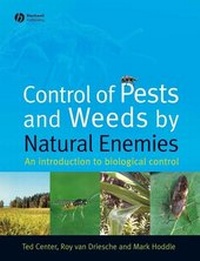
Control of Pests and Weeds by Natural Enemies
An Introduction to Biological Control
Published on 15. April 2008
Book
Paperback/Softback
484 pages
978-1-4051-4571-8 (ISBN)
Description
Biological control - utilizing a population of natural enemies to seasonally or permanently suppress pests - is not a new concept. The cottony cushion scale, which nearly destroyed the citrus industry of California, was controlled by an introduced predatory insect in the 1880s. Accelerated invasions by insects and spread of weedy non-native plants in the last century have increased the need for the use of biological control. Use of carefully chosen natural enemies has become a major tool for the protection of natural ecosystems, biodiversity and agricultural and urban environments.
This book offers a multifaceted yet integrated discussion on two major applications of biological control: permanent control of invasive insects and plants at the landscape level and temporary suppression of both native and exotic pests in farms, tree plantations, and greenhouses. Written by leading international experts in the field, the text discusses control of invasive species and the role of natural enemies in pest management.
This book is essential reading for courses on Invasive Species, Pest Management, and Crop Protection. It is an invaluable reference book for biocontrol professionals, restorationists, agriculturalists, and wildlife biologists.
Further information and resources can be found on the Editor's own website at: www.invasiveforestinsectandweedbiocontrol.info/index.htm
This book offers a multifaceted yet integrated discussion on two major applications of biological control: permanent control of invasive insects and plants at the landscape level and temporary suppression of both native and exotic pests in farms, tree plantations, and greenhouses. Written by leading international experts in the field, the text discusses control of invasive species and the role of natural enemies in pest management.
This book is essential reading for courses on Invasive Species, Pest Management, and Crop Protection. It is an invaluable reference book for biocontrol professionals, restorationists, agriculturalists, and wildlife biologists.
Further information and resources can be found on the Editor's own website at: www.invasiveforestinsectandweedbiocontrol.info/index.htm
Reviews / Votes
"This text will be valued by students, biocontrol professionals, farmers, and ecologists concerned with invasive species and pest management." (Southeastern Naturalist, July 2008) "Valuable for upper-level curricula and as a reference course ... Highly recommended." (CHOICE, January 2009)More details
Product info
Paperback
Edition
1. Auflage
Language
English
Place of publication
Hoboken
United Kingdom
Publishing group
John Wiley and Sons Ltd
Target group
Professional and scholarly
Upper level undergraduate and graduate students of agricultural science, pest management, biological control, crop protection, crop science, and entomology, biocontrol professionals, restorationists, agriculturalists, and wildlife monitors.
Dimensions
Height: 24.3 cm
Width: 18.9 cm
Thickness: 2.3 cm
Weight
1088 gr
ISBN-13
978-1-4051-4571-8 (9781405145718)
Schweitzer Classification
Other editions
Additional editions
Roy Van Driesche | Mark Hoddle | Ted Center
Control of Pests and Weeds by Natural Enemies
An Introduction to Biological Control
E-Book
01/2009
Wiley-Blackwell
€73.99
Available for download
Persons
Roy Van Driesche, University of Massachusetts, is an expert in biological control in the Entomology Division of the University of Massachusetts at Amherst. An earlier book on this topic by Van Driesche was published in 1996 as well as one on the invasive species problem. He is currently working to resolve the threat to eastern hemlock (a native forest tree) posed by an invasive Japanese adelgid.
Mark Hoddle, University of California, Riverside, has written numerous articles and edited conference proceedings on biocontrol. He has recently successfully controlled the glassy wing sharpshooter in French Polynesia with introduced egg parasitoids.
Ted Center, US Department of Agriculture, Agriculture Research Service, is a world leader in biological control of invasive plants, in particular against the world's worst water weed, waterhyacinth, and against melaleuca, an invasive Australian tree threatening the survival of the Florida Everglades, a World Heritage site.
Mark Hoddle, University of California, Riverside, has written numerous articles and edited conference proceedings on biocontrol. He has recently successfully controlled the glassy wing sharpshooter in French Polynesia with introduced egg parasitoids.
Ted Center, US Department of Agriculture, Agriculture Research Service, is a world leader in biological control of invasive plants, in particular against the world's worst water weed, waterhyacinth, and against melaleuca, an invasive Australian tree threatening the survival of the Florida Everglades, a World Heritage site.
Content
Preface.
Part I: Scope of biological control:.
1. Introduction.
2. Types of biological control, targets, and agents.
Part II: Kinds of natural enemies:.
3. Parasitoid diversity and ecology.
4. Predator diversity and ecology.
5. Weed biocontrol agent diversity and ecology.
6. Arthropod pathogen diversity and ecology.
Part III: Invasions: why biological control is needed:.
7. The invasion crisis.
8. Ways to suppress invasive species.
Part IV: Natural enemy introductions: theory and practice:.
9. Interaction webs as the conceptual framework for classical biological control.
10. The role of population ecology and population models in biological control: Joseph Elkinton (University of Massachusetts).
12. Weed biological control.
Part V: Tools for classical biological control:.
13. Foreign exploration.
14. Climate matching.
15. Molecular tools: Richard Stouthamer (University of California Riverside).
Part VI: Safety:.
16. Non-target impacts of biological control agents.
17. Predicting natural enemy host ranges.
18. Avoiding indirect non-target impacts.
Part VII: Measuring natural enemy impacts on pests:.
19. Field colonization of natural enemies.
20. Natural enemy evaluation.
Part VIII: Conserving biological control agents in crops:.
21. Protecting natural enemies from pesticides.
22. Enhancing crops as natural enemy environments.
Part IX: Biopesticides:.
23. Microbial pesticides: issues and concepts.
24. Use of arthropod pathogens as pesticides.
Part X: Augmentative biological control:.
25. Biological control in greenhouses.
26. Augmentative release of natural enemies in outdoor crops.
Part XI: Other targets and new directions:.
27. Vertebrate pests.
28. Expanding the biological control horizon: new purposes and new targets.
29. Future directions.
References.
Index
Part I: Scope of biological control:.
1. Introduction.
2. Types of biological control, targets, and agents.
Part II: Kinds of natural enemies:.
3. Parasitoid diversity and ecology.
4. Predator diversity and ecology.
5. Weed biocontrol agent diversity and ecology.
6. Arthropod pathogen diversity and ecology.
Part III: Invasions: why biological control is needed:.
7. The invasion crisis.
8. Ways to suppress invasive species.
Part IV: Natural enemy introductions: theory and practice:.
9. Interaction webs as the conceptual framework for classical biological control.
10. The role of population ecology and population models in biological control: Joseph Elkinton (University of Massachusetts).
12. Weed biological control.
Part V: Tools for classical biological control:.
13. Foreign exploration.
14. Climate matching.
15. Molecular tools: Richard Stouthamer (University of California Riverside).
Part VI: Safety:.
16. Non-target impacts of biological control agents.
17. Predicting natural enemy host ranges.
18. Avoiding indirect non-target impacts.
Part VII: Measuring natural enemy impacts on pests:.
19. Field colonization of natural enemies.
20. Natural enemy evaluation.
Part VIII: Conserving biological control agents in crops:.
21. Protecting natural enemies from pesticides.
22. Enhancing crops as natural enemy environments.
Part IX: Biopesticides:.
23. Microbial pesticides: issues and concepts.
24. Use of arthropod pathogens as pesticides.
Part X: Augmentative biological control:.
25. Biological control in greenhouses.
26. Augmentative release of natural enemies in outdoor crops.
Part XI: Other targets and new directions:.
27. Vertebrate pests.
28. Expanding the biological control horizon: new purposes and new targets.
29. Future directions.
References.
Index