

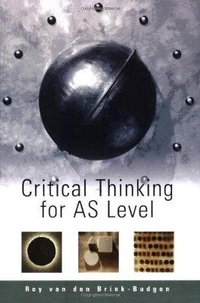
Critical Thinking For As Level
Published on 30. September 2005
Book
Paperback/Softback
160 pages
978-1-84528-085-7 (ISBN)
Description
In one volume it covers: Unit 1. Credibility of evidence; how context can affect credibility; issues of perception, language, interpretation, and judgement; different types of evidence; results of bias; possible weaknesses and strengths; using a credibility calculus; judging a case. Unit 2. Assessing and developing argument; differences between arguments and other forms of persuasion; what forms arguments can take; the nature of conclusions; assumptions and evidence; evaluating arguments; special kinds of argument content; producing arguments.
Reviews / Votes
"'Students will not only be able to better understand their course material but also to produce better essays and assignments.' Focus on Business Education 'When teaching for the OCR AS-level course I found this an ideal book - the right depth for teachers and the right length for students. It is written with such obvious enthusiasm for lucid and practical thinking that it can be recommended to teachers and students in any field.' Roger Sutcliffe, Chairman, Sapere"More details
Language
English
Place of publication
London
United Kingdom
Publishing group
Little, Brown Book Group
Target group
College/higher education
Dimensions
Height: 235 mm
Width: 155 mm
ISBN-13
978-1-84528-085-7 (9781845280857)
Copyright in bibliographic data and cover images is held by Nielsen Book Services Limited or by the publishers or by their respective licensors: all rights reserved.
Schweitzer Classification
Person
Dr Roy van den Brink-Budgen has been developing assessment materials in Critical Thinking for eighteen years, and has been teaching it for ten. His significant contribution to the development of the subject as one of growing importance in the curriculum is well-known. Roy has also probably taught more INSETs for staff in Critical Thinking than anyone else in the country. His previous book Critical Thinking for Students became the most widely-used textbook in the subject, commended by both teachers and students on many courses.
Content
In one volume it covers: Unit 1. Credibility of evidence; how context can affect credibility; issues of perception, language, interpretation, and judgement; different types of evidence; results of bias; possible weaknesses and strengths; using a credibility calculus; judging a case. Unit 2. Assessing and developing argument; differences between arguments and other forms of persuasion; what forms arguments can take; the nature of conclusions; assumptions and evidence; evaluating arguments; special kinds of argument content; producing arguments.