

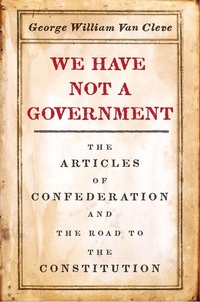
We Have Not a Government
The Articles of Confederation and the Road to the Constitution
Published on 5. April 2019
Book
Paperback/Softback
400 pages
978-0-226-64152-2 (ISBN)
Description
In 1783, as the Revolutionary War came to a close, Alexander Hamilton resigned in disgust from the Continental Congress after it refused to consider a fundamental reform of the Articles of Confederation. Just four years later, that same government collapsed, and Congress grudgingly agreed to support the 1787 Philadelphia Constitutional Convention, which altered the Articles beyond recognition. What occurred during this remarkably brief interval to cause the Confederation to lose public confidence and inspire Americans to replace it with a dramatically more flexible and powerful government? We Have Not a Government is the story of this contentious moment in American history.
In George William Van Cleve's book, we encounter a sharply divided America. The Confederation faced massive war debts with virtually no authority to compel its members to pay them. It experienced punishing trade restrictions and strong resistance to American territorial expansion from powerful European governments. Bitter sectional divisions that deadlocked the Continental Congress arose from exploding western settlement. And a deep, long-lasting recession led to sharp controversies and social unrest across the country amid roiling debates over greatly increased taxes, debt relief, and paper money. Van Cleve shows how these remarkable stresses transformed the Confederation into a stalemate government and eventually led previously conflicting states, sections, and interest groups to advocate for a union powerful enough to govern a continental empire.
Touching on the stories of a wide-ranging cast of characters--including John Adams, Patrick Henry, Daniel Shays, George Washington, and Thayendanegea--Van Cleve makes clear that it was the Confederation's failures that created a political crisis and led to the 1787 Constitution. Clearly argued and superbly written, We Have Not a Government is a must-read history of this crucial period in our nation's early life.
In George William Van Cleve's book, we encounter a sharply divided America. The Confederation faced massive war debts with virtually no authority to compel its members to pay them. It experienced punishing trade restrictions and strong resistance to American territorial expansion from powerful European governments. Bitter sectional divisions that deadlocked the Continental Congress arose from exploding western settlement. And a deep, long-lasting recession led to sharp controversies and social unrest across the country amid roiling debates over greatly increased taxes, debt relief, and paper money. Van Cleve shows how these remarkable stresses transformed the Confederation into a stalemate government and eventually led previously conflicting states, sections, and interest groups to advocate for a union powerful enough to govern a continental empire.
Touching on the stories of a wide-ranging cast of characters--including John Adams, Patrick Henry, Daniel Shays, George Washington, and Thayendanegea--Van Cleve makes clear that it was the Confederation's failures that created a political crisis and led to the 1787 Constitution. Clearly argued and superbly written, We Have Not a Government is a must-read history of this crucial period in our nation's early life.
Reviews / Votes
"With careful attention and rich research, this book examines in depth each of the ways that the Confederation failed."--David O. Stewart "Washington Independent Review of Books " "[Van Cleve] describes in great detail the varied and complicated issues faced by the impotent, insolvent Congress. . . .This detailed and well-researched history and analysis will appeal to scholars and serious popular history buffs."--Library Journal "We Have Not a Government provides a focused explanation of the reasons the Articles of Confederation, the nation's first federal constitution, went lurching toward collapse. . . .Van Cleve patiently examines the specific matters of public policy that vexed national politics in the mid-1780s. He draws sharp conclusions and generally takes decided stands on matters that historians still actively dispute. . . .What Van Cleve does demonstrate, persuasively, is that the genuine crisis of the Confederation required creating a "staggeringly powerful" national government through a "grand bargain" that went well beyond what any state might have asked for itself."--Jack Rakove, Pulitzer Prize winner "Washington Post "More details
Language
English
Place of publication
Chicago
United States
Publishing group
The University of Chicago Press
Product notice
Paperback (trade)
Unsewn / adhesive bound
Dimensions
Height: 229 mm
Width: 152 mm
Thickness: 28 mm
Weight
567 gr
ISBN-13
978-0-226-64152-2 (9780226641522)
Copyright in bibliographic data and cover images is held by Nielsen Book Services Limited or by the publishers or by their respective licensors: all rights reserved.
Schweitzer Classification
Person
George William Van Cleve is research professor in law and history at Seattle University School of Law. He is the author of A Slaveholders' Union, also published by the University of Chicago Press. He received his Ph.D. from the University of Virginia, and his J.D. from Harvard Law School.