

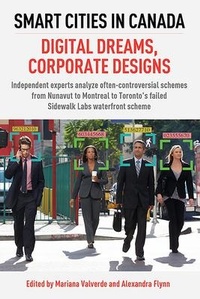
Smart Cities for Canada
Promise and Perils
Published on 15. June 2021
Book
Paperback/Softback
128 pages
978-1-4594-1544-7 (ISBN)
Description
"Smart cities" use surveillance, big data processing and interactive technologies to reshape urban life. Transit riders can see the bus coming on a map on their phones. Cities can measure and analyze the garbage collected from every household. Businesses can track individuals' movements and precisely target advertisements.
Google's failed Sidewalk Labs proposal in Toronto, which drew sharp criticism over surveillance and privacy concerns, is just one of the many smart city projects which have been proposed or are underway in Canada. Iqaluit, Edmonton, Guelph, Montreal, Toronto and other cities and towns are all grappling with how to use these technologies. Some cities have quickly partnered with digital giants like Uber, Bell and IBM. Others have kept their distance. Big tech companies are hard at work recruiting customers and shaping - sometimes making - public policy on data collection and privacy.
Smart Cities for Canada: Promise and Perils is the first book on smart cities in Canada. In this collection, experts from across the country investigate what this new approach means for the problems cities face, and expose the larger issues about urban planning and democracy raised by smart city technology. This is a valuable, timely, independent-minded book for Canadians.
Google's failed Sidewalk Labs proposal in Toronto, which drew sharp criticism over surveillance and privacy concerns, is just one of the many smart city projects which have been proposed or are underway in Canada. Iqaluit, Edmonton, Guelph, Montreal, Toronto and other cities and towns are all grappling with how to use these technologies. Some cities have quickly partnered with digital giants like Uber, Bell and IBM. Others have kept their distance. Big tech companies are hard at work recruiting customers and shaping - sometimes making - public policy on data collection and privacy.
Smart Cities for Canada: Promise and Perils is the first book on smart cities in Canada. In this collection, experts from across the country investigate what this new approach means for the problems cities face, and expose the larger issues about urban planning and democracy raised by smart city technology. This is a valuable, timely, independent-minded book for Canadians.
More details
Language
English
Place of publication
Toronto
Canada
Target group
Professional and scholarly
Product notice
Paperback (trade)
Unsewn / adhesive bound
Dimensions
Height: 226 mm
Width: 152 mm
Thickness: 13 mm
Weight
318 gr
ISBN-13
978-1-4594-1544-7 (9781459415447)
Copyright in bibliographic data and cover images is held by Nielsen Book Services Limited or by the publishers or by their respective licensors: all rights reserved.
Schweitzer Classification
Persons
Mariana Valverde is a Professor at University of Toronto Centre for Criminology & Sociolegal Studies, and a Fellow of the Royal society of Canada. Her fields of study are the legal regulation of sexuality, socio-legal theory, historical sociology, and urban governance and law. She has written eight books, co-edited four anthologies and over 45 articles. In 2016 she received the Kalven prize of the Law and Society Association, for her longstanding contribution to empirical socio-legal scholarship. In addition to scholarly publishing, Mariana also writes for magazines, newspapers, and online forums, mostly on public-private infrastructure partnerships but occasionally on other topics; she has been published in The Conversation and Spacing Magazine. Professor Valverde lives in Toronto. Alexandra Flynn is an Assistant Professor at the Peter A. Allard School of Law at The University of British Columbia, where she specializes in municipal law and governance. She teaches interactive, practice-based courses in legal research, municipal and planning law, and administrative law. Prior to joining UBC, Alex was an Assistant Professor in the City Studies program at the University of Toronto (Scarborough), where she taught and researched in the areas of urban governance, property, and local government law. Her previous project, "Reimagining Local Governance: The Landscape of 'Local' in Toronto" (2017), examined Toronto's complex local governance model along with its motley of institutions - some granted delegated authority and some not. Her current project focuses on Indigenous-municipal relationships in the land use planning process. In 2017, she received a SSHRC Insight Development Grant to investigate the notion of a "municipal duty to consult" and its potential for reciprocal, respectful relationships between Indigenous and municipal governments.