

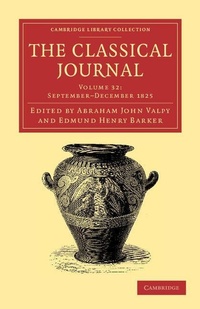
The Classical Journal
Published on 28. February 2013
Book
Paperback/Softback
388 pages
978-1-108-05813-1 (ISBN)
Description
A precursor of modern academic journals, this quarterly periodical, published between 1810 and 1829 and now reissued in forty volumes, was founded and edited by Abraham John Valpy (1787-1854). Educated at Pembroke College, Oxford, Valpy established himself in London as an editor and publisher, primarily of classical texts. Edmund Henry Barker (1788-1839), who had studied at Trinity College, Cambridge, became a contributor and then co-editor of this journal, which fuelled a scholarly feud with the editors of the Museum criticum (1813-26), a rival periodical (also reissued in the Cambridge Library Collection). Although its coverage overlapped with that of its competitor, the Classical Journal also included general literary and antiquarian articles as well as Oxford and Cambridge prize poems and examination papers. It remains a valuable resource, illuminating the development of nineteenth-century classical scholarship and academic journals. Volume 32 contains the September and December issues for 1825.
More details
Series
Language
English
Place of publication
Cambridge
United Kingdom
Target group
College/higher education
Professional and scholarly
Product notice
Paperback (trade)
Illustrations
Worked examples or Exercises
Dimensions
Height: 216 mm
Width: 140 mm
Thickness: 23 mm
Weight
546 gr
ISBN-13
978-1-108-05813-1 (9781108058131)
Copyright in bibliographic data and cover images is held by Nielsen Book Services Limited or by the publishers or by their respective licensors: all rights reserved.
Schweitzer Classification
Other editions
Complete work / Part of the work
Abraham John Valpy | Edmund Henry Barker
The Classical Journal 40 Volume Set
Book
02/2013
Cambridge University Press
€1,903.21
Article is exhausted, reprint undefined
Content
Part LXIII. Is the First Philippic of Demosthenes One Oration, or Two?; On the stereotype printing and Porson Greek type at Cambridge University Press; Quisquiliae; Notice of Sir W. Jones' Grammar of the Persian Language; Adversaria literaria; Notice of The Birds of Aristophanes; Some remarks on the value of Roman tragedy; Biblical criticism; Oxford Latin prize poem, 1776; Notice of A Select Collection of Drawings from Curious Antique Gems; Biblical criticism; Notice of A Narrative of a Journey into Persia, and Residence at Teheran; Clinton's civil and literary chronology of Greece; Cambridge English prize poem for 1825; Literary notices concerning Cicero's lost treatise De gloria; Oratio in collegii regalis medicorum aedibus novis habita; Notice of an essay on Young's and Champollion's phonetic system of hieroglyphics; Biblical criticism; Oriental manuscripts; Ancient inscriptions discovered at Cyrene; Notice of Milton, De doctrina Christiana libri duo; Puerilia; Collatio cod. MS Homeri Odysseae; Literary intelligence; For the purposes of education; Part LXIV. Analysis of Faber's corroboration of the Pentateuch; Cambridge prize poems for 1825; Porsonian prize; Biblical criticism; Original Persian letters; Biblical criticism; Some remarks on the value of Roman tragedy; Notice of Milton, De doctrina Christiana libri duo; Biblical criticism; Nugae; Notice of Institutes of Christian Perfection; Notice of Maps and Plans Illustrative of Herodotus; Explication d'une inscription grecque en verse; Notice of Ancient Unedited Monuments; Biblical criticism; The Rev. W. Benwell; Goettling's 'Essay on the theory of Greek accentuation'; Notice of Gesenius' Hebrew lexicon; Notice of Epigrammata; Premiere inscription du voyage de Fr. Cailliou; Belzoni's Egyptian tomb; Hermann 'In nuptiis Maximiliani principis Saxoniae'; Poem of Schlegel; Literary intelligence; To correspondents; For the purposes of education.