

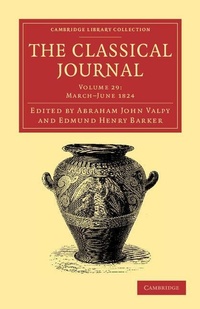
The Classical Journal
Published on 28. February 2013
Book
Paperback/Softback
428 pages
978-1-108-05810-0 (ISBN)
Description
A precursor of modern academic journals, this quarterly periodical, published between 1810 and 1829 and now reissued in forty volumes, was founded and edited by Abraham John Valpy (1787-1854). Educated at Pembroke College, Oxford, Valpy established himself in London as an editor and publisher, primarily of classical texts. Edmund Henry Barker (1788-1839), who had studied at Trinity College, Cambridge, became a contributor and then co-editor of this journal, which fuelled a scholarly feud with the editors of the Museum criticum (1813-26), a rival periodical (also reissued in the Cambridge Library Collection). Although its coverage overlapped with that of its competitor, the Classical Journal also included general literary and antiquarian articles as well as Oxford and Cambridge prize poems and examination papers. It remains a valuable resource, illuminating the development of nineteenth-century classical scholarship and academic journals. Volume 29 contains the March and June issues for 1824.
More details
Series
Language
English
Place of publication
Cambridge
United Kingdom
Target group
College/higher education
Professional and scholarly
Product notice
Paperback (trade)
Illustrations
4 Plates, black and white
Dimensions
Height: 216 mm
Width: 140 mm
Thickness: 25 mm
Weight
601 gr
ISBN-13
978-1-108-05810-0 (9781108058100)
Copyright in bibliographic data and cover images is held by Nielsen Book Services Limited or by the publishers or by their respective licensors: all rights reserved.
Schweitzer Classification
Other editions
Complete work / Part of the work
Abraham John Valpy | Edmund Henry Barker
The Classical Journal 40 Volume Set
Book
02/2013
Cambridge University Press
€1,903.21
Article is exhausted, reprint undefined
Content
Part LVII. Biblical Criticism; Itinerary from Tripoli to Cashenah; Observationes in Phrynichum Lobeckianum; Observations on the zodiac of Dendera; Carmina Samaritanorum anecdota; Notae criticae in Horatii opera; Notice of L'art de plaire d'Ovide; Theocriti quaedam; Index of passages of Menander and Apollodorus imitated by Terence; On a new edition of the polyglott Bible; Notice of Histoire de la musique; On the various readings of the Hebrew Bible; De versibus quibusdam Horatianis; Itinerary from Tripoli to Housa; Barker's Germany and Agricola of Tacitus; On the pyramids of Egypt; Sophoclis quaedam; Aspasiou scholion epitome; 'Peintures antiques et inedites de vases grecs'; Nugae; A Greek inscription on a brass helmet from Olympia; Parallel passages; Latin prize poem; Notice of 'Cambridge Classical Examinations'; The scholia of Hermeas on Plato's Phaedrus; Mexican antiquity; Notice of Robertson's Latin Phrase Book; Examinations for the Classical triposes; Adversaria literaria; Notice of The Characters of Theophrastus; Literary intelligence; Notes to correspondents; Part LVIII. Striking Coincidences between Homer and Tasso; Notice of The Odes of Anacreon; On the genius and writings of Claudian; Remarks on the English translation of the Bible; The arithmetic of the Holy Scriptures; Is the nightingale the herald of the day?; Nugae; On the pyramids of Egypt; The scholia of Hermeas on Plato's Phaedrus; The 1st and 2d chapters of St Matthew; In Sophoclis Oedip. Colon. emendationes; Biblical criticism; Notice of A Grammar of the Three Principal Oriental Languages; Remarks on some passages in the New Testament; Muhamedan invocation; Notice of Observations on the History and Doctrine of Christianity; The mystical hymns of Orpheus; Museum in Greece; Cambridge examination for Junior Sophs.; Technical memory; Calssical criticism; De quantitate syllabarum; On the origin of Milton's Lycidas; In Demosthenem commentarii; On the error relative to the time of departure of the Israelites from Egypt; De verbo 'aktaino' vel 'aktainoo'; Litterae quaedam ineditae; Adversaria literaria; Oxford Latin prize poem; American prize poem; Notice of Journal of a Tour in Asia Minor; Literary intelligence; Notes to correspondents.