

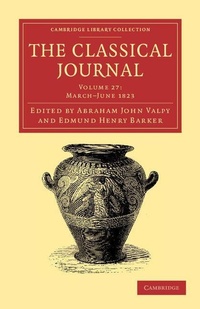
The Classical Journal
Published on 28. February 2013
Book
Paperback/Softback
398 pages
978-1-108-05808-7 (ISBN)
Description
A precursor of modern academic journals, this quarterly periodical, published between 1810 and 1829 and now reissued in forty volumes, was founded and edited by Abraham John Valpy (1787-1854). Educated at Pembroke College, Oxford, Valpy established himself in London as an editor and publisher, primarily of classical texts. Edmund Henry Barker (1788-1839), who had studied at Trinity College, Cambridge, became a contributor and then co-editor of this journal, which fuelled a scholarly feud with the editors of the Museum criticum (1813-26), a rival periodical (also reissued in the Cambridge Library Collection). Although its coverage overlapped with that of its competitor, the Classical Journal also included general literary and antiquarian articles as well as Oxford and Cambridge prize poems and examination papers. It remains a valuable resource, illuminating the development of nineteenth-century classical scholarship and academic journals. Volume 27 contains the March and June issues for 1823.
More details
Series
Language
English
Place of publication
Cambridge
United Kingdom
Target group
College/higher education
Professional and scholarly
Product notice
Paperback (trade)
Illustrations
1 Maps
Dimensions
Height: 216 mm
Width: 140 mm
Thickness: 23 mm
Weight
560 gr
ISBN-13
978-1-108-05808-7 (9781108058087)
Copyright in bibliographic data and cover images is held by Nielsen Book Services Limited or by the publishers or by their respective licensors: all rights reserved.
Schweitzer Classification
Other editions
Complete work / Part of the work
Abraham John Valpy | Edmund Henry Barker
The Classical Journal 40 Volume Set
Book
02/2013
Cambridge University Press
€1,903.21
Article is exhausted, reprint undefined
Content
Part LIII. New Ilium and the Troy of Homer; Nugae; On the fables of Aesop and Babrias; Notice of Peyron; Creuzer's edition of Olympiodorus; In Demosthenem commentarii; The classical collector's vade-mecum; On the liberty of prophesying; The symbolical language of ancient art and mythology; Is the nightingale the herald of the day?; Hebrew criticism; English Latinity; Earliest printed editions of the Hebrew Bible; African fragments; Biblical criticism; Horne's Introduction to the Critical Study and Knowledge of the Holy Scriptures; Barker's reply to Boiotos; Oxford Latin prize poem for 1821; On the attributes that constitute the perfection of being; Notice of Journal of a Tour in the Levant; 'To asma tou Kolokotrone'; Observationes quaedam ad N. T.; Westminster prologue and epilogue for Dec. 1822; Morelli epistola; H. Grotii carmen; Adversaria literaria; Classical criticism; Cambridge triposes for 1823; Literary intelligence; To correspondents; Part LIV. Critical Observations on Some Latin Authors; Barkeri De Arcadio Antiocheno; A plan for translating languages without study; In Demosthenem commentarii; The meekness of Moses considered; On the attributes that constitute the perfection of being; Observationes quaedam ad N. T.; A reply to Gulchin; African fragments; The arithmetic of the Holy Scriptures; Notice of Thucydide; A controverted passage in Justin Martyr; On the genius and writings of Claudian; Leake's Topography of Athens; Barkeri Amoenitates philosophicae; On the materials for a history of ancient Persia; Embalming among the Egyptians; Idyllia heroica decem; Egyptian, Babylonian, and Persepolitan writing; Oxford English prize poem for 1823; 'Institutes of Latin grammar'; 'Scripture chronology'; 'Essais su les prepositions'; Sophocles et Theocritus emendati; Critica sacra; Dr Crombie's Gymnasium; Biblical criticism; 'Canares: a poem in modern Greek'; Notice of Photius the Patriarch; Oxford Latin prize poem; Adversaria literaria; Knight's Carmina Homerica; List of theological works; Biblical criticism; Literary intelligence; To correspondents.